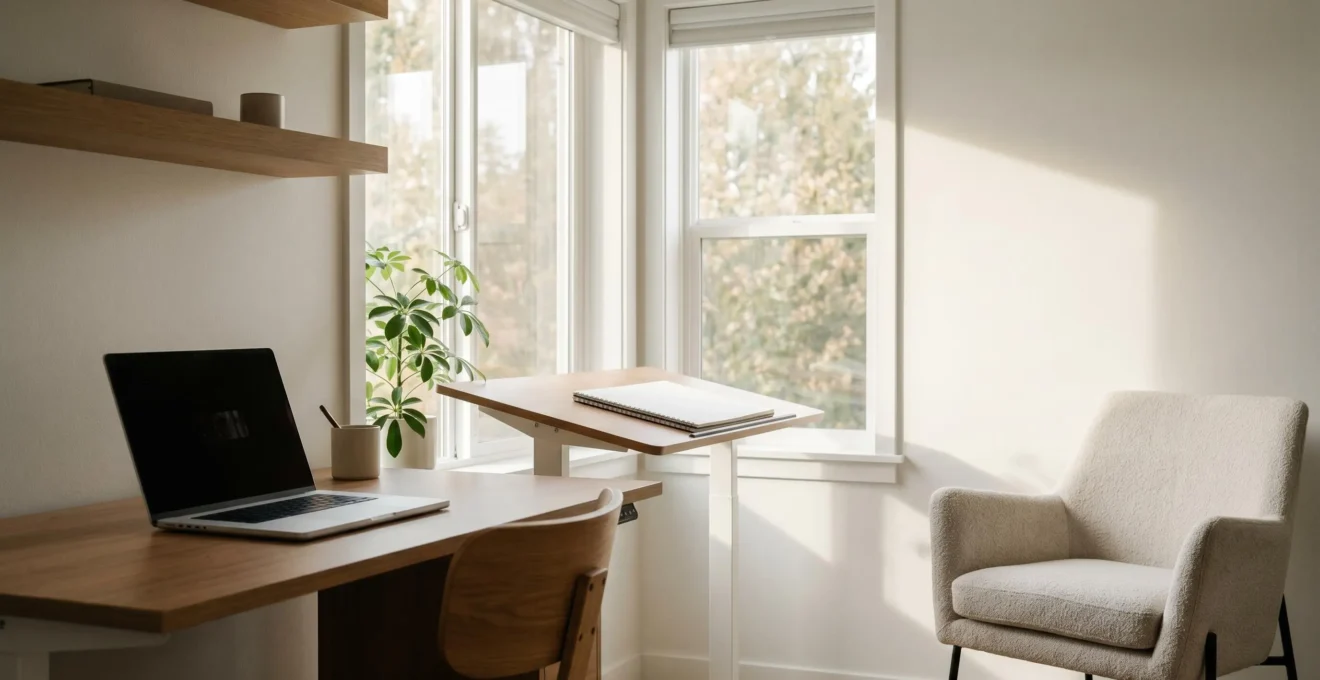
A ‘perfect’ looking workspace often sabotages creativity; the real key is designing a functional system that manages your cognitive energy.
- Your physical layout directly dictates your mental load, impacting focus more than you think.
- True ergonomics is about sustaining creative energy for hours, not just preventing back pain.
- The “perfect” space is a myth that fuels procrastination; an imperfect, functional start is far more valuable.
Recommendation: Start by analyzing your creative workflow, not your shopping list. Optimize your environment for your process first, then select pieces that support it.
For any creative professional working from home, the dream is a workspace that looks like it’s straight out of a design magazine. We’ve all spent hours scrolling through inspiration, pinning images of pristine desks, perfect lighting, and artfully placed greenery. The common advice follows: get an ergonomic chair, ensure good lighting, and keep it tidy. But what if, after all that effort, the space still feels… unproductive? You have the right things, but the creative flow just isn’t happening. Distractions creep in, focus wanes after an hour, and the beautiful setup feels more like a stage than a workshop.
The problem is that we’ve been taught to think about our workspace as a collection of objects rather than a functional system. We focus on the aesthetics of individual items instead of the strategic configuration of the whole environment. But what if the secret to unlocking your creative productivity wasn’t in adding another plant, but in fundamentally rethinking how your space works for your brain? The real key lies not in what you put in your space, but how you arrange it to manage your cognitive energy, trigger focus, and support sustained deep work.
This guide moves beyond the superficial to give you an interior designer’s functional approach. We will deconstruct the environmental psychology behind creative output, exploring how layout influences cognitive load, how to engineer ergonomics for marathon creative sessions, and when to embrace minimalism versus inspirational clutter. We will also tackle the psychological barriers, like the perfectionism myth, that prevent you from starting, and provide a clear framework for building a workspace that is not just beautiful, but a powerful, strategic tool for your craft.
This article provides a structured path to designing a high-performance creative environment. Below is a summary of the key areas we will explore to transform your workspace from a simple room into a strategic asset.
Summary: How to Design a Workspace That Systematically Boosts Creative Output
- Why Your Workspace Layout Affects Creative Output More Than Your Skill Level?
- How to Arrange Workspace Ergonomics for 6-Hour Creative Sessions Without Fatigue?
- Minimal White Studio or Inspiration-Filled Space: Which Environment Boosts Creativity?
- The Workspace Perfection Myth That Stops Creatives from Starting for Months
- When to Optimise Your Current Space vs When to Find a Larger Creative Studio?
- Why Solid Wood Frame Construction Outlasts Particleboard by 20+ Years and How to Spot the Difference?
- How to Turn Everyday Transitions (Walking, Waiting, Eating) Into Powerful Mindful Moments?
- How to Select Well-Made Pieces That Transform Your Home into a Lasting, Cohesive Environment?
Why Your Workspace Layout Affects Creative Output More Than Your Skill Level?
It’s a difficult truth for many creatives: the physical arrangement of your desk can have a more immediate impact on your daily output than your raw talent. This isn’t about a lack of skill, but about the science of cognitive load. Every object in your visual field, every disorganised pile of papers, and every tool that isn’t within easy reach contributes to a low-level mental static. This static consumes a portion of your brain’s processing power, leaving less available for complex problem-solving and creative thinking. An inefficient layout forces you to make dozens of micro-decisions throughout the day—”Where is that pen?”, “I need to move this to get to that”—which accumulate and drain your focus.
Research confirms this powerful link between environment and performance. As the HR Future Research Team notes in their analysis of productive environments, “The physical configuration of a workspace affects cognitive load in ways that are easy to underestimate.” They explain that a cluttered or poorly configured space increases the “mental overhead of basic tasks.” This isn’t just about feeling stressed; it’s a measurable drain on your cognitive resources. In fact, studies demonstrate that the physical environment can impact performance by up to 20%. This means a strategically designed workspace isn’t a luxury; it’s a performance-enhancing tool.
Think of your workspace layout as the user interface for your creativity. A well-designed UI is intuitive, with essential functions immediately accessible and distractions minimised. A poor UI is confusing and requires extra effort to navigate, leading to frustration and abandonment. By deliberately designing your layout—creating zones for different tasks, ensuring clear surfaces, and organising tools by workflow—you are effectively reducing your cognitive load and freeing up mental energy. This reclaimed energy can then be channelled directly into what matters most: your creative work.
How to Arrange Workspace Ergonomics for 6-Hour Creative Sessions Without Fatigue?
When most people hear “ergonomics,” they think of an expensive chair and maybe a standing desk. While important, this view is incomplete. For a creative professional, true ergonomics is not just about preventing physical pain; it’s about sustaining mental and creative energy over long, uninterrupted sessions. A six-hour deep work session is a marathon, not a sprint. Your environment must be designed to support this endurance, managing not just your posture but your focus, your sensory input, and your need for micro-movements.
The impact of a truly ergonomic system is profound. Beyond comfort, well-designed ergonomic interventions have a quantifiable impact on output. For example, some studies indicate that ergonomic interventions can achieve a 67% reduction in absenteeism and a 15% increase in productivity. For a solo creative, this translates into more billable hours and a higher quality of work. This goes beyond the chair; it involves creating a dynamic environment that adapts to the different phases of your creative process. Ideation might happen while standing or pacing, while detailed execution requires a stable, focused seated position.
A high-performance ergonomic setup is a system of moving parts designed to minimise physical and sensory friction. It anticipates your needs before they become distractions. Does your lighting strain your eyes as the day progresses? Is your screen position forcing you to hunch forward? Do you have a dedicated space to step away and reset your eyes and mind? Each of these elements, if ignored, creates a tiny “debt” in your energy reserves. Over a long session, these debts accumulate, leading to fatigue, distraction, and a sharp decline in the quality of your creative output. The goal is to design a space where you can forget your body and become completely absorbed in your work.
Your Action Plan: Setting Up for Creative Endurance
- Alternate between sitting and standing positions throughout your work session, mapping posture changes to different creative phases (e.g., standing for brainstorming, sitting for execution).
- Create a dedicated ‘sensory reset’ corner separate from your primary desk for brief eye-palming exercises and stretching between deep work blocks.
- Install tunable smart lighting that shifts from cool, blue-tinted light (4000-6500K) during peak focus hours to warmer tones (under 3000K) for wind-down periods.
- Position secondary tools like tablets or reference books on articulated arms that can be brought into your primary field of view only when needed, reducing visual clutter.
- Ensure proper ventilation and air quality, as elevated CO2 levels have been shown to directly impair cognitive function during long indoor sessions.
Minimal White Studio or Inspiration-Filled Space: Which Environment Boosts Creativity?
One of the most persistent debates in workspace design is the battle between minimalism and maximalism. On one side, you have the pristine, all-white studio—a blank canvas meant to foster clarity and focus. On the other, the inspiration-filled den, brimming with books, art, and objects that spark ideas. The truth is, neither is universally superior. The right choice depends entirely on the nature of your creative work and your personal cognitive style. The key is not to pick a side, but to design a space that can support both modes of thinking: convergent and divergent.
Convergent thinking, the process of finding a single, correct solution to a problem (e.g., editing code, finalising a design, writing a specific paragraph), thrives in a minimalist environment. A clean, uncluttered space reduces external stimuli, minimises cognitive load, and allows for intense, linear focus. A landmark study in Building and Environment found that spaces with minimal visual distraction significantly improved performance in tasks requiring cognitive flexibility. This is the environment you need for execution and refinement.
However, divergent thinking—the process of generating many different ideas and possibilities (e.g., brainstorming, sketching, mind-mapping)—often benefits from a richer, more stimulating environment. This is where an “inspiration-filled” space shines. As a Psychology Today research summary on the topic highlights, “Research on creativity and cognitive flexibility suggests that visual access to materials (notes, sketches, references, partially formed ideas) can support associative thinking.” Having these environmental triggers visible allows your brain to make unexpected connections you wouldn’t find by staring at a blank wall.
When ideas remain visible rather than buried in folders or files, the mind is more likely to link them in unexpected ways.
– Psychology Today Research Summary, How Physical Space Shapes Creative Thinking at Work
The ideal solution for most creatives is a modular, hybrid space. This could mean having a clean, minimal primary desk for execution, and a separate wall or a rolling mood board dedicated to divergent inspiration. It might involve having boxes of inspirational materials that can be brought out during the ideation phase and put away during the focus phase. The goal is to create a workspace that is not static, but can be easily reconfigured to serve the specific cognitive demands of your current task.
The Workspace Perfection Myth That Stops Creatives from Starting for Months
There is a dangerous trap that ensnares countless creative professionals: the quest for the “perfect” workspace. It begins innocently, with a desire to create an optimized, inspiring environment. But it quickly morphs into a form of high-level procrastination. You tell yourself you can’t *really* start that big project until the desk is just right, the lighting is perfect, and the cable management is flawless. The workspace itself becomes a project with impossibly high stakes, and the fear of not getting it perfect leads to paralysis. This isn’t just a delay; it’s a psychological barrier known as perfectionism-procrastination.
Expert Finding: Perfectionism as a Procrastination Trigger
Research on workplace behavior reveals that perfectionists often delay workspace optimization indefinitely because they fear not creating the ‘perfect’ setup. Instead of accepting that initial attempts might be imperfect, they become paralyzed by the fear of failure. According to a summary of findings on workplace procrastination, this loop prevents them from starting creative work for months, as the workspace itself becomes a high-stakes project threatening their identity of always producing flawless results.
This cycle is not a character flaw but a deeply ingrained habit. As renowned psychiatrist and neuroscientist Dr. Jud Brewer explains, perfectionism is fundamentally about avoiding the discomfort of potential failure. It feels safer to keep planning the “perfect” space than to start the actual work and risk it being imperfect. The irony is that this avoidance tactic is what truly guarantees failure—the failure to even begin.
Perfectionism doesn’t drive you forward. It keeps you stuck. This isn’t a mindset problem. Like all forms of procrastination, it’s a habit loop.
– Dr. Jud Brewer, Perfectionism & Procrastination: The Hidden Fears Keeping You Stuck
The antidote is to embrace the concept of a “good enough” workspace. Your creative environment should be a functional, evolving tool, not a finished masterpiece. Start with the bare essentials: a surface to work on, a decent chair, and adequate light. Then, begin your work. As you work, you will discover what you truly need. Perhaps you’ll realize you need more surface area for sketching, or a better way to organize reference books. Let the needs that arise from the creative process itself guide the evolution of your space. An imperfect, working studio is infinitely more valuable than a perfect, imaginary one.
When to Optimise Your Current Space vs When to Find a Larger Creative Studio?
Every creative professional working from a corner of their home eventually faces a critical question: is it time to move? The line between optimising your current setup and taking the financial leap to a dedicated studio is often blurry. The decision isn’t just about needing more space; it’s a strategic calculation involving productivity, professional needs, and psychological boundaries. For many, the feeling that their environment is holding them back is very real. In fact, one study by Savills revealed that 37% of individuals felt their workspace layout negatively impacted their productivity.
The first step is to diagnose the problem accurately. Are you facing a space limitation or a boundary problem? A space limitation is physical: your equipment literally does not fit, or you cannot take on larger, more profitable projects because you lack the physical capacity. A boundary problem is psychological: you find it impossible to disconnect from work because it’s always visible, or constant interruptions from family make deep work impossible. Optimising your current space with clever zoning, room dividers, and noise-cancelling headphones can often solve boundary problems. However, no amount of optimisation can solve a true physical space limitation.
The decision ultimately comes down to a cost-benefit analysis where “cost” isn’t just money, but lost productivity and missed opportunities. If the calculated value of the work you’re unable to do (or the inefficiency you’re enduring) is greater than the monthly rent of a small studio, the decision becomes a logical business investment rather than an expense. The following framework can help clarify whether you’re at an optimisation point or a growth ceiling.
This table from a comparative analysis of workplace strategies offers a clear decision-making framework.
| Decision Factor | Optimize Current Space | Find New/Larger Studio |
|---|---|---|
| Psychological Separation | You can create clear boundaries through rituals and dedicated zones within existing space | You cannot mentally ‘leave’ work at end of day; work physically encroaches on living areas |
| Physical Capacity | All required equipment fits comfortably with room for workflow | Current space prevents you from acquiring essential tools or equipment for career advancement |
| Acoustic Isolation | Background noise is manageable; focus work is achievable with minimal tools (headphones, white noise) | Constant interruptions from family/housemates make sustained deep work impossible |
| Cost-Benefit Analysis | Estimated productivity loss < monthly cost of external studio | Calculated lost productivity value (hours × rate) > studio rental costs |
| Work Stage | Your work is stable; optimization can yield 10-20% efficiency gains | You’ve hit a ‘growth ceiling’ – cannot take on larger projects or meet clients in current space |
| Professional Requirements | Client meetings are virtual or external; space is for solo production only | Your work requires in-person client presentations or collaborative sessions |
Why Solid Wood Frame Construction Outlasts Particleboard by 20+ Years and How to Spot the Difference?
As you design your workspace system, the foundational elements—primarily your desk and chair—deserve special consideration. These aren’t just surfaces; they are the physical anchors of your creative practice. The choice of materials for these core pieces, specifically solid wood versus particleboard, is more than an aesthetic decision. It’s a statement about longevity, stability, and your commitment to your craft. A solid wood desk provides a sense of permanence and durability that a particleboard alternative simply cannot match. It’s an investment that communicates to your subconscious that this is a serious, long-term endeavor.
Particleboard, or medium-density fiberboard (MDF), is made from compressed wood scraps, sawdust, and resin. It’s an affordable and common material, but its weaknesses become apparent over time. It’s highly susceptible to moisture damage, which can cause it to swell and warp irreversibly. Its structural integrity is also limited; screws can strip easily, and joints can loosen, leading to a wobbly, unstable surface—the last thing you need when trying to focus. A particleboard desk might last a few years, but it’s fundamentally a temporary solution.
Solid wood construction, by contrast, is built to last for decades. Pieces are crafted from whole cuts of lumber, offering superior strength, stability, and the ability to be repaired and refinished. A scratch on a solid wood desk can be sanded out; a chip in a particleboard veneer is often a fatal wound. The difference in lifespan is significant, with well-cared-for solid wood furniture often lasting 20 years or more, while particleboard pieces may need replacing every 3-5 years under regular use.
How do you spot the difference? First, check the weight; solid wood is significantly heavier than particleboard. Second, examine the grain. On solid wood, the grain pattern will be unique and continuous over the entire surface and edges. On particleboard with a veneer, the pattern may look repetitive, and you can often spot a seam or a different material composition on the edges or underside. Finally, look at the joinery. Solid wood pieces often feature classic joinery techniques like dovetail or mortise-and-tenon joints, a sign of quality craftsmanship absent in mass-produced particleboard furniture.
How to Turn Everyday Transitions (Walking, Waiting, Eating) Into Powerful Mindful Moments?
The productivity of your workspace isn’t just defined by the hours spent at the desk, but also by the quality of the moments in between. In a home environment, the lines between work and life blur, and the small, transitional moments—walking to the kitchen for coffee, waiting for a file to render, grabbing a quick lunch—are often lost to mindless scrolling or mental clutter. However, a well-designed workspace strategy reclaims these transitions, transforming them from wasted time into powerful opportunities for mental reset and creative insight.
This isn’t about meditating for ten minutes every hour. It’s about designing your space and rituals to create intentional “micro-breaks.” For example, the “walk” to get coffee can become a mindful transition if your path forces you to step away from your work zone and into a different sensory environment, like a space with a window overlooking nature. This physical separation acts as a circuit breaker for your brain, allowing it to disengage from a problem momentarily, which is often when breakthrough ideas occur. This is the principle behind the “sensory reset” corner mentioned in our ergonomics plan.
Similarly, “waiting” doesn’t have to be passive. The two minutes your computer takes to process a large file can be an opportunity. Instead of reaching for your phone, you could have a dedicated analog tool on your desk—a sketchbook, a small sculpture, a puzzle—that you interact with only during these moments. This simple act shifts your brain into a different mode, engaging tactile senses and promoting a different kind of thinking that can feed back into your primary task. It transforms dead time into a moment of active, non-linear thought.
Even “eating” becomes a strategic tool. The act of stepping away from your desk completely to eat in a different room without screens is one of the most powerful ways to protect your cognitive energy. It creates a hard boundary that signals to your brain that it’s time to rest and refuel. By designing these transitional rituals into your day, supported by the physical layout of your space, you turn the entire home environment into a more holistic system for creative performance. You are no longer just working *at* your desk; you are working *within* a supportive ecosystem.
Key Takeaways
- Your workspace is a functional system for managing cognitive energy, not just a collection of nice things.
- Design your environment to support your specific creative workflow, allowing for both focused (convergent) and exploratory (divergent) thinking.
- Invest in foundational pieces made of quality materials; they provide the physical and psychological stability needed for long-term creative work.
How to Select Well-Made Pieces That Transform Your Home into a Lasting, Cohesive Environment?
You have deconstructed the psychology of your workspace, engineered it for ergonomic endurance, and designed its layout as a system for managing focus. The final step is to translate this strategic understanding into the selection of physical objects. Choosing well-made pieces is not about luxury; it’s about embodying the principles of permanence and cohesion. Each item you bring into your workspace should be a deliberate choice that supports the functional system you’ve designed. A lasting, cohesive environment is one where every piece has a purpose and contributes to the overall goal: enabling your best creative work.
Cohesion begins with a defined material and color palette. Instead of choosing items one by one, think in terms of a unified whole. Limit your primary materials to two or three (e.g., oak, black metal, and linen) to create a sense of calm and order. This reduces visual noise and reinforces the feeling of a purpose-built environment. A cohesive space tells your brain that this is a dedicated, serious zone for work, helping you get into a focused state more quickly. It’s the physical manifestation of the mental clarity you seek to cultivate.
When selecting individual pieces, prioritise function and quality over fleeting trends. Ask yourself: does this object solve a specific functional problem? Does its construction quality (like the solid wood we discussed) align with a long-term vision for my career? A cheap, trendy item might provide a short-term aesthetic boost, but a well-made, timeless piece becomes a reliable partner in your creative process for years to come. It weathers the storms of changing tastes and demanding projects. This is how you build a space that feels less like a temporary setup and more like a true professional studio—a space that grows with you and your work.
By applying these principles, you move from being a passive occupant of your space to an active designer of your creative ecosystem. The process is ongoing, but it starts now, with the decision to build a workspace that works as hard as you do. Start today by analyzing your workflow and identifying one small change you can make to reduce friction and enhance your creative flow.