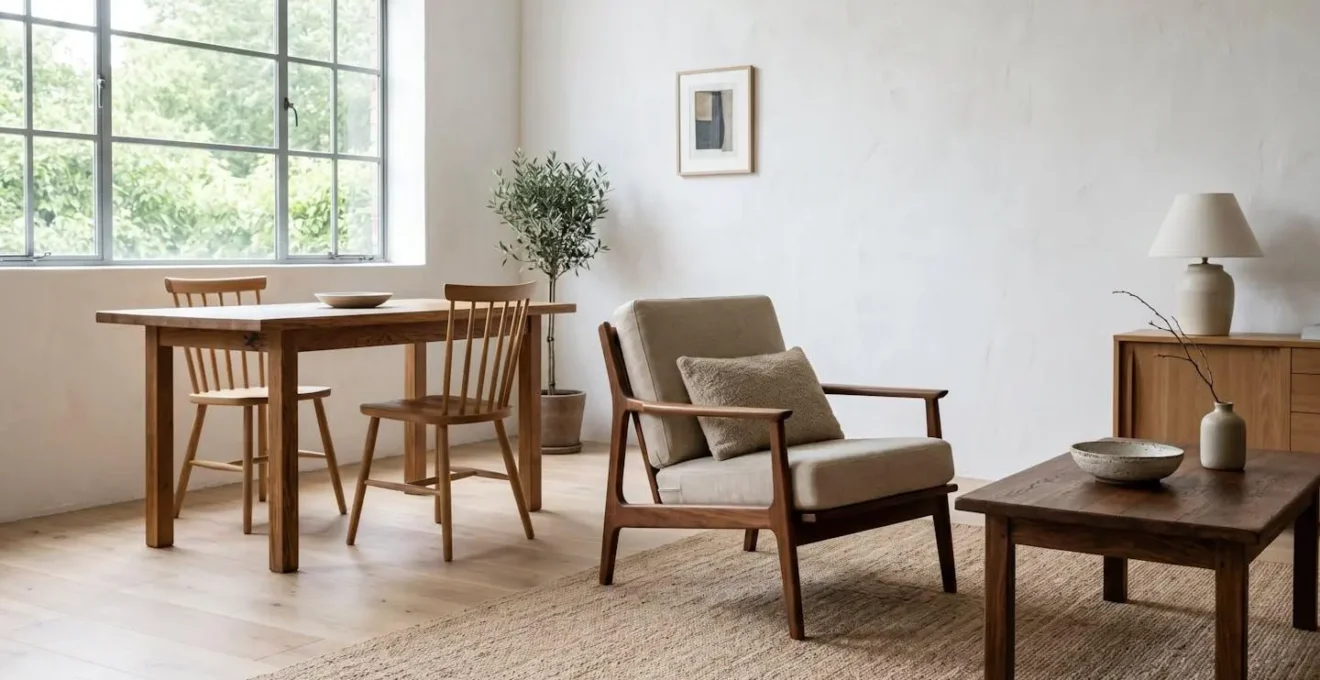
The true cost of furniture is not its price tag, but its price divided by the years you’ll use it.
- Prioritise investment in high-contact items like sofas and dining chairs, which offer the highest return in daily function.
- Look beyond surface-level trends and choose pieces with “material honesty” and classic silhouettes that ensure stylistic longevity.
Recommendation: Shift your mindset from a consumer buying a product to an investor acquiring a long-term asset for your home’s functional equity.
The cycle is frustratingly familiar: you purchase a stylish, affordable piece of furniture, only to see it sag, peel, or wobble within a few short years. This “fast furniture” culture has filled our homes with disposable items that drain our finances and contribute to waste. Many guides will tell you to “check the wood” or “look for sales,” but these are surface-level tactics. They address the symptoms—poor quality—but not the root cause: a flawed purchasing strategy.
We are conditioned to hunt for bargains and follow fleeting trends, treating furniture like seasonal fashion. The common advice to simply spend more money is equally unhelpful, as a high price tag is no guarantee of quality. True value is often hidden in plain sight, obscured by marketing language and designer labels. The conversation needs to move beyond mere aesthetics or initial cost and into the realm of strategic asset acquisition.
But what if the key wasn’t finding a better deal, but adopting an entirely new framework? What if you approached furnishing your home not as a series of expenses, but as a calculated investment in your quality of life? This is the core of the investment mindset. It reframes the goal from “decorating a room” to “building functional equity.” It’s about selecting pieces that appreciate in sentimental value, hold their structural integrity, and ultimately deliver an exceptionally low cost-per-use over decades, not months.
This guide will walk you through that strategic shift. We will deconstruct the true markers of quality, learn how to allocate your budget for maximum impact, and develop an eye for designs that will feel as right in fifteen years as they do today. It’s time to stop replacing and start investing.
To navigate this investment-focused approach, this article breaks down the essential strategies for identifying and curating a home environment built to last. The following sections provide a roadmap to making smarter, more durable choices.
Summary: An Investor’s Guide to Choosing Lifelong Furniture
- Why Solid Wood Frame Construction Outlasts Particleboard by 20+ Years and How to Spot the Difference?
- Sofa vs Coffee Table vs Dining Chairs: Which Furniture Categories Deserve Your £1,000+ Budget?
- Modern Classic vs Trendy Contemporary: Which Design Approach Still Looks Current in 15 Years?
- The Matching Furniture Set Trap That Costs £3,000 and Looks Generic Within 2 Years
- When to Condition Leather, Re-Oil Wood, and Professional Clean Upholstery for Maximum Furniture Lifespan?
- Why Premium Price Tags Don’t Always Equal Quality: The 5 True Markers of Well-Made Products?
- Why 100% Natural Fibres Aren’t Always Superior: The Fabric Blend Quality Truth?
- How to Recognise Genuinely High-Quality Products That Justify Premium Pricing?
Why Solid Wood Frame Construction Outlasts Particleboard by 20+ Years and How to Spot the Difference?
The single greatest determinant of a piece’s lifespan is its core material. While particleboard and MDF (Medium-Density Fibreboard) offer low initial costs, they are fundamentally disposable. Composed of wood dust and resin, they are susceptible to moisture, cannot hold screws securely over time, and lack the structural integrity for repair. This is why, while a particleboard bookcase may only survive 5-15 years, furniture durability research confirms hardwood furniture can last for 30 to over 100 years, making it a multi-generational asset.
Solid wood, by contrast, possesses what can be called material honesty. It can be sanded, refinished, and repaired. Its enemy isn’t time, but neglect. The secret to its longevity lies not just in the wood itself, but in the way it’s joined together. High-quality construction relies on traditional joinery techniques like mortise-and-tenon or dovetail joints, which create immensely strong, interlocking connections that distribute stress across the frame. Glued or stapled butt joints, common in cheap furniture, are guaranteed points of failure.
The strength of proper joinery is scientifically proven. As the experts at Tip Top Furniture explain in their guide:
A well-made mortise and tenon can handle an incredible amount of force—up to 4,000 psi in shear on white oak before it even thinks about failing. That outperforms common nailed joints by a whopping 200% in longevity simulations.
– Tip Top Furniture, Guide to Mortise and Tenon Joint Construction
To spot the difference, use your hands. A solid wood piece feels dense and heavy for its size. Run your hand under a tabletop; a quality piece will feel as finished as the top surface. Look for grain that wraps consistently around corners. On a chest of drawers, check if the grain on the drawer fronts matches—a sign it was cut from a single piece of wood, a hallmark of craftsmanship.
This macro view of a mortise and tenon joint reveals the precision that defines heirloom quality. The interlocking design creates a bond that is stronger than the wood itself, ensuring stability for decades. This is the hidden architecture of furniture that’s built to last, a detail that justifies the investment.
Understanding this material foundation is the first step. Next is learning where to strategically apply this knowledge for the best return on investment.
Sofa vs Coffee Table vs Dining Chairs: Which Furniture Categories Deserve Your £1,000+ Budget?
Not all furniture investments are created equal. To maximize the return on your investment, you must allocate your budget based on a piece’s “functional equity”—its impact on your daily life and its exposure to stress. The highest-priority items are always those with high-contact and high-stress roles. This includes your primary sofa, your mattress, and your dining chairs. These are the workhorses of your home, used daily and bearing the most weight and friction.
Investing over £1,000 in a quality sofa with a kiln-dried hardwood frame and high-resilience foam cushions means you’re not just buying a seat; you’re buying a decade or more of comfort, support, and structural integrity. A cheaper sofa may look good for a year, but its particleboard frame will quickly weaken, and its low-density cushions will compress, leading to discomfort and the need for replacement. This principle was powerfully illustrated by a design blogger who tracked her purchases over ten years. Her investment sofa, costing more than her first car, remained the beloved centrepiece of her home, while she was forced to replace three sets of cheaper dining chairs during the same period, proving the superior cost-per-use of the quality piece.
Conversely, low-contact or low-stress items like side tables, consoles, or decorative accent chairs can be areas for more modest spending. A coffee table, for example, primarily serves a static function. While solid wood is still preferable for longevity, the structural demands are far lower than for a chair that must support a person’s weight daily. This strategic allocation allows you to build a room’s foundation with unshakeable quality where it matters most.
The following table, based on comprehensive budget analyses, provides a clear framework for prioritizing your furniture investments. As a recent comparative analysis from home experts shows, aligning budget with use-case is the cornerstone of a smart furnishing strategy.
| Furniture Category | Recommended Budget Range | Expected Lifespan with Quality | Investment Priority |
|---|---|---|---|
| Sofa (Primary) | $1,000 – $5,000 | 10-15 years | High (daily use) |
| Dining Chairs | $150 – $400 per chair | 10-15 years | High (daily use) |
| Mattress | $1,000 – $3,000 | 10-15 years | High (health impact) |
| Dining Table | $800 – $3,000 | 15-20 years | Medium-High |
| Coffee Table | $300 – $1,200 | 15-20 years | Medium (low stress) |
| Console/Media Unit | $400 – $1,500 | 10-15 years | Low-Medium (trend-dependent) |
Once your budget is wisely allocated, the next challenge is selecting a style that won’t feel dated before the piece has even reached its mid-life.
Modern Classic vs Trendy Contemporary: Which Design Approach Still Looks Current in 15 Years?
Structural longevity is only half the battle; stylistic longevity is the other. The goal is to choose pieces that pass “The 10-Year Test”—designs that will remain relevant and desirable long after current trends have faded. The key lies in favouring Modern Classics over Trendy Contemporary styles. Trendy pieces are often defined by exaggerated forms, of-the-moment colours (like Millennial Pink or Gen-Z Green), or specific materials (like bouclé or rattan) that instantly date a room once their popularity wanes.
Modern Classics, on the other hand, are rooted in principles of good design that are timeless. They often feature clean lines, simple geometry, and a focus on natural materials. Think of the iconic Eames Lounge Chair, a Florence Knoll sofa, or a Hans Wegner Wishbone Chair. These pieces were revolutionary at their debut but have transcended their eras because their design is fundamentally human-centric, prioritizing comfort and function over ornamentation. As the Decorilla design team notes, “Their form often contradicted the styles at the time, making them iconic. But it also tends to be more refined and simplified than preceding designs.”
This timeless quality comes from a DNA of simplicity and material honesty. A piece built from solid walnut with a clear, functional form will always find a place in a well-designed home. It serves as a stable, neutral foundation that allows you to introduce trends in smaller, less expensive doses, such as through cushions, throws, or decorative objects. A trendy, oddly shaped sofa in a loud colour, however, dominates a room and becomes a costly replacement problem when it inevitably falls out of fashion.
Action Plan: Auditing Furniture for Timeless DNA
- Material & Finish Review: Identify all points of contact. Prioritize natural materials like solid wood, stone, leather, and high-quality wool or linen that develop a patina rather than degrading.
- Geometric Profile Analysis: Collect an inventory of its silhouettes. Do clean, straightforward lines dominate, or is the piece defined by excessive ornamentation and complex shapes?
- Form vs. Function Assessment: Confront its design with its purpose. Test for genuine comfort and ergonomic function—does it serve the human body well, or is it purely a visual statement?
- Repairability & Evolution Check: Evaluate its potential for a second life. A timeless piece can be sanded, re-oiled, or reupholstered to adapt over time, whereas a generic one is often disposable.
- Palette & Integration Plan: Assess its color foundation. Does it rely on a versatile neutral palette (whites, greys, warm woods) that can be easily integrated into future decor schemes, or a dominant, trend-based color that will dictate all other choices?
With an eye for timeless style, the next step is to assemble these individual pieces into a cohesive whole without falling into a common and costly trap.
The Matching Furniture Set Trap That Costs £3,000 and Looks Generic Within 2 Years
The “room in a box”—a perfectly matching set of a sofa, loveseat, armchair, and tables—is one of the most tempting and ultimately unsatisfying purchases in interior design. Retailers promote these sets as an easy, one-click solution to furnishing a room. However, this approach creates a space that lacks personality, looks dated quickly, and is surprisingly inflexible. When every piece is identical in style, wood finish, and fabric, the room becomes a monotonous showroom, devoid of character or story.
This generic look is the opposite of a lasting, personal environment. Furthermore, if one piece becomes damaged or worn, you’re faced with the impossible task of replacing it or the expensive decision of replacing the entire set. The superior strategy is to aim for curated cohesion instead of perfect matching. This means creating a unified look through a common thread—such as a consistent wood tone, a repeated metal finish, or a harmonious colour palette—while allowing for diversity in form and style.
This approach allows you to mix a mid-century modern credenza with a contemporary sofa and a vintage armchair. The room feels collected and personal because the pieces relate to each other without being identical. They are unified by a shared material language, not a factory-made prescription. This method provides flexibility and makes the home feel as if it has evolved organically over time.
Case Study: The Common Thread Approach
London-based interior designer Sofiya Burnusuz demonstrates this “transitional design” method effectively. She starts by selecting timeless, high-quality foundation pieces, such as a neutral classic sofa and a solid wood dining table. These serve as the anchor. She then incorporates current trends in moderation through smaller, more easily replaceable accent pieces, like velvet ottomans or sculptural side tables. The cohesion is achieved through the unwavering quality of the foundational items and a consistent neutral palette, allowing personality to shine through the curated diversity of the accents.
This living space exemplifies curated cohesion. The vintage walnut sideboard, the neutral linen armchair, and the contemporary brass lamp are from different eras and styles, yet they feel harmonious. The unifying threads are the warm wood tones and the brushed metal finish, creating a sophisticated and personal environment that will never look like a catalogue page.
Acquiring these well-made, curated pieces is the first half of the investment. The second is protecting them for the long term.
When to Condition Leather, Re-Oil Wood, and Professional Clean Upholstery for Maximum Furniture Lifespan?
Investing in quality furniture is not a one-time transaction; it’s the beginning of a long-term relationship that requires care. Proper maintenance is what transforms a 15-year piece into a 50-year heirloom. Each material has its own needs, and a proactive, seasonal approach is the most effective way to protect your assets from degradation. This isn’t about arduous cleaning, but about simple, preventative rituals.
For solid wood, the main goal is to prevent it from drying out, which can lead to cracking, especially in centrally heated homes. A light re-oiling with a product appropriate for the finish (like tung or linseed oil) should be done once a year, ideally in autumn before the heating is turned on. For leather, the key is to keep it supple and prevent the natural oils from evaporating. It should be conditioned every 6 to 12 months with a quality leather cream, more frequently for pieces in direct sunlight. Upholstered furniture requires the most regular attention. Weekly vacuuming with an upholstery attachment prevents dust and grit from abrading the fibres. A professional deep clean should be scheduled every 1-2 years to remove accumulated oils and soil.
Think of this not as a chore, but as part of the total cost of ownership. Interior design professionals often recommend homeowners plan for annual maintenance costs of 5-10% of a piece’s price to cover professional services and quality care products. This small, ongoing investment is fractional compared to the cost of premature replacement due to neglect.
A structured maintenance schedule removes the guesswork and ensures each piece receives the care it needs at the right time. Here is a simple calendar to follow:
- Spring (March-May): Schedule professional deep cleaning for high-traffic upholstery. Condition all leather surfaces after the dry winter air. Inspect and tighten any loose joints or hardware on chairs and tables.
- Summer (June-August): Focus on light maintenance like dusting and vacuuming. Spot-clean any fabric stains immediately. Protect wood and leather from prolonged, direct sunlight exposure to prevent fading and cracking.
- Autumn (September-November): Re-oil all solid wood furniture before the central heating season begins. For outdoor furniture, clean and treat it before bringing it into storage. Vacuum thoroughly under all sofa and chair cushions.
- Winter (December-February): Monitor indoor humidity levels, aiming for 35-45% to prevent wood from cracking. Rotate and flip seat and back cushions on sofas to ensure even wear. Address any water rings or heat marks on wood surfaces immediately.
But before you can maintain a piece, you must be certain you’ve actually bought quality, and not just an expensive look-alike.
Why Premium Price Tags Don’t Always Equal Quality: The 5 True Markers of Well-Made Products?
In today’s market, a high price is often a function of branding and marketing, not necessarily superior craftsmanship. Many “designer” brands leverage their name to sell mass-produced items made with the same cheap materials as their budget counterparts. To be a savvy investor, you must learn to ignore the price tag and the logo and instead become an inspector, relying on your own senses to identify the true markers of quality. These are the subtle, often hidden, details that manufacturers of lesser goods hope you’ll overlook.
This requires a hands-on, multi-sensory assessment. A genuinely well-made piece will reveal its quality not just to the eye, but also to the touch and even the ear. It’s about moving beyond the showroom presentation and conducting a quick but thorough physical audit. This forensic approach empowers you to distinguish between furniture that is merely expensive and furniture that is truly valuable. It’s the difference between buying a story and buying a substantive, lasting asset.
Here are the five key markers to look for, which form a reliable checklist for evaluating any potential furniture investment before you buy:
- Weight and Density: This is the simplest test. Lift a corner of the piece or try to slide it. Solid hardwood is significantly heavier than particleboard or MDF. A coffee table that feels surprisingly light for its size is an immediate red flag, signalling a hollow or composite core.
- Hidden Surfaces Quality: A company that invests in quality does so everywhere, not just on the visible surfaces. Flip over a chair, inspect the underside of a table, or pull a drawer all the way out. On a quality piece, these hidden areas will be smooth, well-sanded, and finished, not rough and raw. The back panel of a cabinet should be solid wood or thick plywood, not a flimsy piece of cardboard stapled on.
- Hardware Quality: Drawer pulls, hinges, and legs should feel substantial and heavy in your hand. Operate a drawer; it should glide smoothly and quietly on quality metal runners, not scrape along a wooden groove. Flimsy, lightweight, or poorly plated hardware is a sign that costs were cut in the most functional areas.
- Brand Transparency and Warranty: A manufacturer confident in their product will be transparent about it. Look for companies that openly discuss their materials and manufacturing processes. Do they offer a substantial warranty (5+ years) on the frame? Is their customer service accessible and knowledgeable? A refusal to provide details is a warning.
- Multi-Sensory Feedback: Go beyond visuals. Run your hand along the surface—is it smooth or can you feel ripples from a thin veneer? Tap on a large surface—does it produce a solid, deep thud or a hollow, high-pitched rattle? Even smell can be an indicator; natural wood and leather have distinct, pleasant scents, whereas cheap furniture often off-gasses chemical smells from glues and finishes.
This same nuanced inspection applies not just to the frame, but to the very fabric that covers it.
Why 100% Natural Fibres Aren’t Always Superior: The Fabric Blend Quality Truth?
The belief that “100% natural” is always best is a common misconception in furniture upholstery. While fibres like 100% linen, cotton, or silk have a luxurious feel, they often lack the durability required for high-traffic furniture. Pure linen wrinkles if you look at it too long, 100% cotton is highly susceptible to staining and stretching, and silk is too delicate for anything but the most formal, low-use applications. For furniture that is meant to be lived on, the truth is often in the blend.
A high-performance blend is not a compromise on quality; it’s an enhancement of function. The strategic addition of a small percentage of synthetic fibre can dramatically improve a natural fabric’s performance without sacrificing its desirable texture and appearance. For example, blending 10-20% nylon into wool creates a fabric with the softness and resilience of wool but with significantly increased abrasion resistance, making it ideal for a family sofa. A cotton/polyester blend (e.g., 80/20) retains the soft feel of cotton while gaining crucial stain resistance and durability from the polyester.
The goal is to match the fabric to the function. A 100% linen fabric might be perfect for curtains, which hang untouched, but it’s a poor choice for dining chair seats that face daily friction and spills. A high-quality aniline leather is beautiful but will show every scratch, making it better for a study accent chair than a sofa used by kids and pets. Understanding this trade-off between “pure” aesthetics and practical durability is key to avoiding costly reupholstering down the line. The right fabric is the one that best serves the piece’s intended use and environment.
Choosing the right material involves looking at its specific application. For example:
- For high-traffic family sofas: A Wool/Nylon blend or a Cotton/Polyester blend offers the best combination of comfort and high durability.
- For decorative or low-use pieces: 100% Linen or Aniline Leather can be excellent choices where their beautiful aging process (patina) can be appreciated without being subjected to heavy wear.
- For light-use chairs or pillows: A Linen/Cotton blend provides a good middle ground, offering a more robust structure than pure linen while maintaining a natural look and feel.
Ultimately, all these details—material, construction, style, and maintenance—combine to answer the final, most important question.
Key Takeaways
- True value is measured by “cost-per-use,” not the initial price tag; a more expensive but durable piece is often the cheaper long-term option.
- Focus your budget on high-contact furniture like sofas and chairs, as they provide the greatest “functional equity” in your daily life.
- Build a cohesive, personal space through “curated cohesion”—unifying different styles with common materials or finishes—rather than buying generic matching sets.
How to Recognise Genuinely High-Quality Products That Justify Premium Pricing?
The final synthesis of the investment mindset is understanding how to calculate the true value of a piece, which allows you to confidently recognise when a premium price is justified. The most powerful tool for this is the cost-per-use calculation. This simple formula reframes price from a one-time expense to a long-term operating cost. By dividing the initial price by its expected years of service, you can compare the real value of different options.
This calculation consistently proves that investing more upfront in quality is the most fiscally responsible decision. For instance, an analysis of furniture longevity clearly shows how a $1,200 solid mango wood dining table expected to last 40 years has an annual cost of just $30. In contrast, a $300 particleboard table that needs replacing every 7 years has an annual cost of over $42, making it 40% more expensive over the long term, not to mention the hassle and waste of repeated replacements.
This long-term value is amplified by a piece’s repairability, a quality inherent in solid materials but absent in composites. Damage to a solid wood piece is often a setback, not a death sentence. This capacity for renewal is a core part of its value proposition. As the craftspeople at James & James Furniture highlight:
Solid wood can be sanded, stained, and repaired multiple times throughout its lifespan. Minor scratches disappear with simple refinishing, and structural repairs remain possible due to the material’s consistent density and strength.
– James & James Furniture, Why Solid Wood Beats Particle Board: The Smart Investment Guide
A genuinely high-quality product, therefore, justifies its price through a combination of superior materials, timeless design, durable construction, and the potential for a long, serviceable life. It is an asset designed for decades of use, not a disposable good designed for a few seasons of style. Recognizing this difference is the final step in becoming a true furniture investor.
By adopting this investment-focused mindset, you move from being a passive consumer to an active curator of your own environment, building a home filled not with things, but with lasting assets that enrich your daily life.