The secret to unforgettable meals isn’t the food, but the intentional design of a multi-sensory and emotional experience.
- Memory is not a perfect recording; it’s shaped by the most intense (peak) and final (end) moments of an event.
- Atmosphere, sequence, and intention are more powerful than expensive ingredients in creating value and meaning.
- Authentic connection is fostered by moving beyond small talk and creating a space for genuine sharing.
Recommendation: Start by defining the one key feeling you want your guests to leave with, then build the sensory and conversational details around that single intention.
We’ve all had them: meals that fade from memory before the dishes are even washed, and those other, rarer meals that become cornerstones of our personal history. What separates a simple dinner from a cherished memory? It’s a question that goes far beyond the menu. While many focus on perfecting a signature dish or finding the right playlist, these are merely isolated components. They are the notes, not the symphony. The conventional approach often misses the most crucial element: the thoughtful choreography of the entire experience.
This isn’t about performative hosting or stressful perfection. It’s about shifting your role from a cook to an Experience Architect. The true art of creating a lasting impression lies in understanding the psychology of memory and deliberately designing a sensory and emotional arc that guides your guests through an evening of connection and delight. It’s the difference between feeding people and truly nourishing them.
This guide will deconstruct the process of creating these meaningful events. We will explore why some moments stick while others don’t, how to build a complete sensory journey, how to spark conversations that matter, and, most importantly, how to do it all with a sense of joy and presence that becomes the most welcoming part of the entire experience.
To navigate this journey from simple host to experience architect, this article breaks down the essential principles. The following sections will guide you through the art and science of crafting meals that resonate long after the last guest has departed.
Summary: From Host to Experience Architect
- Why Some Meals Become Cherished Memories While Others Are Forgotten Within Days?
- How to Design a Complete Sensory Arc Across Multiple Courses and Ambiance?
- How to Facilitate Meaningful Conversation and Connection During a Special Dining Experience?
- How to Create Beautiful Dining Experiences Without Becoming Stressed or Performative?
- How to Develop 3-5 Signature Dining Experiences That Reflect Your Values and Bring You Joy to Host?
- Why Atmosphere, Sequence and Intention Matter More Than Expensive Ingredients?
- Why Traveller-Local Interactions Usually Stay Superficial Even When Both Parties Want More?
- How to Design Gastronomic Experiences at Home That Create Lasting Memories and Deep Satisfaction?
Why Some Meals Become Cherished Memories While Others Are Forgotten Within Days?
The answer lies not in the average quality of the evening, but in a psychological principle known as the Peak-End Rule. Pioneered by Nobel laureate Daniel Kahneman, this rule states that our memory of an experience is disproportionately shaped by its most emotionally intense moment (the “peak”) and how it concludes (the “end”). We don’t remember the sum of every moment, but a snapshot of the highlights. This is why a dinner with a single, hilarious story or a moment of profound connection can outshine a technically perfect but emotionally flat meal.
People judge an experience largely based on how they felt at its peak (i.e. its most intense point) and at its end, rather than based on the total sum or average of every moment of the experience.
– Daniel Kahneman, Peak-End Rule Research
As a host, this is an incredibly empowering concept. It means you don’t need to stress about every single detail being flawless. Instead, you can focus your energy on architecting specific, memorable high points. Consider a meal where the main course is merely average. If it’s followed by a spectacular, show-stopping dessert and a heartfelt farewell, guests are likely to leave with an overwhelmingly positive memory. The spectacular end re-frames the entire experience. This insight, confirmed by research on memory formation, reveals that the host’s job is not to be a perfect performer, but a thoughtful architect of the defining memory.
How to Design a Complete Sensory Arc Across Multiple Courses and Ambiance?
A memorable meal engages more than just the palate. It’s a symphony for the senses, and the host is the conductor. A “sensory arc” is the intentional progression of sights, sounds, smells, and textures throughout the evening. It’s about thinking beyond the plate to the entire environment. Research shows this isn’t just a nice idea; 63% of consumers actively seek dining experiences that engage multiple senses. Your home can be the most intimate venue for this.
The arc begins before the first bite. Start with lighting: as guests arrive, lighting can be brighter and more welcoming. As the evening progresses, dimming the lights creates intimacy and focuses attention on the table and conversation. Then consider the soundscape: music should be a supporting character, not the lead. An instrumental playlist that begins with something upbeat and transitions to a calmer tempo can subtly guide the energy of the room. In fact, hospitality research indicates that guests give 25% higher culinary experience ratings when exposed to well-matched soundscapes.
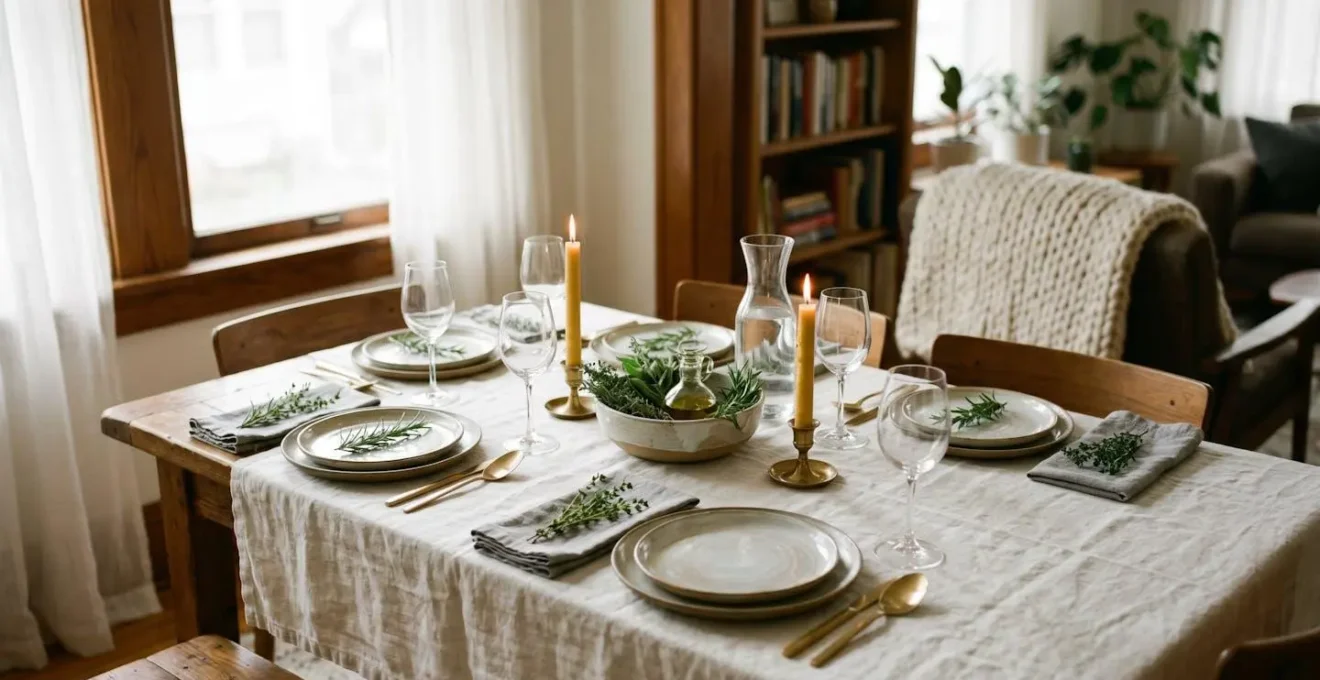
Finally, think about scent and texture. The aroma of something baking as guests walk in, the weight of the silverware, the feel of a linen napkin—these details complete the sensory tapestry. They signal care and intentionality, enriching the experience and making it more vivid in memory.
The goal is to create a cohesive journey. A bright, citrusy scent for an appetizer might give way to the warm, earthy aroma of a roast, and finally, the rich smell of chocolate or coffee. Each element should feel connected, building on the last to create a complete sensory world for your guests to inhabit for a few precious hours.
How to Facilitate Meaningful Conversation and Connection During a Special Dining Experience?
The finest food and most beautiful setting fall flat if the conversation never moves beyond polite small talk. The deepest, most lasting memories are forged through connection. As one expert host notes, beyond all the details, what truly matters is “the conversation and who you bring together.” Your role as an experience architect is to create the conditions for that connection to flourish. This doesn’t happen by accident; it happens by design.
The key is to gently steer guests away from conversational autopilot. The classic “What do you do?” can feel like an interview and often leads to a dead end. The goal is to introduce prompts that are open-ended, slightly personal, and universally accessible. They grant social permission for guests to share a more authentic version of themselves. This can start with simple, non-intimidating openers before moving to deeper questions as the evening progresses and trust is built.
Avoid yes/no questions at all costs, as they immediately halt the flow. Instead, you can introduce a single, thought-provoking question placed on the table, or go around and have each person answer a quick, fun prompt. The aim is to create shared moments of discovery and vulnerability, transforming a group of individuals into a temporary, bonded community. When you facilitate this, the meal becomes the backdrop for something far more nourishing: meaningful human connection.
Your Action Plan: Sparking Deeper Conversation
- Start with safe, intriguing openers: Ask questions like “What’s the origin story behind your first name?” or “What are three communities you belong to?” to get people sharing without high stakes.
- Introduce a deeper question later: Once guests are comfortable, you can pose a more reflective question like, “What advice would you tell your 18-year-old self?” or “When is a time you’ve asked for help?”
- Structure for sharing, not interrogation: Frame it as a collective activity where everyone, including the host, participates. This models vulnerability and makes it feel collaborative.
- Avoid yes/no questions entirely: Actively listen and guide the conversation by asking “how” or “why” or “what did that feel like?” to encourage richer stories.
- Use the physical space: Consider placing a single, beautifully printed question card in the center of the table to serve as a gentle, optional invitation for the group to explore together.
How to Create Beautiful Dining Experiences Without Becoming Stressed or Performative?
The greatest enemy of a warm, welcoming dining experience is a stressed-out host. When you’re frantically trying to manage every detail, you’re not present with your guests. The goal is to shift from a mindset of perfection to one of presence. As one foodie expert wisely states, the secret to “stress-free dinner party tips come down to planning, not perfection.” The magic happens when you do the work upfront so you can relax and enjoy the moment alongside your guests.
This strategy is called “front-loading” the work. It involves meticulous planning in the days leading up to the event so that on the day itself, you’re merely executing and managing, not creating from scratch. This means choosing a menu with dishes that can be prepped in advance, setting the table the night before, and creating a detailed timeline for the day of the party. The aim is to have the majority of the work done before the doorbell rings.
This preparation is also a centering ritual. The act of slowly setting the table, arranging flowers, or lighting a candle just before guests arrive is a moment to transition from “doing” to “being.” It’s a physical and mental gear shift from the role of a busy preparer to that of a gracious, present host. Your calm is contagious; it sets the tone for the entire evening and gives your guests permission to relax and be themselves.
Ultimately, your guests are there to connect with you, not to judge your culinary skills or decor. By focusing on a well-executed but simple plan, you free yourself from the pressure of performance and open yourself up to the joy of genuine hospitality.
How to Develop 3-5 Signature Dining Experiences That Reflect Your Values and Bring You Joy to Host?
The most confident and joyful hosts are often not those who reinvent the wheel every time, but those who have developed a handful of signature experiences they can execute with grace and ease. A signature experience is more than a signature dish; it’s a complete, repeatable framework—a specific mood, menu style, and flow that feels authentically “you.” This approach transforms hosting from a series of stressful one-offs into a joyful, creative practice.
Think about what you truly love. Is it a casual, family-style “Taco Tuesday” elevated with amazing homemade salsas and a killer margarita? A cozy, candlelit “Winter Soup Night” with crusty bread and deep conversation? Or a vibrant “Summer Garden Party” with fresh salads and grilled everything? The theme itself is less important than its alignment with your values and personality. Developing a repeatable framework allows you to perfect the details over time, building confidence with each iteration.
Case Study: The Quarterly Supper Club
A host who began creating recurring celebratory meals during the pandemic discovered the power of the signature experience. By establishing a quarterly supper club with a consistent structure but a varying seasonal menu, they found they could control the ambiance and details with increasing confidence. This repeatable format not only made guests feel special but also brought immense joy to the host, who could focus on small, creative variations rather than reinventing the entire event each time. It became a cherished tradition, proving that a solid framework is a launchpad for creativity, not a limitation.
As one blogger on the art of hosting puts it, “we get to create an enjoyable experience for others. This to me is the mindset of a good hostess/host.” This mindset is cultivated through practice. By developing a few signature experiences, you’re not just making hosting easier on yourself; you’re codifying your unique brand of hospitality and creating traditions that you and your guests will look forward to for years to come.
Why Atmosphere, Sequence and Intention Matter More Than Expensive Ingredients?
We’ve been conditioned to believe that luxury dining is about foie gras and truffles. But the real currency of a high-end experience is context. As sensory marketers and designers know, “Atmosphere is the single most influential factor in how diners perceive not just the meal, but each other.” A simple, well-prepared meal served in a thoughtfully curated environment will always be more memorable than an expensive, complicated dish served in a chaotic or sterile one. The environment re-frames the value of everything within it.
Consider the “Elevated Taco Night” case study from upscale steakhouses. They take a simple concept—tacos—and transform it into a premium experience. How? Not by using gold-flaked tortillas, but through intentional atmosphere design. A curated Latin playlist sets a mood, dim, warm lighting creates intimacy, and the sizzle and scent from an open kitchen build anticipation. The context becomes the most valuable ingredient, elevating the perceived value of the food itself. This proves that you can create a five-star feeling with a one-star budget if you master the atmosphere.
This is where sequence and intention come in. The experience doesn’t just happen; it unfolds. By deliberately planning the sequence of events—the “sensory arc” from when guests arrive to when they leave—you are guiding their experience. Is there a welcome drink ready? Is the music at the right volume? Does the energy of the space shift after dinner? Every choice is a brushstroke in the overall picture. The intention behind each choice is what gives it power and transforms a simple meal into an act of artful hospitality.
Why Traveller-Local Interactions Usually Stay Superficial Even When Both Parties Want More?
While the title might reference travel, the core principle is universal and speaks directly to the art of hosting: breaking through social scripts. At most gatherings, hosts and guests fall into prescribed roles. The guest is a passive recipient; the host is a service provider. This dynamic often keeps interactions pleasant but superficial, even when everyone involved secretly craves a deeper connection. The solution, as one platform dedicated to connection notes, is that “As the host, your job is to create an environment for sharing and connection.”
This environment is built by intentionally disrupting the script, starting from the very beginning. You must model the vibe you want from the invitation itself. Instead of a generic “Dinner at 7,” an invitation could read: “Join us for a dinner party full of fun ways to connect—we’ll have some prompts and games designed to get us out of our heads and get to know each other in a deeper way.” This sets a clear expectation that this will not be a standard, small-talk-filled evening. It gives guests a chance to opt-in to a more meaningful experience.
Another powerful technique is to use collaborative activities that transform guests from passive recipients to active contributors. This could be as simple as having a “make your own cocktail” bar, asking guests to help assemble dessert, or having a collaborative playlist. These small acts of participation break down the formal host/guest barrier and create a sense of shared ownership and camaraderie. To make this work, the host must model vulnerability first. By sharing a personal story or being the first to answer a deep question, you grant guests the social permission to reciprocate, creating a virtuous cycle of openness and connection.
Key Takeaways
- Architect the Memory: Your guests won’t remember every detail, but they will remember the peak emotional moments and the ending. Focus your energy on creating one or two “wow” moments and a warm, memorable farewell.
- Conduct a Sensory Symphony: A great experience engages all senses. Think intentionally about the arc of lighting, sound, scent, and texture throughout the evening to create a complete, immersive world.
- Connection Over Perfection: The most memorable experiences are not the flawless ones, but the human ones. Prioritize creating an environment for genuine conversation and shared moments over a perfectly executed but sterile event. Your calm presence is the most important ingredient.
How to Design Gastronomic Experiences at Home That Create Lasting Memories and Deep Satisfaction?
We’ve journeyed through the psychology of memory, the art of sensory design, and the science of connection. The culmination of all these ideas is the understanding that hosting is not a test of your skills, but a practice of your humanity. The goal is to move from being a “meal provider” to a “Memory Architect.” This framework blends meticulous planning with the magic of spontaneous charm, ensuring that both you and your guests leave the evening feeling nourished in every sense of the word.
The Memory Architect framework essentially follows a three-act structure. Act One is Arrival and Decompression: creating a welcoming atmosphere that helps guests shed the stress of the outside world. Act Two is Deepening Connection: using the meal itself as the backdrop for guided conversation and shared experiences. Act Three is the Lasting Impression: crafting a strong, warm ending that solidifies the positive memories of the evening, perfectly illustrating the Peak-End Rule.
Ultimately, the most profound takeaway is that “the most memorable experiences are not the flawless ones, but the human ones.” A cracked glass, a slightly overcooked dish, a moment of shared laughter over a small mistake—these are not failures. They are moments of authenticity that make the experience real and relatable. When you embrace this philosophy, a huge weight is lifted. You are free to be present, to connect, and to find joy in the simple, powerful act of bringing people together around a table.
Begin your journey as an Experience Architect today. For your very next meal, even a simple weeknight dinner, choose one intention—whether it’s to have a no-phones-allowed conversation or to simply light a candle—and see how that single act of intentionality can transform the entire experience.