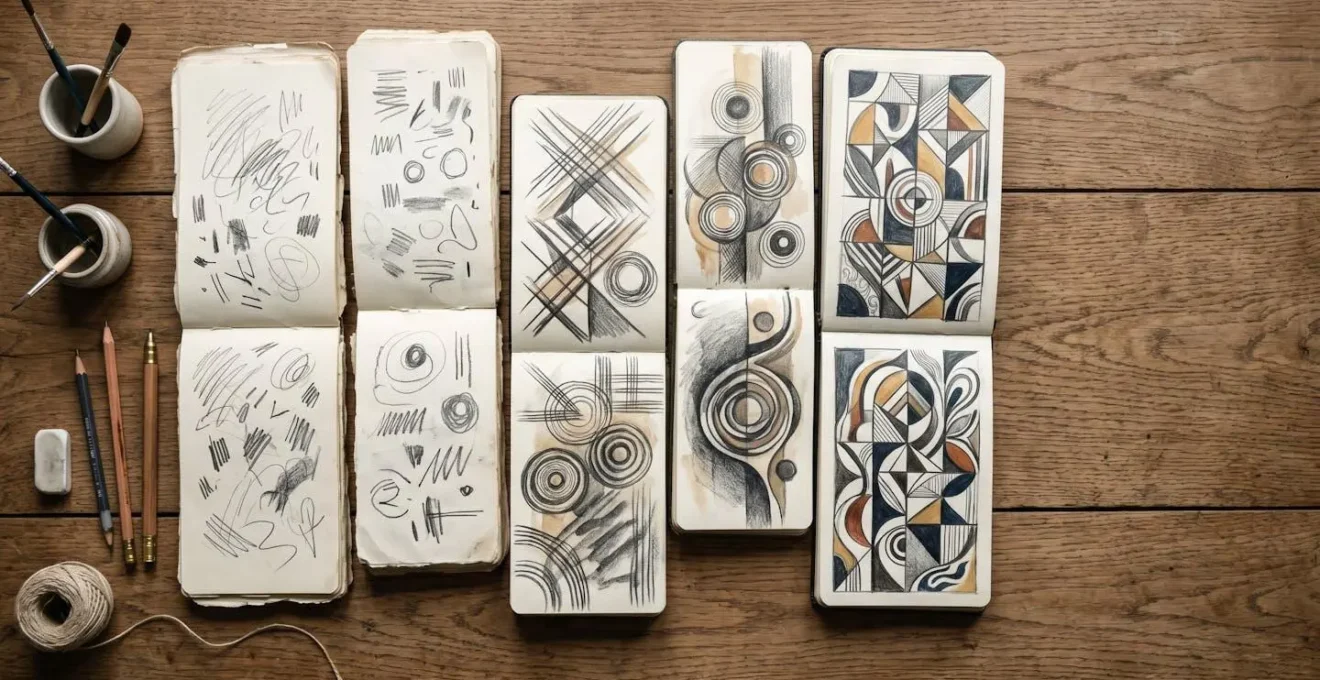
Contrary to popular belief, a coherent visual language isn’t “found”—it’s systematically built.
- Your sketchbook’s primary role is not to be a gallery of perfect drawings, but a data lab for collecting and analyzing creative insights.
- Consistency trumps intensity; daily, small creative acts build the neural pathways necessary for developing a unique voice.
- A structured process of capturing, clustering, refining, and executing ideas is what transforms random inspiration into a recognizable style.
Recommendation: Shift your mindset from seeking a magical “style” to implementing a disciplined, cyclical process. This is the professional path to developing an authentic and sustainable creative practice.
For many emerging artists, the sketchbook is a space of both boundless potential and deep frustration. It’s a graveyard of half-formed concepts, random doodles, and brilliant sparks that never caught fire. You fill page after page, hoping that a unique, coherent “style” will magically emerge from the chaos. You’re told to “just draw every day” or “find your voice,” but this advice often leads to more scattered work, not clarity. The struggle is real: how do you bridge the gap between these disconnected flashes of inspiration and a cohesive body of work that feels distinctly yours?
The problem is that we often treat the sketchbook as a final destination—a place to create finished mini-masterpieces. This pressure fuels perfectionism and prevents us from seeing the real value of our sketches. But what if the true key to developing a visual language isn’t about finding a style, but about building a system? What if your sketchbook’s true purpose is to be a data lab, a place for messy, judgment-free collection of idea data? This shift in perspective is the foundation of a professional creative practice.
This guide will walk you through a disciplined, yet liberating, framework for transforming your random sketchbook entries into a powerful and consistent visual language. We will move beyond vague platitudes and give you a sustainable system based on the principles of capture, analysis, and conscious refinement. This is the process for turning your creative chaos into a signature voice.
To help you navigate this process, we’ve structured this guide into a clear, step-by-step journey. Each section tackles a critical component of building your creative system, from evaluating ideas to structuring your entire workflow.
Summary: From Random Sketches to a Signature Style
- How to Decide Which Sketchbook Ideas Are Worth Developing into Full Projects?
- Why Daily Sketchbook Practice Accelerates Your Artistic Growth More Than Intensive Sessions?
- Sketchbook or Drawing Tablet: Which Captures Spontaneous Ideas More Effectively?
- The Perfectionism Trap That Kills 70% of Promising Sketchbook Ideas Before They Start
- When to Schedule Sketchbook Time: Morning Clarity or Evening Reflection?
- How to Build a Creative Framework That Enhances Rather Than Restricts Artistic Freedom?
- The Influence Absorption Problem That Stops 90% of Creatives from Finding Their Voice
- How to Structure Your Creative Process for Consistent Output Without Losing Spontaneity?
How to Decide Which Sketchbook Ideas Are Worth Developing into Full Projects?
Your sketchbook is overflowing with ideas, but 99% of them will, and should, remain as simple sketches. The professional artist’s skill isn’t just generating ideas, but identifying which ones have the legs to become something more. Wasting weeks on a weak concept is a massive drain on your creative energy. The key is to develop a quick, objective filtering system to evaluate your idea data before you commit significant time and resources. This isn’t about judging the quality of a sketch, but about assessing the potential of the underlying concept.
Instead of relying on a gut feeling alone, which can be influenced by your mood, you need a structured test. A simple, multi-stage evaluation process can help you distinguish a fleeting thought from a foundational concept for a series. This process forces you to consider the idea’s visual strength, narrative potential, and versatility. The image below perfectly captures this moment of thoughtful curation, where raw concepts are sorted and weighed, separating the seeds from the chaff.
As you can see, this is an active, analytical process. By externalizing your ideas into small thumbnails, you create the distance needed for objective evaluation. To make this practical, you can adopt a simple litmus test to run your most promising sketches through. Think of it as a quick diagnostic to check the health of an idea.
- Stage 1 – The Thumbnail Test: Can you simplify your idea into a compelling small image? If the concept loses its clarity or impact when reduced to a tiny square, it may lack the core visual strength needed for a larger piece.
- Stage 2 – The Story Test: Can you articulate a simple story or emotion connected to the idea in a single, clear sentence? Strong concepts have inherent narrative potential.
- Stage 3 – The Variation Test: Can you imagine 3-5 distinct variations of the core concept? Ideas with “series potential” allow for deep exploration across multiple pieces without becoming repetitive.
- Bonus – Personal Excitement Check: On a scale of 1-10, how genuinely excited are you about this idea? As a rule of thumb, ideas scoring below a 7 rarely have enough motivational fuel to survive the hard work of full project development.
This filtering stage is the first step in building your system. It ensures that the energy you invest in development is spent on concepts that truly deserve it, setting the foundation for a stronger, more focused portfolio.
Why Daily Sketchbook Practice Accelerates Your Artistic Growth More Than Intensive Sessions?
The romanticized image of an artist is one of manic, caffeine-fueled all-nighters, producing a masterpiece in a single burst of inspiration. The reality of professional practice is far less dramatic and much more disciplined. It’s about the quiet, consistent, and often unglamorous act of showing up every day. Intensive, sporadic sessions feel productive, but they are less effective for long-term growth than a small, daily habit. The reason for this lies in the way our brains build skill and creativity: neuroplasticity.
Think of your creative ability not as a well you draw from, but as a muscle you build. A single, grueling 8-hour workout once a month won’t make you strong; 20 minutes of targeted exercise every day will. The same principle applies to your art. Daily practice creates a consistent signal to your brain to build and strengthen the neural pathways associated with drawing, observation, and conceptual thinking. This is your creative metabolism—the consistent processing of visual information that turns looking into seeing. It’s a scientifically backed phenomenon; research demonstrates that even 30 hours of targeted creative practice spread over several weeks can induce measurable changes in the brain.
This steady, cumulative effort does more than just improve your technical skill. It builds a vast internal library of shapes, forms, and solutions that you can draw upon subconsciously. As a Neuroscience Research Team noted in their study on creativity and brain aging:
Long-term practice related to creativity may be more effective in promoting neural plasticity and brain health than short-term experiences.
– Neuroscience Research Team, Creativity Key to Slowing Brain Aging Study
Daily practice also demystifies inspiration. When you wait for a lightning bolt of genius, you give away your power. When you commit to a daily practice, you create the conditions for inspiration to find you. It becomes a reliable visitor, not a fickle muse. This habit transforms you from someone who waits for ideas into someone who generates them on demand.
Ultimately, a daily sketchbook habit is the engine of your artistic growth. It’s not about producing a masterpiece every day. It’s about laying one brick, perfectly, every single day. Soon, you’ll look back and find you’ve built a fortress.
Sketchbook or Drawing Tablet: Which Captures Spontaneous Ideas More Effectively?
In the digital age, the question of tools is constant. Should you capture your fleeting ideas in a traditional paper sketchbook or on a sleek drawing tablet? Digital tools offer undeniable advantages: endless brushes, an undo button, and seamless integration into a digital workflow. For finished, polished work, they are often superior. However, for the raw, spontaneous capture of initial ideas—the very first phase of our system—the humble sketchbook often holds a distinct, tactile advantage.
The key difference lies in the concept of “friction.” A tablet offers a smooth, frictionless experience. An idea flows from your brain to the screen with minimal resistance. While this sounds ideal, this lack of friction can sometimes lead to generic, sterile-looking ideas. The physical sketchbook, by contrast, is full of wonderful, productive friction. The texture of the paper, the specific way a pencil drags, the unpredictable bleed of an ink pen—all these physical variables create a feedback loop between your hand, your eyes, and your brain. This isn’t a flaw; it’s a feature.
This tactile feedback engages more of your senses and can lead to “happy accidents” that a perfectly controlled digital environment might prevent. As creative workflow researchers put it, the physicality of the medium is part of the thought process itself:
The resistance of graphite, the whisper of charcoal, the subtle buckling of paper under ink—all contribute to a feedback loop between hand and mind.
– Creative Workflow Researchers
Furthermore, a sketchbook is a finite, contained object. It’s portable, requires no batteries, and has no distracting notifications. This “limitation” is a strength. It encourages you to focus solely on the idea at hand without getting lost in the infinite possibilities of brushes, layers, and effects. The goal at the capture stage is speed and authenticity, not perfection. The sketchbook is optimized for this, inviting messiness and imperfection in a way that a pristine digital canvas sometimes discourages.
This isn’t an argument to abandon digital tools. A hybrid approach is often best. Use the physical sketchbook for raw, unfiltered idea generation—the “Play & Gather” phase. Then, scan your best ideas and use the power of your tablet for the “Refine & Develop” and “Execute” phases. By using the right tool for the right stage, you get the best of both worlds.
The Perfectionism Trap That Kills 70% of Promising Sketchbook Ideas Before They Start
There is an invisible killer lurking in every sketchbook: the desire for every page to be a perfect, portfolio-worthy piece. This is the perfectionism trap, and it is the single most destructive force for an emerging artist. It whispers that an idea isn’t good enough, that your skills aren’t ready, that you’ll “ruin the page.” Before you even put pencil to paper, the idea is strangled. This isn’t just a feeling; it’s a widespread issue. According to a 2021 survey, up to 74% of creatives report perfectionism-related behaviors, such as procrastination and excessive self-criticism, as a major barrier.
Perfectionism fundamentally misunderstands the purpose of a sketchbook. As we’ve established, your sketchbook is a lab, not a gallery. Its purpose is to collect idea data—messy, raw, and unfiltered. When you try to make every sketch perfect, you are prematurely optimizing. You are polishing a single rock before you’ve even finished excavating the quarry. This mindset prevents you from taking risks, experimenting, and generating the sheer volume of “bad” ideas necessary to find the few good ones.
The image below is a powerful visual metaphor for this internal struggle. The pristine, blank page represents the paralyzing pressure of perfection, while the crumpled paper represents the “failed” attempt—which, in reality, is just a necessary part of the process. It’s a data point, nothing more.
To escape this trap, you must consciously give yourself permission to be messy. Reframe “mistakes” as “data.” Every “bad” drawing teaches you something. Here are a few practical strategies to fight back against perfectionism:
- The “First Page” Ritual: Deliberately “ruin” the first page of every new sketchbook. Scribble on it, spill coffee on it, write “This sketchbook is for ugly ideas.” This breaks the seal of perfection from the start.
- Use “Cheap” Materials: Sometimes, a beautiful, expensive leather-bound sketchbook is the worst thing for creativity. Use cheap copy paper or a simple spiral-bound pad. When the materials feel disposable, you feel freer to experiment.
- Set a Time Limit: Give yourself just 2-5 minutes per sketch. This forces you to focus on capturing the essence of the idea rather than rendering it perfectly.
By embracing imperfection and treating your sketchbook as a space for pure play, you liberate yourself to generate the volume and variety of ideas needed to fuel your creative system. The goal is not a perfect sketchbook; the goal is a thriving creative practice.
When to Schedule Sketchbook Time: Morning Clarity or Evening Reflection?
Now that you’re committed to a daily practice, the next practical question is: *when*? We often hear generic advice to “draw in the morning” or “unwind by sketching at night.” But the optimal time isn’t universal; it depends on what you’re trying to achieve. Different times of day correspond to different brain states, and you can strategically leverage these states to enhance specific parts of your creative process: idea generation versus idea refinement.
Morning, for many people, is a time of high focus and analytical clarity. Your brain is rested, and your prefrontal cortex—the “CEO” of your brain—is fully online, ready for problem-solving and focused tasks. This state is ideal for developing and refining existing ideas. Evening, on the other hand, is often characterized by a more diffuse, wandering state of mind. Your analytical filters are down, allowing for more associative, divergent thinking. This state is perfect for generating new, unexpected ideas and making surprising connections.
Case Study: Brain States of Jazz Improvisers
This isn’t just a theory; it’s backed by neuroscience. A fascinating 2024 neuroimaging study published in Neuropsychologia examined the brain activity of jazz musicians during improvisation. Researchers found that creative flow states were linked to specific brain oscillation patterns. More diffuse attention states, similar to our relaxed evening minds, facilitated divergent thinking and unexpected musical connections. In contrast, more focused attention states, like our morning clarity, were better for refining musical phrases based on existing knowledge and structure.
This suggests that the most effective artists don’t just have one sketchbook slot; they have two. By creating a “dual-slot” system, you can align your creative tasks with your natural brain rhythms for maximum output. Instead of forcing one to fit all, you can create a daily rhythm that supports both generation and synthesis.
- Morning Idea Download (10 minutes): Upon waking, before your analytical brain is fully engaged, use this slot to capture dream fragments, fresh thoughts, and subconscious imagery. This is for pure, judgment-free generation.
- Evening Synthesis (15 minutes): Before bed, review the day’s observations, sketches, and visual inputs. Use this reflective slot to look for recurring patterns, themes, or connections between different ideas. This transforms scattered thoughts into coherent frameworks.
- Adapt to Your Goal: If your goal is to generate brand-new concepts, lean into your most diffuse brain state (early morning grogginess or late-night drowsiness). If you’re developing an existing idea for a project, use your peak focus hours (often mid-morning).
By strategically scheduling your sketchbook time, you stop fighting against your brain’s natural tendencies and start working with them. This small adjustment can dramatically increase both the quantity of your ideas and the quality of your insights.
How to Build a Creative Framework That Enhances Rather Than Restricts Artistic Freedom?
The word “framework” or “system” can feel threatening to an artist. It conjures images of rigid rules, creative straitjackets, and the death of spontaneity. This is a fundamental misunderstanding. A well-designed creative framework is not a prison; it is a playground. It provides the boundaries—the walls, the slide, the swings—that give you the safety and structure to play freely and without fear. Without any structure, you’re not free; you’re just lost in an empty field.
A creative framework is a set of self-imposed constraints that guide your exploration. These constraints can be anything: a limited color palette, a specific subject matter for a month, a rule to only use a certain tool, or a compositional grid. Far from limiting you, these constraints force you to become more creative. When you can’t rely on your usual tricks, you have to invent new solutions. This is how a unique voice is forged—not in the infinite void of “do anything,” but in the focused challenge of “do something interesting within these limits.”
The image below illustrates this concept perfectly. The hand-drawn geometric lines on the sketchbook page aren’t caging the expressive marks within them; they are giving them a stage. They create a deliberate space for play, turning a blank page into a structured environment for exploration. This is the essence of a creative framework: a structure that enables freedom.
So, how do you build your own framework? Start small and be intentional. Don’t impose a dozen rules at once. Choose one or two simple constraints for a set period, like a week or a month. Here are some examples of effective creative constraints to build your framework:
- Material Constraint: For one week, use only a single black pen and a gray marker.
- Subject Constraint: For one month, every sketch must involve a type of fruit.
- Compositional Constraint: Divide every sketchbook spread into a nine-square grid and create a small, distinct composition in each square.
- Time Constraint: Every daily sketch must be completed in under five minutes.
By consciously choosing your own rules, you take control of your creative development. You stop being a passive recipient of random inspiration and become the active architect of your visual world. This is the shift from an amateur mindset to a professional one.
The Influence Absorption Problem That Stops 90% of Creatives from Finding Their Voice
Inspiration is everywhere, but so is the danger of imitation. In our hyper-connected world, we are constantly bombarded with the incredible work of other artists on social media and portfolio sites. While this is a fantastic source of motivation, it also creates a massive problem: influence absorption. This is the process of subconsciously soaking up the styles of artists you admire until your own work becomes a diluted echo of theirs, rather than a clear expression of your own voice. You end up creating work that *looks* good, but doesn’t feel like *you*.
This happens because we engage in passive consumption instead of active study. Scrolling through Instagram is not research; it’s a form of creative snacking that fills you up without providing real nourishment. To develop your own voice, you must move from being a passive fan to being an active student. This requires a systematic deconstruction of the work you admire. You need to understand *why* you like something on a technical and conceptual level, not just have a vague feeling that it’s “cool.”
The solution is to perform a regular “Influence Audit.” This is a structured exercise designed to make you consciously aware of the specific elements you are drawn to in other artists’ work. By identifying these recurring patterns, you are not discovering their voice; you are discovering the building blocks of your own voice, which you are recognizing in their work. This audit transforms influence from a threat into a tool for self-discovery.
Your Action Plan: The Systematic Influence Audit
- List 5 Favorite Artists/Creators: Write down the names of five artists whose work deeply resonates with you. Be specific—choose artists you return to repeatedly, not just passing interests.
- Identify Concrete Admiration Elements: Next to each artist, write exactly WHY you admire their work in concrete terms. Avoid vague words like ‘style.’ Instead, specify: ‘uses high-contrast shadows,’ ‘simplifies forms to geometric shapes,’ or ’employs a limited, earthy color palette.’
- Find Common Threads: Circle or highlight the elements that appear multiple times across your list. These recurring patterns are the core components of YOUR emerging voice that you’re recognizing in others.
- Conscious Recombination: Choose ONE element from your common threads (e.g., ‘high-contrast shadows’). For your next 10 sketches, consciously practice this single element combined with your own preferred subject matter. This is active study, not passive imitation.
- Distinguish Study from Consumption: Schedule “active study” sessions (1-2 hours weekly) to deliberately deconstruct admired work. Keep this separate from “passive consumption” (mindless scrolling), which leads to subconscious copying without understanding.
By systematically auditing your influences, you take control. You are no longer a victim of absorption but an intentional artist, consciously selecting the tools and techniques you want to integrate into your own unique visual language.
Key Takeaways
- A coherent visual language is not found, but systematically built through a disciplined process.
- Your sketchbook’s primary purpose is to be a “data lab” for messy, judgment-free idea collection, not a gallery of perfect art.
- Creative growth is fueled by consistent daily practice (Creative Metabolism) and strategic constraints that foster, rather than restrict, freedom.
How to Structure Your Creative Process for Consistent Output Without Losing Spontaneity?
We’ve explored the individual components: evaluating ideas, daily practice, overcoming perfectionism, and auditing influences. Now, it’s time to assemble them into a single, powerful, and cyclical system. This is the overarching structure that brings everything together, allowing for both consistent, high-quality output and the spontaneous, playful exploration that keeps creativity alive. A lack of structure leads to sporadic bursts of activity followed by long, frustrating droughts. A rigid, linear structure kills joy and spontaneity. The answer is a cyclical process where different modes of thinking—playful and analytical—are given their own dedicated time and space.
This model protects your creative ecosystem by separating the delicate, judgment-free act of “gathering” from the analytical, goal-oriented act of “executing.” As the UAL Teaching Exchange notes, the sketchbook is a place for broad exploration:
Your sketchbook can provide opportunities for an exploration of visual language in art and design, such as line, shape, colour and texture, volume, pattern and rhythm. It may also be a place for invention and experimentation with ideas, techniques and media.
– UAL Teaching Exchange, Visual Directions: Sketchbooks Overview
This exploratory function must be protected. The best way to do this is with a four-phase model that cycles continuously. This ensures that your “project” work is always being fed by a steady stream of new “practice” work, and your practice is informed by the challenges you face in your projects.
- Phase 1 – Play & Gather (Spontaneous): This is your daily sketchbook practice. Dedicate 30-60 minutes daily to messy, goal-free exploration. Capture observations, random thoughts, and visual experiments. This is pure data collection.
- Phase 2 – Identify & Cluster (Analytical): This is a weekly review session. Spend an hour flipping through your week’s sketches, looking for recurring themes, shapes, or subjects. Use sticky notes or tags to cluster similar idea data together. This is where you start to see the patterns of your subconscious voice.
- Phase 3 – Refine & Develop (Strategic): Based on the patterns you’ve identified, select 1-3 promising concepts to develop into structured project plans. Define the scope, materials, timeline, and desired outcome. This phase transforms raw data into actionable projects.
- Phase 4 – Execute (Focused): Work on your defined projects with clear milestones. Use focused, multi-hour blocks for project execution, keeping this time separate from your daily spontaneous practice. The key is to never let project work (Phase 4) stop your daily gathering (Phase 1).
By adopting this cyclical process, you create a sustainable and self-fueling creative engine. It provides the structure necessary for consistent output without sacrificing the spontaneous play that is the lifeblood of art. This is how you stop being an artist who sometimes has ideas and become an artist who has a system for creating.