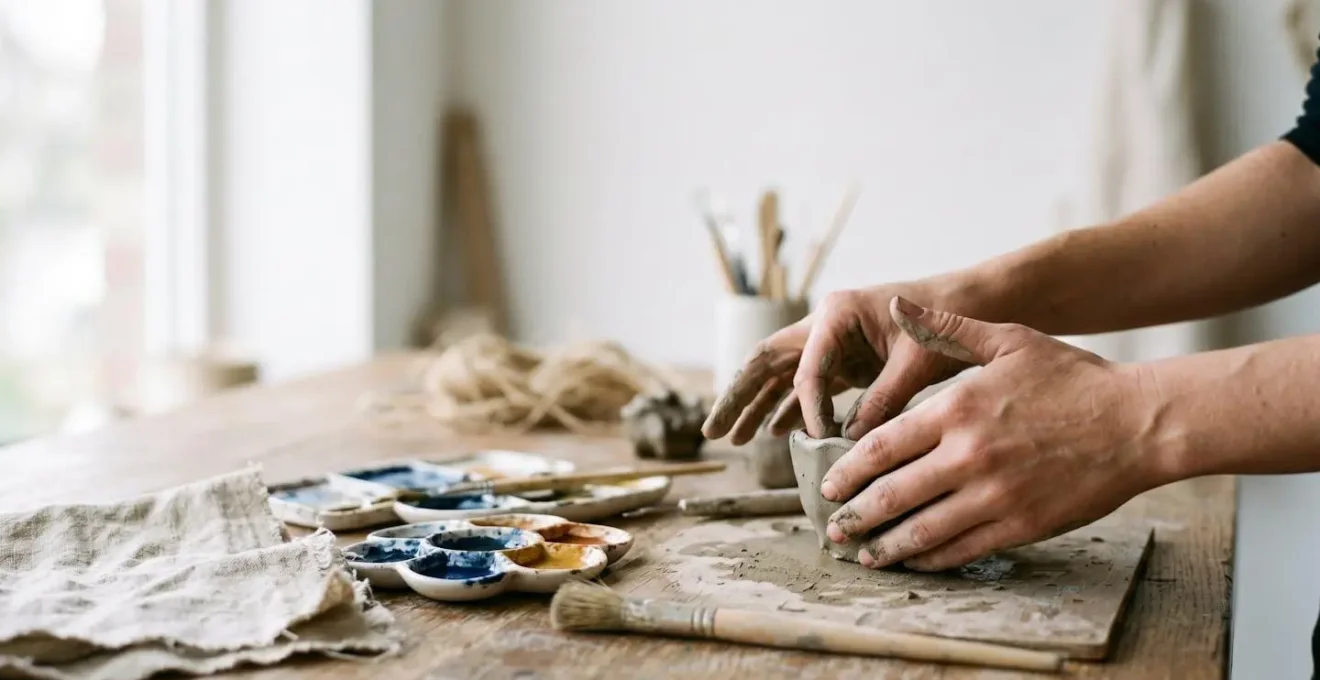
The secret to a fulfilling creative practice isn’t finding a new skill to master, but giving yourself permission to play without a goal.
- Most adults abandon creativity because it becomes another “achievement domain” filled with pressure and expectations.
- True creative relief comes from “Nourishing Play”—activities chosen for sensory joy and the process itself, not the outcome.
Recommendation: Instead of asking “What can I make?”, start by asking “What feels like relief right now?”. This shift is the first step toward a sustainable and joyful creative practice.
Remember that feeling as a child, getting lost for hours with crayons, mud, or building blocks? There was no goal, no metric for success, just the pure, unadulterated joy of creation. For many busy professionals, that feeling is a distant memory. The very idea of a “creative outlet” often comes with a silent, heavy attachment: the pressure to be good at it. We pick up a paintbrush and immediately worry about the result. We start writing and agonize over every word. Our potential source of relief quickly becomes another item on our to-do list, another domain where we must perform and achieve.
The common advice is to “make time for hobbies” or “just be consistent.” But this overlooks the fundamental problem. In a culture obsessed with optimization and productivity, we have forgotten how to play. We have been conditioned to turn every activity into a project with a measurable outcome. This tendency is especially potent for those in creative professions, where the line between work and personal expression becomes dangerously blurred, leading to burnout and a sense of profound exhaustion.
But what if the solution wasn’t about trying harder, but about a gentle, radical shift in perspective? What if the true purpose of a creative outlet is not to produce something impressive, but to access a state of Nourishing Play? This is not about adding another skill to your repertoire; it’s about carving out a sacred, pressure-free space for your soul to breathe. It’s a practice of separating your creativity from your competence, and in doing so, finding a wellspring of joy and balance that our achievement-driven lives desperately need.
This article is your permission slip to reclaim that joy. We will explore why we abandon creative play, how to choose an outlet that truly nourishes you, and how to protect it from the creeping pressures of performance. Let’s begin the journey back to creativity that feels like relief, not another job.
Summary: Reclaiming Your Creative Joy: A Guide to Pressure-Free Play
- Why Most Adults Abandon Creative Play by Age 35 and the Hidden Cost to Their Wellbeing?
- How to Select a Creative Outlet That Feels Like Relief Rather Than Another Skill to Master?
- How to Keep Your Personal Creative Practice Pure When Your Day Job Is Also Creative?
- How to Maintain a Creative Outlet Consistently Without Adding Pressure to Your Already Full Life?
- When to Change or Expand Your Creative Outlet Without Feeling Like You’re Quitting?
- Why Suppressing Personal Expression for Social Acceptance Leads to Burnout Within 18 Months?
- Why Most Popular Self-Care Practices Are Actually Forms of Procrastination or Numbing?
- How to Express Your Personal Identity Through Lifestyle Choices Without Social Friction?
Why Most Adults Abandon Creative Play by Age 35 and the Hidden Cost to Their Wellbeing?
The transition from childhood’s boundless creativity to adulthood’s structured reality is often marked by a quiet, gradual loss. We don’t consciously decide to stop playing; it’s a slow erosion driven by societal expectations and the mounting pressures of career and family. The “real world” demands quantifiable results, efficiency, and a clear return on investment for our time. Spontaneous, process-oriented activities that don’t produce a tangible outcome are often deemed frivolous or unproductive. As a result, the very nature of play becomes reclassified in our minds as a luxury we can no longer afford.
This isn’t just a feeling; it’s a documented phenomenon. Recent research reveals a striking disconnect, showing that while most adults acknowledge the health benefits of creativity, nearly 47% of adults devote no time to creative activities. The internal critic, honed by years of performance reviews and academic grading, takes over. We fear not being “good enough,” and the potential for joy is overshadowed by the fear of failure. The creative impulse, once a source of delight, becomes a source of anxiety.
The hidden cost of this abandonment is immense. Suppressing our innate need for creative expression is not a neutral act; it depletes our reserves of resilience and contributes to a pervasive sense of emptiness and disconnection. As Dr. Sandra Russ notes in her research on the topic, many adults have such limited opportunities to express creativity that it becomes difficult to even identify. This lack of expression leaves a void. Without a space for non-judgmental exploration, we lose a vital tool for processing emotions, reducing stress, and connecting with our authentic selves. This creative deficit is a significant, yet often overlooked, contributor to the rising rates of burnout and mental exhaustion in modern adult life.
How to Select a Creative Outlet That Feels Like Relief Rather Than Another Skill to Master?
The journey back to creativity begins not with a grand commitment, but with a gentle inquiry. The goal is to sidestep the achievement-oriented part of your brain and connect with what your body and soul are truly craving. The most common mistake is choosing an outlet based on what looks impressive or what you think you *should* be doing. Instead, the focus must be on the *sensation* of the activity itself. Does it feel like an exhale? Or does it feel like you’re holding your breath, waiting for a result?
To distinguish between a nourishing practice and another achievement domain, consider the spectrum of creative modalities. On one end, you have purely process-based activities like finger painting, dancing freely to music, or experimenting with sounds. Here, there is no “right” way and the end product is irrelevant. On the other end are skill-based activities like life drawing, learning a complex musical piece, or mastering a craft. While deeply rewarding, these can easily trigger our perfectionism. The key is to start on the process end of the spectrum, or to approach a skill-based activity with a process-oriented mindset.
This image perfectly captures the tactile difference between these two approaches—one focused on spontaneous exploration, the other on careful placement. Your task is to find which one feels more like freedom to you right now.
A helpful way to diagnose your true motivation is to ask yourself a series of gentle, honest questions. This isn’t a test to pass, but a tool for self-discovery. It’s an audit of your internal landscape to ensure you are moving towards genuine relief. Before committing to a new outlet, use this checklist to guide your choice.
Your Action Plan: The Joy vs. Achievement Audit
- Assess the Sensation: As you consider or engage in the activity, ask: “Does my body feel more relaxed or more tense right now?” Pay attention to your shoulders, your jaw, and your breath as reliable indicators.
- Check Your Focus: In the moment, are you thinking about the end result or the current sensation? True relief is found in the present-moment experience of color, texture, or movement.
- Gauge Your Motivation: Ask the crucial question: “Would I still do this if no one ever saw it?” This clarifies whether the activity serves internal fulfillment or a need for external validation.
- Distinguish Discovery from Optimization: Notice if you are experiencing novelty and discovery, or if your mind is already trying to optimize and improve. The goal here is exploration, not perfection.
- Plan the Integration: Based on your answers, choose one small, low-stakes activity to try for just 15 minutes this week with the sole intention of enjoying the process.
How to Keep Your Personal Creative Practice Pure When Your Day Job Is Also Creative?
For professionals in creative fields—designers, writers, marketers, artists—the challenge of finding a personal outlet is uniquely complex. When your daily work involves solving creative problems for clients, it can be difficult to switch off that “problem-solving” brain. Your creative energy is a finite resource, and after a long day of monetizing it, the last thing you want is to engage in more of the same. This often leads to a creative practice that feels like unpaid overtime rather than a source of restoration.
The key to protecting your personal practice is sensory cross-training. This principle involves intentionally choosing an outlet that uses different senses, muscles, and cognitive pathways than your professional work. If your job is primarily digital and visual (like a graphic designer), a nourishing outlet might be tactile and analog, like pottery, gardening, or baking bread. If you’re a writer who works with words all day, your relief might be found in a non-verbal practice like painting, playing an instrument, or dancing. This shift in modality is crucial because it allows the overused parts of your brain to rest while activating others, leading to genuine rejuvenation rather than further depletion.
This isn’t just a nice idea; it’s linked to overall wellbeing. According to the American Psychiatric Association’s Healthy Minds Monthly Poll, 71% of adults who report excellent mental health engage in creative activities frequently. The study highlights that this engagement provides a vital mental break. Madison Utendahl, an expert on the topic, reinforces this connection:
Burnout is not merely a symptom of our work environment but a sign of a much deeper identity crisis. It’s a state that forces us to confront uncomfortable truths about our values, priorities, and the societal narratives that shape our understanding of success and self-worth
– Madison Utendahl, Burnout: A Symptom of an Identity Crisis
By consciously separating your “work creativity” from your “play creativity,” you are not just finding a hobby; you are actively building a firewall against burnout. You are creating a sanctuary where your expression is not for sale, not up for critique, and not tied to any outcome. It is simply, and sacredly, for you.
How to Maintain a Creative Outlet Consistently Without Adding Pressure to Your Already Full Life?
The intention to build a consistent creative practice is often sabotaged by one simple, flawed belief: that it needs to be a significant time commitment to be worthwhile. In our all-or-nothing culture, we imagine we need long, uninterrupted hours in a dedicated studio. When our busy lives can’t accommodate this ideal, we do nothing at all. This is the perfectionist mindset at work, and it’s the biggest barrier to consistency.
The gentle, anti-perfectionist approach is to redefine “consistency.” It’s not about duration; it’s about frequency. It’s better to touch your creative practice for 15 minutes four times a week than to wait for a mythical four-hour block on a Sunday that never materializes. This “small, frequent” approach lowers the barrier to entry so much that it becomes harder to make an excuse than to just do it. Think of it as a creative snack rather than a full-course meal. These small moments accumulate, building momentum and weaving creativity into the fabric of your life rather than treating it as a separate, demanding event.
The science backs this up. You don’t need to be a professional artist or spend hours to reap the benefits. As Dr. Petros Levounis, President of the American Psychiatric Association, states, “Creative activities aren’t just for fun, they can help us take a step back from the daily grind, use our brains differently, and relax.” Research further supports this, indicating that even short periods of creative activity can have a measurable physiological impact. Studies have found that just 30 to 45 minutes of art-making, at any skill level, correlates with reductions in cortisol and self-reported anxiety.
To implement this, try “habit stacking.” Anchor your short creative burst to an existing daily routine. For example: sketch in a notebook for 10 minutes while your coffee brews. Play the guitar for 15 minutes right after you get home from work. Write one paragraph in a journal before you go to sleep. By making the commitment tiny and linking it to something you already do, you remove the decision-making fatigue and the pressure to perform. You are simply showing up for your own joy, one small, consistent moment at a time.
When to Change or Expand Your Creative Outlet Without Feeling Like You’re Quitting?
In a culture that lionizes grit and equates “sticking with it” to moral strength, the decision to change a hobby can be fraught with guilt. We often feel that moving on from an activity we once loved is a sign of failure or a lack of discipline. This is the achievement mindset creeping back in, framing our personal outlets as projects we must see through to completion. But a truly nourishing creative practice is not a lifelong contract; it’s a dynamic relationship that should evolve as we do.
The permission-giving perspective is to think of your creative life in Creative Seasons. The outlet that nourished you during a period of high stress and social activity might not be the one you need during a quiet, introspective winter. The practice that felt like an escape a year ago might now feel like a chore. This is not failure; it’s feedback. Your internal landscape is signaling a shift in its needs. Listening to that signal and adapting your practice is the highest form of creative self-care. It’s about staying true to the *purpose* (joy and relief) rather than being dogmatically attached to the *method* (a specific hobby).
This idea is reflected in a longitudinal study of adults during the pandemic, which found that people’s creative activities shifted based on their changing psychological needs. Some activities, like gardening, were associated with reduced anxiety, while others served different functions. The research demonstrates that evolving our creative outlets is an adaptive and healthy response to life’s transitions.
Signs it might be time for a new Creative Season include: feeling a sense of obligation rather than anticipation, consistently procrastinating on the activity, or noticing that it no longer leaves you feeling energized or relieved. When you feel this, it’s not a signal to quit, but an invitation to explore. Maybe you put down the guitar for a few months and pick up a camera. Maybe you box up your watercolors and try a pottery class. You can always come back. Abandoning the idea of “quitting” and embracing the concept of a creative evolution liberates you to follow your curiosity without judgment.
Why Suppressing Personal Expression for Social Acceptance Leads to Burnout Within 18 Months?
Burnout is often discussed as a work-related issue—a consequence of too many hours, too much stress, and too little support. While these factors are significant, they are often symptoms of a much deeper malaise. At its core, burnout is frequently an identity crisis, born from the chronic suppression of our authentic selves. We spend our days conforming to professional roles, social expectations, and familial duties, often at the expense of our own innate values, curiosities, and modes of expression.
This constant self-editing creates what can be called “Identity Dissonance”—a painful gap between who we are and who we feel we must pretend to be to gain acceptance, approval, or career advancement. Each time we silence a unique idea, hide a quirky interest, or temper our personality to fit in, we create a small stress response in our bodies. Over time, these thousands of micro-suppressions accumulate into a crushing weight of chronic stress. Your nervous system doesn’t distinguish between the stress of a deadline and the stress of self-betrayal. It simply registers a threat.
This is not just a psychological theory; it’s a process documented in clinical research. A longitudinal qualitative study of employees in burnout rehabilitation found that the experience of burnout was fundamentally an “identity rupture.” Participants went through phases of resisting their own vulnerability and struggling to develop and test a new identity that felt more aligned with their true selves. The study shows that the collapse we call burnout is the body’s and mind’s final, desperate signal that the chasm between our inner and outer worlds has become unsustainable. The timeline of 18 months represents a typical cycle where the initial energy required for self-suppression gives way to deep-seated exhaustion and, eventually, a full-blown crisis.
A personal creative outlet, in this context, is not a mere hobby. It is an act of defiance against this dissonance. It is a dedicated practice of honoring your authentic voice, a space where you don’t have to pretend. It’s a way of closing the gap, of reminding yourself who you are outside of the roles you play. This makes it a powerful, non-negotiable antidote to the identity crisis that fuels modern burnout.
Why Most Popular Self-Care Practices Are Actually Forms of Procrastination or Numbing?
In the modern lexicon, “self-care” has become a buzzword often co-opted by consumer culture. It’s marketed as bubble baths, binge-watching the latest series, or “treating yourself” with online shopping. While these activities can provide temporary pleasure or distraction, they often fall into the category of numbing rather than true nourishment. They are forms of passive consumption designed to help us avoid uncomfortable feelings, rather than engage with and process them.
The critical distinction lies in the function of the activity. Numbing behaviors are an escape. They are an automatic, often compulsive, response to stress, boredom, or sadness. The goal is to turn the volume down on our internal world. Think of endless scrolling on social media, consuming junk food, or zoning out in front of a screen for hours. While they offer immediate relief, they often leave us feeling groggy, empty, or even guilty afterward, and they do nothing to build our long-term resilience.
Nourishing self-care, on the other hand, is an act of engagement. It is a conscious choice to do something that supports our mental, emotional, or physical health. It requires a degree of presence and intentionality. Creative expression is a prime example of nourishing self-care. It allows us to engage with our inner world in a constructive way—to transform difficult emotions into art, to find flow and focus, or to simply experience the joy of making something with our own hands. It fills our cup instead of just temporarily plugging the leak.
This table breaks down the fundamental differences, helping you to become more aware of your own patterns and make more conscious choices about how you spend your precious downtime.
| Dimension | Nourishing Self-Care | Numbing Self-Care |
|---|---|---|
| Primary Function | Engages the mind to process emotions and meet genuine needs | Distracts the mind to avoid uncomfortable feelings |
| After-Feeling | Sense of satisfaction, relief, or restored energy | Immediate craving for more, guilt, or emptiness |
| Intentionality | Conscious decision to support mental, emotional, physical health | Automatic escape or avoidance behavior |
| Examples | Creative expression, mindful movement, connecting with nature, meaningful conversation | Endless scrolling, binge-watching, compulsive shopping, excessive screen time |
| Physical Response | Body feels more relaxed and rejuvenated | Body feels groggy, tense, or disconnected |
| Long-term Impact | Builds resilience and authentic wellbeing | Depletes energy and creates dependency on distraction |
Recognizing the difference is the first step. The next time you feel the urge to reach for a numbing behavior, gently pause and ask yourself: “What do I truly need right now? Is it to escape, or is it to connect?” Sometimes, the answer might be a numbing activity, and that’s okay without judgment. But building a practice of choosing nourishment more often is the foundation of sustainable wellbeing. For a deeper understanding of this dynamic, you can explore the concepts laid out by sources like Neurodivergent Insights on self-care.
Key Takeaways
- The goal of a creative outlet is not achievement but “Nourishing Play”—a state of joyful, process-oriented exploration that restores energy.
- For creative professionals, “sensory cross-training” (switching from digital to analog, or verbal to non-verbal) is essential to prevent burnout.
- Consistency is built through small, frequent engagements (15-20 minutes) rather than waiting for large blocks of time, which removes pressure.
How to Express Your Personal Identity Through Lifestyle Choices Without Social Friction?
Integrating your authentic creative identity into your daily life is the ultimate goal. This isn’t about making a grand, disruptive statement, but about allowing your inner world to gently and authentically infuse your outer world. It’s about closing the “Identity Dissonance” gap not just in the privacy of your studio, but in the small choices you make every day. This expression can be subtle: the way you arrange your workspace, the colorful socks you wear with a corporate suit, the music you play while cooking, or the unique way you tell a story.
The key to doing this without creating social friction is to lead with joy, not with a need for validation. When you make these choices for your own delight, they radiate a quiet confidence that others find intriguing, not confrontational. People are drawn to authenticity. When your personal expression is a genuine reflection of who you are, it doesn’t read as a performance or a rebellion. It reads as you simply being you. The focus is internal—”Does this choice feel true to me?”—rather than external—”What will they think of this choice?”.
As Dr. Sandra Russ, a leading researcher in the field, concludes, “play and creativity have clear mental health benefits and should be nurtured and encouraged across the lifespan.” This encouragement is not just for private moments but for our whole lives. By allowing small pieces of your creative self to show up in your lifestyle, you are constantly reinforcing your own identity. You are sending a consistent message to yourself that who you are is valuable and worthy of expression, both in private and in public. This practice turns your entire life into a canvas, reducing the pressure on any single creative outlet to hold the entirety of your expressive needs.
This journey of reclaiming creativity is not a linear path to mastering a skill. It’s a cyclical, gentle process of returning to yourself. It’s about giving yourself permission to be a beginner, to be messy, to be unproductive, and to simply play. By doing so, you are not just finding a hobby; you are cultivating a more resilient, joyful, and authentic way of being in the world.
To begin this journey, the next step is not to buy supplies or enroll in a class, but to take a quiet moment to ask yourself: what small act of creative play could bring me a moment of relief today?