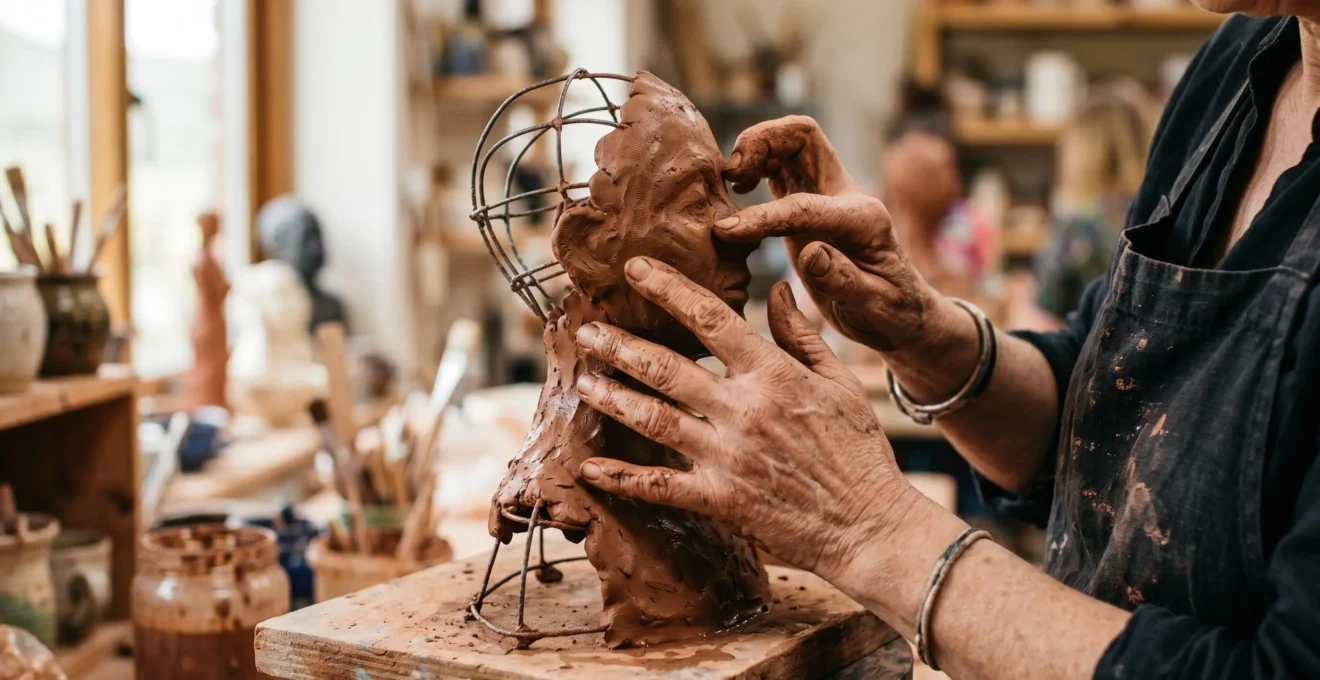
Progressing in sculpture isn’t about mastering one material; it’s about developing the ‘structural intelligence’ to bring ambitious forms to life in any medium.
- True mastery lies in understanding the internal architecture (the armature) and the external form as a single, interdependent system.
- Your choice of an additive (clay) or subtractive (stone) method reflects your fundamental creative mindset—whether you are an “explorer” or a “revealer” of form.
Recommendation: Shift your focus from just practicing techniques to actively analyzing the physical and aesthetic properties of materials to inform your creative decisions from the very start.
For many aspiring sculptors, the journey begins with excitement, a block of clay, and a handful of tools. You master basic forms, perhaps a simple figure or a piece of pottery. But then, a plateau arrives. Your work feels static, lacking the dynamic presence or complex detail you admire in the pieces of masters. The ambition to create something truly bold and intricate is there, but the bridge from a simple shape to a complex, stable, and expressive sculpture seems impossibly long. You’re left wondering what the secret is. Is it a matter of more expensive tools? A different kind of clay?
The common advice often circles around familiar refrains: “just keep practicing,” “start with clay because it’s forgiving,” or “copy the great masters.” While valuable, this advice misses the fundamental cognitive leap required to progress. It focuses on the ‘what’ and not the ‘how’ or, more importantly, the ‘why’. The transition to advanced sculpture isn’t just a refinement of hand skills; it is a profound shift in thinking. It’s about moving beyond the surface and developing a deep, intuitive understanding of form, weight, balance, and material character.
But what if the true key wasn’t in mastering a single material, but in cultivating a form of ‘structural intelligence’? This is the ability to see the invisible skeleton within a form, to anticipate how a material will behave under stress, and to enter a dialogue with your medium, allowing its properties to guide your creation. This is the mindset that separates a hobbyist from an artist who can confidently tackle ambitious projects, whether in clay, stone, wood, or even fabric.
This article will guide you through the process of developing this crucial three-dimensional thinking. We will deconstruct the core principles that allow sculptors to move from basic forms to complex traditional techniques, exploring everything from material psychology to the engineering of a supportive armature. Prepare to transform not just what you make, but how you see.
Contents: A Guide to Advanced Three-Dimensional Thinking
- Why Material Choice Determines 80% of Your Sculpture’s Final Character?
- How to Build Armatures That Support Ambitious Sculptures Without Collapse?
- Clay Modelling vs Stone Carving: Which Sculptural Method Suits Your Creative Thinking?
- The Beginner Sculptor’s Mistake That Wastes £200 in Materials Per Project
- When Does Home Sculpture Practice Require Upgrading to Professional Studio Space?
- Why 100% Natural Fibres Aren’t Always Superior: The Fabric Blend Quality Truth?
- Why Solid Wood Frame Construction Outlasts Particleboard by 20+ Years and How to Spot the Difference?
- How to Select Well-Made Pieces That Transform Your Home into a Lasting, Cohesive Environment?
Why Material Choice Determines 80% of Your Sculpture’s Final Character?
In sculpture, the material is not a passive recipient of your creative idea; it is an active collaborator. An artist who ignores the inherent voice of their chosen medium is like a composer who ignores the timbre of their instruments. The decision to use bronze instead of marble, or clay instead of wood, is not merely a technical choice. It is a foundational aesthetic decision that dictates the sculpture’s texture, its relationship with light, its physical presence, and even how it will age over time. This is what we call the ‘material dialogue’—a conversation between artist and substance.
The choice of material is one of the most important decisions a sculptor makes, as it profoundly affects the final piece’s appearance, texture, and durability.
– Finest Sculpture, The Art of Sculpture: A Journey Through Time, Materials, and Techniques
Think of the difference between a highly polished marble figure and a rough-hewn oak carving of the same subject. The marble reflects light, suggesting purity, permanence, and a certain coldness. The wood absorbs light, conveying warmth, life, and a connection to nature. The subject may be identical, but the emotional and narrative impact is completely different. The material’s character becomes inseparable from the sculpture’s character.
This dialogue extends over decades and centuries. A fascinating example is the lost wax casting method for bronze. As detailed in an exploration of historical sculptural techniques, this ancient process creates works that develop a characteristic green patina over time. This chemical transformation of the surface is not a sign of decay but an integral part of its evolving beauty. By choosing bronze, the sculptor is choosing to incorporate the passage of time into the artwork itself. This demonstrates that structural intelligence begins with understanding that your material has a past, a present, and a future.
How to Build Armatures That Support Ambitious Sculptures Without Collapse?
As your sculptural ambitions grow, you will quickly move beyond small, self-supporting forms. For any sculpture of significant size, complexity, or with dynamic posing, an internal support structure—the armature—is not just helpful; it is essential. Thinking of the armature as mere “scaffolding” is a beginner’s mistake. A professional sculptor views the armature as the anatomical skeleton of the work, providing the foundational strength and defining the core gesture of the piece before a single gram of clay is applied.
Building a successful armature is an exercise in structural intelligence. It requires you to think like an engineer, considering load paths, centers of gravity, and torque. The goal is to create a structure that is both rigid enough to prevent sagging and collapse, yet light enough not to become unmanageably heavy. The materials are often simple—aluminum wire, steel pipes, wood—but the principles are complex. Joints must be secure, and the main “spine” of the armature must correctly transfer the weight of the entire piece down to its base.
As the image above masterfully illustrates, the most effective armatures often mimic organic structures found in nature. Notice how the wires twist and branch, not in random patterns, but in a way that suggests the load-bearing trabeculae of bone or the branching of a tree. This biomimetic approach is the pinnacle of armature design, creating maximum strength with minimal material. It is a visual representation of a sculptor thinking in three dimensions, planning the internal forces of their creation as carefully as the external form.
Your armature is the first, and most critical, sculptural act. A weak or poorly designed armature will doom a project from the start, no matter how skilled your modeling is. Conversely, a strong, dynamic armature provides a confident foundation upon which you can build, explore, and realize your most ambitious visions. It is the hidden hero of all great sculpture.
Clay Modelling vs Stone Carving: Which Sculptural Method Suits Your Creative Thinking?
The choice between an additive method like clay modeling and a subtractive method like stone carving is more than a technical preference; it’s a reflection of your creative psychology. Do you find form through experimentation and building up, or do you prefer to liberate a preconceived form from a solid block? Answering this question reveals your innate “sculptural mindset” and is key to finding the process that aligns with your thinking, minimizing frustration and maximizing creative flow.
The additive approach, working with pliable materials like clay, wax, or plaster, is the domain of the “Explorer” mindset. It is a process of discovery. You begin with an armature or a core and gradually add material, building up forms, testing shapes, and making changes. Mistakes are forgiving; if a proportion is wrong, you can simply remove a piece of clay or add more. This iterative process is highly intuitive and provides immediate tactile feedback, making it ideal for those who think with their hands and enjoy the freedom to change direction as the piece evolves.
The subtractive approach, working with hard materials like stone or wood, belongs to the “Revealer” mindset. This process is one of discipline and revelation. The sculptor believes the form already exists within the block of material, and their job is to chip away the excess to release it. Every action with the chisel is irreversible. This demands meticulous planning, foresight, and a clear vision from the outset. It is a methodical, high-stakes dialogue with the material, where each stroke is a permanent commitment.
To help clarify this distinction, a comparative analysis of these artistic methods provides a clear framework for understanding the cognitive and technical differences. The following table summarizes the core philosophies of each approach.
| Characteristic | Clay Modelling (Additive) | Stone Carving (Subtractive) |
|---|---|---|
| Cognitive Approach | Explorer mindset: discover form through building and experimentation | Revealer mindset: liberate pre-conceived form from within material |
| Error Correction | Highly forgiving: allows correction of mistakes and changing of design by adding or removing soft clay | Irreversible discipline: material once removed cannot be replaced, requires precise planning |
| Material Flexibility | Pliable materials (clay, wax, plaster) allow changes and refinements throughout process | Hard materials (stone, wood) require decisiveness and precision with each stroke |
| Working Philosophy | Building and creation: adding material to shape vision through iterative process | Reduction and revelation: removing excess until intended form emerges from block |
| Skill Development | Ideal for beginners: flexible and encouraging experimentation with immediate tactile feedback | Requires patience and mastery: unmatched discipline but steeper learning curve |
| Hybrid Application | Used for detailed maquettes to perfect form before committing to final material | Final execution method after clay prototyping for complex large-scale works |
Neither method is inherently superior. In fact, many professional sculptors use both, often creating detailed clay maquettes (an additive process) to perfect a design before committing it to stone (a subtractive process). Understanding which mindset you naturally gravitate towards is the first step in choosing the path that will best serve your artistic voice.
The Beginner Sculptor’s Mistake That Wastes £200 in Materials Per Project
Every aspiring artist fears wasting expensive materials. For the beginner sculptor, this fear often leads to a single, critical, and costly mistake: the material-technique mismatch. This occurs when a design is conceived and perfected in a forgiving medium like clay, but then the artist attempts to execute it in a demanding material like stone or wood without understanding the profound structural differences. The result is often catastrophic failure—cracks, breaks, and a beautiful idea that shatters along with a significant financial investment.
The problem is not the ambition to work with premium materials. The problem is a failure of structural intelligence. Clay allows for thin, delicate extensions and complex poses that are self-supporting on a small scale. These same forms, when scaled up in heavy stone or fibrous wood, create immense internal stress. A limb that was perfectly stable in clay can easily snap off in marble if the design does not account for the material’s weight and brittleness.
Case Study: The Material-Technique Mismatch
During the 19th and early 20th centuries, it was common for sculptors to create finished models in clay, which were then mechanically reproduced in stone by assistants using pointing machines. However, as noted in historical analyses of sculptural methods, this indirect process often led to lifeless copies. The designs were conceived for the logic of clay, not for the inherent character and structural demands of stone. Master sculptors eventually learned that a small clay maquette does not reveal the structural challenges of a larger work in a different material. This led to costly failures and a renewed appreciation for designing *for* the final material from the very beginning.
How do you avoid this expensive pitfall? The key is to use your initial models not just to perfect form, but to test structure. If you plan to carve in wood, create a small wooden maquette. Feel how the grain directs your tools. Discover its weak points. If you plan to cast in bronze, think about how the molten metal will flow. This practice of making small-scale technical maquettes in the final material, or a material with similar properties, is a crucial step. It bridges the gap between your vision and the physical reality of the medium, saving you from learning a very expensive lesson later on.
When Does Home Sculpture Practice Require Upgrading to Professional Studio Space?
The home studio is a wonderful incubator for creativity, but there comes a point in every serious sculptor’s journey where the limitations of a domestic space begin to stifle artistic growth. Recognizing when to make the leap to a professional or shared studio is a critical decision. It’s not just about having more room; it’s about unlocking new possibilities in scale, material, and safety that are simply unfeasible at home. This transition is often prompted by one of three critical triggers: scale, safety, or specialization.
The most obvious trigger is scale. Your ideas are getting bigger, but your doorways are not. When your sculptures become too large to maneuver through your home, or their weight begins to test the limits of a domestic floor, it’s a clear sign you’ve outgrown your space. Safety is an even more urgent consideration. Working with materials that produce toxic fumes, like resins, or processes that involve high fire risk, such as welding or casting, requires industrial-grade ventilation and safety protocols that a home studio cannot provide. Prioritizing your health is non-negotiable.
Finally, the trigger of specialization arises when your artistic vision demands equipment that is impractical for a home setting. You may dream of creating large ceramic pieces but lack space for a kiln, or wish to forge metal without a proper forge and anvil setup. A professional studio provides access to this specialized equipment, often on a shared basis, making advanced techniques accessible. Furthermore, a study highlighted by guides for emerging artists found that hobbyists who engaged with a community were 40% more likely to continue their practice, showing the immense motivational benefit of a shared space.
Action Plan: Auditing Your Home Workspace for Sculptural Growth
- Contact Points Assessment: List every sculptural activity you perform (sanding, carving, mixing, firing) and identify the “outputs” they generate: dust, fumes, noise, or waste. Where do these outputs go in your current space?
- Resource Collection: Inventory your current tools and materials. Now, list the tools and materials required for the next ambitious project you dream of making. Identify the gap in size, weight, or safety requirements.
- Coherence Check: Confront your artistic ambition with your physical limitations. Measure your largest planned piece against your doorframes and ceiling height. Does your workspace’s scale cohere with your creative goals?
- Emotional Impact Audit: Evaluate your workspace’s psychological effect. Does it feel like an inspiring creative sanctuary or a constant source of logistical stress and compromise? Be honest about how the space makes you feel.
- Integration Plan: Based on your audit, prioritize the single most critical upgrade needed to unlock your growth. Is it investing in professional ventilation (Safety), finding more square footage (Scale), or gaining access to a kiln or welder (Specialization)?
Why 100% Natural Fibres Aren’t Always Superior: The Fabric Blend Quality Truth?
A sculptor develops an intimate, hands-on knowledge of materials. This tactile expertise, this “material intelligence,” doesn’t switch off when they leave the studio. It becomes a lens through which they see the world. When a sculptor looks at draped fabric, they don’t just see a curtain or a piece of clothing; they see a form of soft sculpture. They analyze the weight of the folds, the tension in the creases, and how the material interacts with light—the very same principles they apply to clay or stone.
This perspective reveals a truth often missed in the mainstream obsession with “100% natural” materials: purity does not always equal quality or performance. In sculpture, some of the most enduring materials are alloys, not pure elements. Bronze, a blend of copper and tin, is far stronger and more durable than pure copper. The addition of tin fundamentally changes the material’s properties for the better.
The same principle applies to textiles. A high-quality fabric blend is the textile equivalent of an alloy. While a 100% linen fabric has a beautiful texture, blending it with a small amount of a synthetic fibre can drastically reduce wrinkling and increase its durability without sacrificing its aesthetic appeal. A touch of elastane can give a fabric the perfect amount of stretch to drape beautifully over a form, creating more dynamic folds. The sculptor’s eye understands that the goal isn’t material purity; it’s optimal performance for the intended form. A well-engineered blend is a testament to sophisticated material science, just as bronze is a testament to ancient metallurgy.
Therefore, when assessing a textile, apply your developing sculptural intelligence. Don’t just read the label for its composition; feel its weight, observe its drape, and consider its purpose. A slight blend might be the very thing that gives the fabric the strength and character to hold its sculptural form perfectly.
Why Solid Wood Frame Construction Outlasts Particleboard by 20+ Years and How to Spot the Difference?
The art of woodcarving is a deep dialogue between the artist and the tree it came from. As any sculptor who works with wood knows, you cannot simply impose your will upon it. You must learn to “read” the wood—to understand its grain, identify its knots, and respect its internal structure. This skill, born from the necessity of preventing a sculpture from cracking or splitting, is a form of structural intelligence that is directly transferable to assessing the quality and longevity of everyday objects, especially furniture.
Wood offers a warmth and natural texture that is unique among sculptural materials. While it’s less durable than stone or metal, wood is easily carved and has been used by cultures worldwide.
– Finest Sculpture, The Art of Sculpture: A Journey Through Time, Materials, and Techniques
Particleboard, the staple of cheap, flat-pack furniture, is the antithesis of this principle. It is composed of wood dust and chips compressed with adhesive. It has no grain, no internal structure, and no integrity. It is sculptural “noise.” Solid wood, by contrast, possesses a continuous grain—long fibers that run the length of the board, giving it immense tensile strength and resilience. This is why a solid wood frame can last for generations while a particleboard one may sag and disintegrate within a few years, especially when exposed to moisture.
So how does a sculptor’s eye spot the difference? You look for the same clues you would in a block of wood destined for carving. As outlined in a beginner’s guide to sculpture, reading the grain is paramount. In high-quality furniture, you should see continuous grain patterns that wrap around corners and extend across surfaces. On a tabletop, the end-grain pattern should be visible on the short sides. In particleboard, you will see a uniform, mottled texture or a printed-on, repetitive wood-effect pattern that looks unnaturally perfect. By learning to identify the honest, continuous lines of real wood grain, you are applying the same structural intelligence that a carver uses to ensure their creation will endure.
Key takeaways
- True sculptural progress stems from developing ‘structural intelligence,’ not just mastering one material.
- The choice between additive (clay) and subtractive (stone) methods is a psychological one, reflecting whether you are a creative “explorer” or “revealer.”
- You can apply a sculptor’s eye for material quality, form, and structure to improve choices in other domains, like furniture and textiles.
How to Select Well-Made Pieces That Transform Your Home into a Lasting, Cohesive Environment?
A sculptor does not simply create an object; they create an object that actively shapes the space around it. A well-placed sculpture commands attention, directs movement, and creates a focal point. This deep understanding of composition—the interplay between object (positive space) and emptiness (negative space)—is one of the most powerful skills you develop. It transforms not only your art but also your ability to curate your own living environment, turning a simple room into a cohesive and lasting personal gallery.
The mistake many people make in interior design is thinking in two dimensions. They match colors and arrange furniture against walls. A sculptor thinks in three dimensions. They consider how pieces relate to each other in space, creating a dialogue of materials and forms. It’s not about everything matching. It’s about creating a harmonious conversation: the rough texture of a stone piece might complement the smooth warmth of a wooden table, while the cool gleam of a metal lamp provides a contrasting accent. This is composing with texture, not just color.
To begin curating your home with a sculptor’s eye, you must learn to treat empty space as an active element. A well-made piece needs room to “breathe” visually. Overcrowding a space diminishes the power of every object within it. By strategically balancing mass and negative space, you allow individual pieces to command their own presence, creating a calm and intentional environment. The following principles, often used by artists, can be directly applied to home curation:
- Apply the Rule of Thirds to Room Composition: Visually divide your space into a 3×3 grid and place key furniture and sculptural pieces at the intersections to create natural focal points and guide the eye.
- Create a Material Dialogue: Instead of matching colors, establish cohesion through a textural conversation. Pair rough with smooth, warm with cool, and organic with manufactured to create a rich, multi-dimensional experience.
- Identify Your “Hero Piece”: For each room, select one signature anchor—a striking sculpture, a unique armchair, or a significant work of art. Build the surrounding environment to complement and support this central element, not compete with it.
- Use Strategic Lighting: Position pieces to interact dynamically with both natural and artificial light. A sculpture can be transformed by the direction and intensity of light, creating an evolving visual interest throughout the day.
- Balance Mass and Negative Space: Treat emptiness as a crucial design tool. Avoid overcrowding by allowing individual pieces visual breathing room, which enhances their presence and creates a more serene atmosphere.
Begin applying these principles of structural intelligence and material dialogue not just to your art, but to how you see the world around you. This shift in perception is the final step in your transformation, allowing you to not only create beautiful objects but to curate a beautiful and cohesive life.