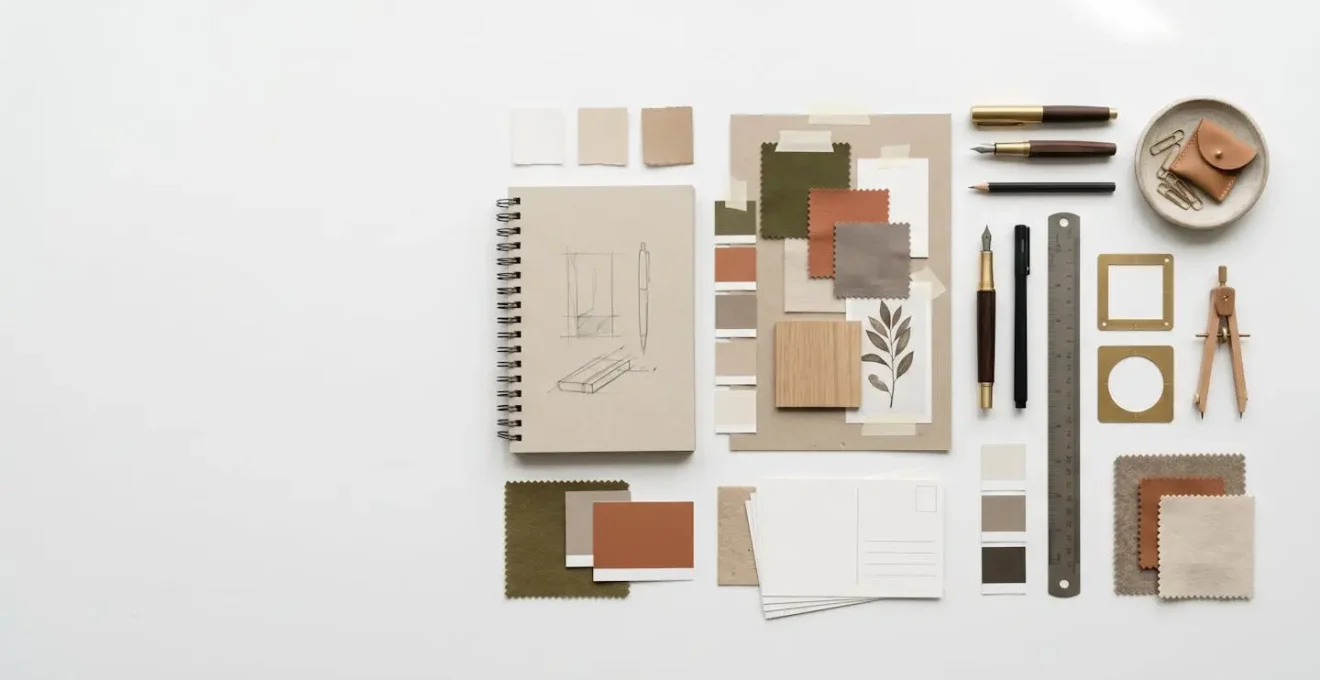
The core problem for many creatives isn’t a lack of skill, but a lack of a strategic system for differentiation, leading to competent but forgettable work.
- A signature style is not found, but engineered through deliberate deconstruction of influences and strategic rejection of what doesn’t align with your core vision.
- Consistency isn’t about repetition; it’s the vehicle for building brand trust and memory, directly impacting professional opportunities and revenue.
Recommendation: Stop passively consuming inspiration and start actively deconstructing it. Treat your aesthetic as your most valuable intellectual property and build a system to manage it.
In the crowded creative marketplace, technical competence is merely the price of entry. You can produce good work, meet deadlines, and satisfy clients, yet still feel a nagging sense of invisibility. Your portfolio is solid, but it could belong to anyone. This is the paradox of the modern creative: your work is competent but generic, blending into a sea of sameness. The common advice—”be authentic,” “find your voice”—rings hollow because it offers no practical roadmap. It mistakes the destination for the journey.
The belief that a signature style is a mystical gift bestowed upon a chosen few is the single most debilitating myth in our industry. It’s a passive approach that leaves your career to chance. The truth is far more empowering: a recognisable aesthetic is not found, it is engineered. It’s the result of a deliberate, strategic process of analysis, choice, and constraint. It involves understanding not just what to include, but, more importantly, what to reject. It’s about building a brand asset, not just making pretty pictures.
This guide abandons platitudes and provides a strategic framework for creative differentiation. We will dissect the reasons your work looks like everyone else’s and provide a methodology to build a style that is both unique and adaptable. We will explore the tension between trends and timelessness, the mechanics of evolving your aesthetic without alienating your audience, and finally, how to package this unique identity into a portfolio that doesn’t just showcase your skills, but wins you the opportunities you deserve.
Summary: A Consultant’s Framework for Building a Recognisable Creative Identity
- Why Your Work Looks Like Everyone Else’s: The 5 Missing Elements of Signature Style
- How to Evolve Your Signature Aesthetic Without Confusing Your Established Audience?
- Following Design Trends vs Building Timeless Aesthetic: Which Strategy for Long-Term Recognition?
- The Influence Absorption Problem That Stops 90% of Creatives from Finding Their Voice
- When Does Signature Style Become Creative Limitation: The 3 Warning Signs?
- How to Sequence Your Portfolio So Reviewers See Growth Rather Than Inconsistency?
- Why Inconsistent Visual Content Undermines Trust Even When the Message Is Strong?
- How to Curate a Comprehensive Portfolio That Wins Professional Opportunities?
Why Your Work Looks Like Everyone Else’s: The 5 Missing Elements of Signature Style
The root of generic work isn’t a lack of talent; it’s a lack of a defined creative system. You’re likely trapped in a cycle of passive influence absorption, where trends and popular aesthetics seep into your output without conscious filtering. A true signature style is built on a foundation of deliberate choices and non-negotiable principles. It’s less about a “look” and more about a consistent problem-solving methodology. Without this, your work defaults to the mean, echoing the visual language of the moment rather than establishing your own.
The critical missing element is often strategic rejection. Most creatives focus on what to add—a new technique, a trendy colour palette—but the masters define their style by what they consistently leave out. This discipline creates the negative space that allows your core ideas to stand out. Another missing piece is a formalised creative manifesto: a written document outlining your artistic rules, goals, and values. This transforms vague feelings about your work into a concrete operational guide. In an age of artificial intelligence, where even algorithms can be fingerprinted, developing a human-centric, defensible style is no longer a luxury, but a necessity for relevance. In fact, research published in Nature demonstrates that even advanced AI-generated content retains detectable stylistic signatures, underscoring the intrinsic value and possibility of cultivating a unique human one.
To move from generic to signature, you must shift from being an aesthetic consumer to an aesthetic engineer. This involves dissecting your own process, codifying your instincts, and building a repeatable framework that ensures every piece of work, no matter the subject, bears your unmistakable creative DNA.
How to Evolve Your Signature Aesthetic Without Confusing Your Established Audience?
The fear of becoming creatively stagnant is real, but so is the risk of alienating an audience you’ve worked hard to build. Evolving your aesthetic is not about radical, overnight transformation; it’s about controlled evolution. The key is to identify your “creative DNA”—the core, non-negotiable elements of your style—and use them as an anchor while allowing other, more superficial elements to pivot and adapt. This “anchor and pivot” approach creates visual and conceptual continuity, signaling growth rather than schizophrenia.
An anchor could be a specific approach to composition, a philosophical underpinning, a recurring thematic concern, or a signature colour theory. The pivot elements are more flexible: subject matter, medium, or the adoption of new tools. By keeping the anchor consistent, you provide a familiar through-line for your audience, allowing them to follow your journey. You are teaching them how to read your new work through the lens of your old work. This strategy ensures your body of work feels like a cohesive, developing narrative, not a collection of disjointed experiments.
Case Study: The Sesame Street Rebrand’s “Anchor and Pivot” Strategy
When faced with unifying the identities of Sesame Street and its parent non-profit, Sesame Workshop, the design firm Trollbäck+Company needed to evolve the brand without losing its iconic feel. They chose typography as their anchor. As detailed in a Creative Boom analysis of type trends, they used a broad type family that could unify both brands under one system while allowing each to have its own distinct voice. This demonstrates how a single, core element (the typographic system) can anchor an entire brand architecture, enabling other visual components to evolve without causing audience confusion.
This principle is articulated perfectly by Rosie, a designer at the firm who worked on the project:
Type families with diverse weights and styles help unify complicated and layered brand architecture systems under a single shared typeface. Typography plays a major role in creating attribution across many pieces of communication.
– Rosie (Trollbäck+Company designer), Creative Boom Type Trends 2024 Analysis
This approach shows that evolution doesn’t have to mean erasure. By strategically anchoring your core aesthetic, you earn the creative freedom to explore and grow, taking your audience with you.
Following Design Trends vs Building Timeless Aesthetic: Which Strategy for Long-Term Recognition?
The creative world is locked in a constant battle between the ephemeral and the eternal. Chasing design trends offers the immediate gratification of relevance, making your work feel current and marketable. However, it’s a high-risk strategy that tethers your aesthetic’s value to a fleeting moment. Work built purely on trends becomes dated almost as quickly as it was created, turning your portfolio into a graveyard of past fads. Conversely, a relentless pursuit of “timelessness” can lead to work that is safe, sterile, and disconnected from the contemporary cultural conversation.
The optimal strategy for long-term recognition is not an either/or choice but a strategic synthesis. Think of it as the 80/20 rule of aesthetics. Your work should be built on a foundation that is 80% timeless—grounded in fundamental principles of composition, colour theory, storytelling, and emotional resonance. These are the elements that speak to the human condition, independent of technology or trend. The remaining 20% is your “trend budget.” This is where you can consciously engage with current aesthetics, using them as a spice to add flavour and context to your work, not as the main ingredient.
This approach allows you to remain part of the conversation without becoming a victim of it. As the Buffer Design Team advises, the key is to be selective and authentic in your adoption of trends. Use them to “weave compelling narratives that resonate with your audience on a deeper level,” not just as superficial decoration. By grounding your work in a solid, timeless core, you ensure it has enduring value, while the strategic use of contemporary elements proves you are an active and engaged participant in the present.
The Influence Absorption Problem That Stops 90% of Creatives from Finding Their Voice
The most significant barrier to developing a signature style isn’t a lack of inspiration; it’s an over-consumption of it. Creatives are inundated with a firehose of polished work on platforms like Pinterest, Instagram, and Behance. This constant, passive exposure leads to “Influence Absorption,” a state where the aesthetics of others are internalized so deeply that they overwrite your own nascent creative impulses. You stop creating from an internal source and begin arranging pieces of what you’ve seen. Your brain, seeking efficiency, defaults to these well-worn visual paths, resulting in work that is a pale imitation rather than a genuine expression.
Breaking this cycle requires a radical shift from passive consumption to active deconstruction. Instead of just “liking” a piece of work, you must treat it like a specimen in a lab. What problem was the creator trying to solve? What fundamental principles (of rhythm, tension, value, hierarchy) did they use? How did they lead the viewer’s eye? This analytical process moves you beyond surface-level admiration (“that’s a cool filter”) to a deep understanding of the underlying mechanics. It’s the difference between copying a sentence in a foreign language and actually learning the grammar.
The goal is to build an internal library of principles, not a folder of images to copy. This requires discipline, including periods of deliberate “influence fasting” to clear your head and force your brain to generate its own solutions. By dissecting the work you love—and even the work you hate—you define the boundaries of your own voice, turning unconscious influence into a set of conscious, strategic tools.
Your Action Plan: Deconstructing Influence to Find Your Voice
- Identify the Core Problem: Before examining the solution, analyze the design challenge tackled in a piece of work you admire. What was the core communication objective?
- Trace the Logic: Reveal the relationship between the problem and the final design. Instead of copying surface aesthetics, trace the creator’s decision-making process.
- Map the Process: Visually represent the journey from concept to completion. Deconstruct *how* they built their solution, not just *what* they built.
- Extract the Principles: Isolate the fundamental rules at play—tension, rhythm, value structure, negative space. Move beyond the specific execution to the underlying theory.
- Implement an “Influence Fast”: Deliberately block all consumption of creative work from your direct field for a set period (e.g., 30 days) to force reliance on internal ideation.
When Does Signature Style Become Creative Limitation: The 3 Warning Signs?
A signature style is a powerful asset, but there’s a fine line between a distinctive voice and a creative prison. When consistency calcifies into rigidity, your greatest strength becomes a limitation that stifles growth and makes you irrelevant. This happens when you stop using your style as a lens to interpret the world and start using it as a shield to avoid new challenges. Brand consistency is a powerful amplifier of creativity, but it is not a substitute for it. The goal is a living, breathing aesthetic, not a set of golden handcuffs.
Recognizing the warning signs is critical. The first is predictability. If you, your clients, and your audience can predict exactly what your solution to a new problem will look like before you even begin, your style has become a formula. The second sign is problem avoidance. You start turning down or struggling with projects that don’t fit neatly into your established aesthetic. Instead of adapting your style to solve the problem, you’re looking for problems that fit your style. The third and most dangerous sign is diminishing returns on praise. You’re still getting complimented, but the praise is for executing your style flawlessly, not for a clever solution or an insightful idea. The conversation has shifted from the “what” and “why” of your work to just the “how.”
Research confirms that while consistency is beneficial, it’s not a magic bullet. For instance, according to System1 and IPA research, the most consistent brands saw a tangible increase in their creative quality scores over five years, while the least consistent saw no growth. However, as the Contagious research team points out, this consistency only amplifies *good* creativity; it can’t save a weak underlying concept or revitalize a declining brand. This means your style must be a platform for strong ideas, not a replacement for them.
How to Sequence Your Portfolio So Reviewers See Growth Rather Than Inconsistency?
A portfolio is not an archive; it’s a narrative. And the most common mistake creatives make is letting chronology dictate that story. A chronological sequence often highlights stylistic shifts as jarring inconsistencies rather than deliberate growth. To a busy reviewer, this can read as a lack of focus or a “jack of all trades, master of none” profile. The solution is to abandon the timeline and become a curator, sequencing your projects to tell a specific, compelling story about your value.
The most effective strategy is to sequence for narrative arc. Start with a powerful, representative piece that establishes your core competency (the “inciting incident”). Follow this with projects that demonstrate your range and problem-solving abilities. A stylistically different piece should be framed not as an outlier, but as a “deliberate experiment.” Accompany it with a brief case study explaining your hypothesis, process, and what you learned. This transforms a potential weakness into a demonstrated strength: intellectual curiosity and strategic risk-taking.
Another powerful sequencing method is the “Bookend Strategy.” Start and end your portfolio with two pieces that, while visually distinct, are rooted in the same core philosophy or solve a similar problem in different ways. This creates a satisfying sense of closure and demonstrates a deep, consistent thought process beneath a versatile visual execution. By consciously structuring the order, you guide the reviewer’s perception, ensuring they see a story of skill acquisition and thematic deepening, not a random collection of past work.
Key Takeaways
- A signature style is an engineered brand asset, not a mystical gift. It requires a strategic system of deconstruction and rejection.
- Visual consistency is the primary driver of brand trust and memory recall. Inconsistency actively undermines your message, regardless of its strength.
- Curate your portfolio as a narrative of growth and skill, not a chronological archive. Sequence projects to tell a story about your value.
Why Inconsistent Visual Content Undermines Trust Even When the Message Is Strong?
In the digital realm, trust is the ultimate currency, and it is built or broken in milliseconds. Before a visitor reads a single word of your carefully crafted message, they have already made a snap judgment based on your visual presentation. Inconsistent visual content—clashing fonts, a chaotic color palette, or erratic image styles—creates a subtle but powerful feeling of cognitive dissonance. It signals a lack of professionalism and attention to detail, leading the user to subconsciously question the credibility of the entire operation. If the surface is messy, what does that say about the substance underneath?
This is not just a feeling; it’s a measurable phenomenon. The “memory threshold” is the point at which a consumer has seen a brand 5-7 times and can finally remember and recognize it. Visual consistency is the most efficient lever for reaching this threshold. Every inconsistent touchpoint resets the counter, wasting your marketing and communication efforts. The numbers are stark: studies indicate that 94% of first impressions are design-related, with opinions forming almost instantly. This initial visual judgment forms a powerful bias that colours all subsequent interactions.
The financial implications are just as clear. Building a consistent brand experience is directly tied to revenue. It’s not an expense; it’s an investment in brand equity. For example, comprehensive research from Amra and Elma LLC demonstrates that companies with strong visual consistency across their platforms can see a revenue lift of up to 23%. This proves that a cohesive signature aesthetic is not a matter of artistic vanity. It is a fundamental business strategy that builds trust, accelerates recognition, and directly contributes to the bottom line.
How to Curate a Comprehensive Portfolio That Wins Professional Opportunities?
Your portfolio is your single most important marketing asset. Its purpose is not to show everything you’ve ever done, but to present a compelling, evidence-based argument for why you are the right person for a specific opportunity. A winning portfolio is an act of radical editing and strategic curation. The guiding principle should be “less, but better.” It’s far more powerful to show 5-8 projects that are deeply explained and tied to results than 20 projects with no context. This discipline signals to reviewers that you understand what matters and can separate the signal from the noise.
The curation process should demonstrate what is known as T-shaped expertise. This means showcasing deep, world-class skill in one signature niche (the vertical bar of the “T”) while also showing competent breadth in a few related areas (the horizontal bar). This structure positions you as a specialist with valuable versatility, not a generalist. Furthermore, your project selection should include not just your “best work” in terms of visual polish, but also your “best fit” work—projects that demonstrate your strategic thinking, your ability to navigate complex client feedback, or your process for solving a difficult problem. These process-oriented stories are often more valuable to a potential employer than a perfect final image.
Finally, every project included must be connected to a result. You didn’t just design a website; you designed a website that increased user engagement by 15%. You didn’t just create a brand identity; you created an identity that helped a new product achieve clear market positioning. Connecting your creative work to measurable business outcomes elevates your portfolio from a collection of artifacts to a series of compelling case studies. It transforms you from a creative vendor into a strategic partner, which is the ultimate key to winning high-value professional opportunities.
By shifting from a passive creator to a strategic aesthetic engineer, you take control of your creative identity. Start today by deconstructing one piece of work you admire not for what it looks like, but for how it works. This is the first step in building a body of work that is not just competent, but unforgettably yours.