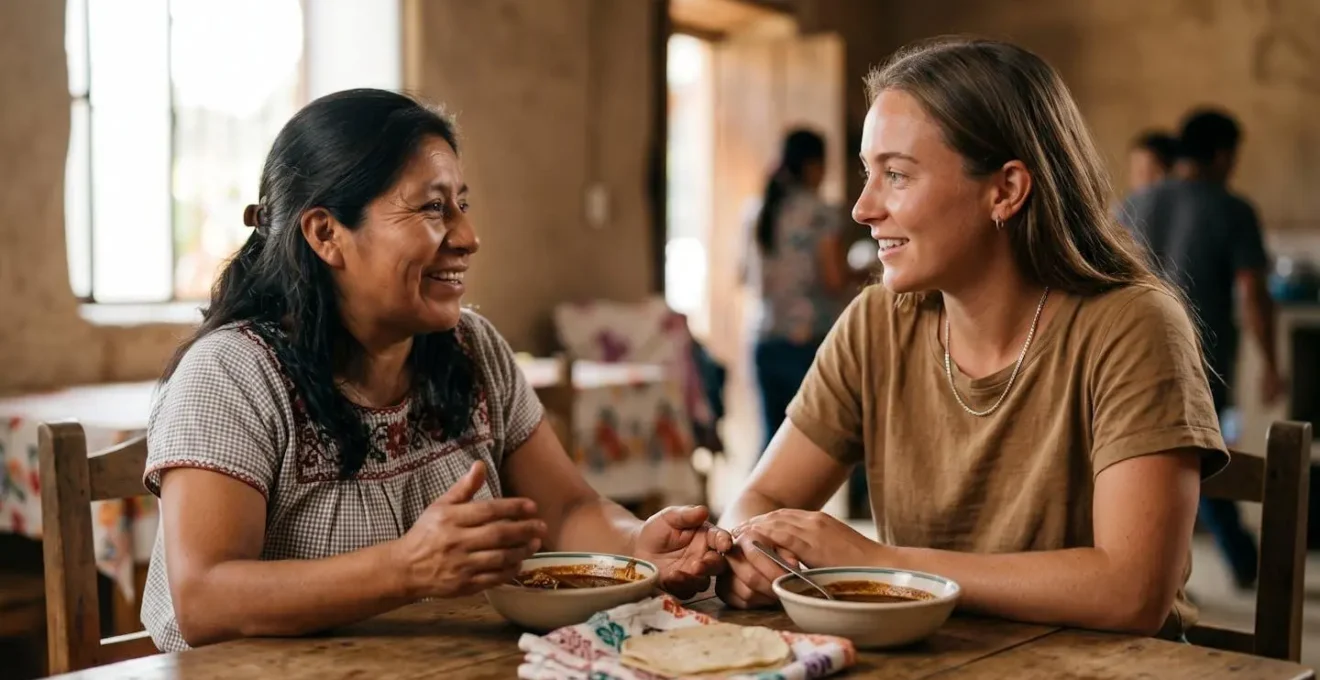
The key to meaningful travel isn’t a checklist of actions, but a psychological shift toward creating the conditions for authentic connection to emerge naturally.
- Surface-level interactions often stem from misaligned social rhythms and the pressure to perform a “traveler” role.
- Genuine bonds are built on a foundation of shared purpose, intentional presence, and reciprocal vulnerability, not forced friendliness.
Recommendation: Shift your focus from “what to do” to “how to be.” Prioritize collaborative activities and environments that allow for genuine self-expression over simply collecting destinations.
For many mindful explorers, the greatest souvenir isn’t a trinket, but a memory of a shared laugh, a deep conversation, or a moment of genuine understanding with someone from another walk of life. Yet, despite this deep-seated desire, our travel experiences often fall short. We collect photos and see the sights, but the human connections remain frustratingly superficial, leaving us feeling more like spectators than participants in the life of a place. We are told to “learn a few local phrases” or “get off the beaten path,” but these actions often feel like checking boxes rather than opening doors.
These well-meaning tips treat connection as a transactional outcome, a prize to be won through the right performance. But what if this entire approach is flawed? The truth is, authentic connection is not a travel hack. It cannot be forced, scheduled, or optimized. It is an emergent property of creating the right internal and external conditions. It’s less about what you do and more about how you show up—with intentional presence, genuine curiosity, and a willingness to be vulnerable.
This guide moves beyond the platitudes to explore the psychology of connection. We will deconstruct the hidden barriers that keep interactions shallow, explore how to create a space for authenticity to flourish without being intrusive, and analyze how the very structure of our travels can support or sabotage our goal. Ultimately, you will learn to cultivate a state of being that invites connection, whether you’re halfway across the world or exploring the hidden corners of your own city.
To help you navigate this journey from surface-level tourism to deep human connection, this article is structured to build from the foundational ‘why’ to the practical ‘how’. The following sections will guide you through each critical stage of this transformative process.
Summary: From Tourist to Connection-Seeker
- Why Traveller-Local Interactions Usually Stay Superficial Even When Both Parties Want More?
- How to Create Conditions for Authentic Connection Without Being Intrusive or Naive?
- Solo Travel, Small Group Tours or Homestays: Which Format Best Supports Authentic Human Connection?
- Why Suppressing Personal Expression for Social Acceptance Leads to Burnout Within 18 Months?
- The Danger of Performing “Meaningful Connection” for Content Rather Than Living It
- How to Maintain Genuine Cross-Cultural Friendships Beyond the Duration of Your Stay?
- Why Most “Cultural” Experiences in the UK Remain Surface-Level Tourism?
- How to Experience Genuine Cultural Immersion Without Long-Haul Travel?
Why Traveller-Local Interactions Usually Stay Superficial Even When Both Parties Want More?
The yearning for connection during travel is often a two-way street, yet the bridge between traveler and local frequently remains uncrossed. The reasons are less about a lack of interest and more about fundamental mismatches in logistics, social patterns, and psychology. We operate in different orbits, even when sharing the same physical space. In fact, deep research on movement patterns shows that travelers and locals consistently visit distinct locations within major cities, creating parallel universes rather than a shared community.
This separation is compounded by a difference in purpose. A traveler’s time is finite and often focused on discovery, while a local’s time is woven into the fabric of daily life—work, errands, and established social routines. A friendly but fleeting question from a tourist may be a welcome diversion, but it rarely has the space to evolve into something deeper amidst the demands of a normal day. There is an inherent power imbalance; the traveler is on a quest, while the local is simply living. This dynamic can unintentionally place the local in the role of a “cultural exhibit” or service provider, a position that inherently stifles peer-to-peer connection.
Furthermore, we misread social cues. As travel expert Samantha Brown notes, in many cultures, “Locals tend to do a lot alone, like going out to eat.” A solo traveler who mirrors this behavior by dining alone with a book might actually be fitting into the local scene more naturally than a large group seeking interaction. The desire to “meet locals” can lead to behaviors that are, ironically, out of sync with how locals actually socialize, creating a barrier of perceived difference that keeps relationships polite but shallow.
How to Create Conditions for Authentic Connection Without Being Intrusive or Naive?
The secret to fostering authentic connection lies not in forcing interactions but in cultivating an environment where it can bloom organically. This requires shifting from a mindset of “getting” a connection to one of “giving” your presence and creating a space of psychological safety. The goal is to move away from transactional tourism and toward collaborative experiences grounded in a shared purpose. When you and a local are working toward a common goal, the artificial roles of “traveler” and “host” dissolve, replaced by the more genuine roles of “partners” or “teammates.”
This approach naturally answers the common fear of being intrusive. When you join a cooking class, a community garden project, or a local workshop, your presence is legitimized by the activity itself. You are there to contribute, learn, and participate, not just to observe or extract an “authentic experience.” This shared context provides a natural, low-pressure framework for conversation and mutual discovery. The focus is on the task at hand, allowing personalities and stories to emerge at their own pace.
This principle of shared purpose is the engine behind some of the most impactful travel experiences, as it replaces passive observation with active collaboration.
As the image above suggests, when hands and minds are engaged in a mutual project, walls come down. The interaction is no longer about one person performing for another; it’s about creating something together. This builds a foundation of shared memory and respect that is far more durable than a simple conversation. It’s in these moments of co-creation that reciprocal vulnerability feels safe, and true connection can take root.
Case Study: G Adventures’ Victoria Falls Cultural Exchange
In a prime example of shared purpose, travelers in Victoria Falls, Zimbabwe, don’t just visit a local village; they participate in its daily life. They join local families at a bustling market to select ingredients, then work together to prepare a traditional Zimbabwean meal. The connection happens not through a staged performance, but over the chopping board and the cooking pot. During the shared meal that follows, stories are exchanged naturally, as equals who have just accomplished something together. This transforms the encounter from a tourist transaction into a genuine, collaborative human experience.
Solo Travel, Small Group Tours or Homestays: Which Format Best Supports Authentic Human Connection?
The structure of your journey profoundly influences the types of connections you can make. Each format—solo travel, small group tours, and homestays—offers a different architecture for human interaction, with unique strengths and weaknesses. There is no single “best” way; the ideal choice depends on your personality, confidence level, and specific connection goals. Are you seeking deep immersion with a few individuals, or broader connections with fellow travelers?
Solo travel offers the highest potential for spontaneous, one-on-one connections with locals. As an individual, you are more approachable and less intimidating than a group. You are a blank slate, free to be invited into situations that would never accommodate a tour bus. However, this path requires significant proactivity and emotional resilience. You are solely responsible for initiating contact, navigating social cues, and dealing with potential loneliness. It is the high-risk, high-reward path to local immersion.
Small group tours, conversely, excel at fostering connections with other travelers. The shared itinerary and experiences create a powerful, accelerated bonding environment. As Carolyn Ray, CEO of JourneyWoman, observes, group trips can also be a fantastic way to “‘practice’ traveling solo.” They provide a safety net and a built-in community, which can build the confidence needed for a future solo adventure. The trade-off is that the group itself can become a “bubble,” making it harder to break out and connect deeply with locals beyond the tour guide.
A homestay offers a direct line to a specific local unit: the host family. This format provides an unparalleled opportunity for deep immersion into the daily rhythms, language, and customs of one household. However, this connection can sometimes feel performative, with both host and guest playing their expected roles. It also largely isolates you from other travelers and the broader community. The following table breaks down these dynamics:
| Travel Format | Connection with Locals | Connection with Travelers | Best For |
|---|---|---|---|
| Solo Travel | High potential – easier for locals to approach individuals | Low to Medium – requires proactive effort | Confident travelers seeking spontaneous local immersion |
| Small Group Tours (10-18 people) | Medium – guide facilitates but group creates barrier | High – shared experiences build bonds quickly | First-time travelers, those building confidence |
| Homestay | High with host family – can be performative | Very Low – isolated from other travelers | Deep dive with one local unit, language learners |
Why Suppressing Personal Expression for Social Acceptance Leads to Burnout Within 18 Months?
While the context of this question is often corporate, its principle is profoundly relevant to the mindful traveler. The pressure to fit in—to be the “right” kind of tourist, to get the “right” kind of photos, to have the “right” kind of experiences—can lead us to suppress our genuine selves. We trade our unique interests and quirks for a generic, socially acceptable travel persona. This act of self-suppression, of constantly performing a role, is emotionally exhausting and the very antithesis of authentic connection.
When you hide the things that truly make you *you*—whether it’s a passion for brutalist architecture, a love for quiet bird-watching, or a quirky sense of humor—you rob yourself of the opportunity to connect with people who share those specific passions. You end up having surface-level conversations that cater to the persona you’re projecting, not the person you are. This constant monitoring and adjusting of your behavior is a form of emotional labor that, over an extended trip or repeated travels, leads to a distinct form of “travel burnout.” The joy of discovery is replaced by the fatigue of performance.
True connection is sparked by the specific, not the generic. It’s when you’re unapologetically engaged in your niche hobby in a foreign park that someone with a shared interest might approach you. As a profile on travel filmmaker Malini Angelica notes, the goal is to get “under the skin of a place, letting its culture, food, and history unfold naturally.” This can only happen when you are also letting your own true nature unfold.
Authenticity is magnetic. Engaging in your own passions with intentional presence creates an aura of genuine engagement that is far more inviting than forced friendliness. It signals that you are not just a consumer of experiences but a person with a rich inner world, making you infinitely more interesting to connect with on a deeper level. Giving yourself permission to be fully yourself is the most powerful tool for connection you have.
The Danger of Performing “Meaningful Connection” for Content Rather Than Living It
In the age of social media, a new and insidious barrier to authentic connection has emerged: the performativity trap. The line between experiencing a moment and capturing it for an audience has become dangerously blurred. When the primary motivation for an interaction is to generate “content,” the interaction itself is compromised. It ceases to be a genuine human exchange and becomes a scene in a movie where you are both the actor and director. The other person is demoted from a fellow human to a prop in your travel narrative.
This isn’t just a cynical take; it’s a documented phenomenon. Recent data reveals that 40% of Millennials pick travel destinations based on how “Instagrammable” the pictures will be. The destination itself is secondary to the content it can produce. This mindset inevitably extends to interactions. The smiling local, the shared meal, the “authentic” craft—they become items on a content checklist. The pressure to capture the perfect, aesthetically pleasing moment of “connection” prevents you from being present enough to actually live it.
It is widely acknowledged that sharing travel experiences on social networks is performative. Tourists seek acceptance within social media communities by providing anticipated content.
– Dr. Xiao Qian, Journal of Hospitality & Tourism Research
Paradoxically, many believe this documentation enhances the experience. A separate study found that over 55% of global luxury travelers believe capturing social media content helps them enjoy a more meaningful trip. This highlights a critical confusion between *documenting* a meaningful experience and *having* one. The act of framing, filtering, and curating a moment for an external audience fundamentally alters your presence within that moment. Your focus shifts from the person in front of you to the imagined audience who will later view the photo or video. This is the essence of the performativity trap: you’re so busy proving you’re having a good time that you forget to actually have one.
How to Maintain Genuine Cross-Cultural Friendships Beyond the Duration of Your Stay?
The bittersweet reality of travel is that even the most profound connections are often fleeting. The challenge lies in transitioning a “travel friendship,” born of a specific time and place, into a durable, long-distance relationship. Vague promises to “keep in touch” rarely survive the return to normal life. Sustaining these bonds requires intentional, proactive effort, and an understanding that friendship maintenance strategies themselves can be culturally specific.
Fascinating research into friendship maintenance across cultures reveals that behaviors we might consider standard are not universal. In societies with high relational mobility (typically more individualistic, where people frequently choose and change their social circles), individuals tend to be more proactive in maintaining friendships. They engage in more self-disclosure and provide more active support, as these relationships are seen as voluntary commitments that require tending. This insight is crucial: if you come from such a culture, you may need to be the one to initiate and maintain contact, as your new friend’s cultural context may not have the same norms around proactive friendship labor.
The key is to replace vague sentiment with concrete, reciprocal rituals. Instead of a generic “how are you?” message, share a specific memory of your time together. Send a photo of something that reminded you of them. Establish small, ongoing exchanges that acknowledge the shift in your dynamic from traveler/host to peers. Acknowledge that the context has changed, and the effort must now be mutual and deliberate. Building and maintaining this bridge requires a clear plan of action.
Your Action Plan: Maintaining Cross-Cultural Friendships
- Trust-Building First Moves: Be more proactive in reaching out first. Don’t wait for them to make contact, as patterns of who initiates can vary greatly across cultures.
- Consistent Self-Disclosure: Don’t just “check in.” Share meaningful personal updates, photos, or stories consistently to maintain emotional closeness despite the physical distance.
- Active Support Provision: Offer tangible help that bridges the gap. This could be sending an article you think they’d like, offering to help with language practice, or connecting them with a resource in your country.
- Acknowledge the New Context: Verbally or in writing, recognize that the dynamic has shifted. A simple “I really value our friendship beyond just my time in your country” can be powerful.
- Establish Reciprocity Rituals: Create small, concrete, ongoing exchanges. Agree to send each other a song you’re listening to once a month, or share a photo of your breakfast every Friday. These small rituals build a durable connection.
Key Takeaways
- Authentic connection is a result of cultivating the right psychological conditions, not performing a set of actions.
- Shared purpose is the most effective tool for dissolving the artificial “traveler-local” barrier and fostering genuine peer-to-peer bonds.
- The pressure to create content for social media is a primary saboteur of presence, turning potential connections into performative acts.
Why Most “Cultural” Experiences in the UK Remain Surface-Level Tourism?
The United Kingdom, with its rich history and highly developed tourism infrastructure, offers a perfect case study for a common paradox: the more streamlined the tourist experience, the harder it can be to find genuine cultural immersion. Many “cultural” experiences are packaged, polished, and presented for mass consumption, creating a protective but ultimately insulating bubble around the traveler. You see the culture, but you don’t touch it; you don’t participate in its messy, vibrant, everyday reality.
This phenomenon isn’t unique to the UK but is particularly pronounced in destinations with a mature tourism industry. The infrastructure designed to make travel easy—efficient transport, multilingual guides, designated photo spots—inadvertently creates a separate track for tourists that runs parallel to, but rarely intersects with, local life. As one analysis notes, “You don’t need to be an ascetic backpacker or a superficial tourist to have an authentic adventure.” The middle ground, however, is often obscured by the tourism machine.
The very existence of this infrastructure can make unmediated experiences inaccessible. For instance, a tour company might have the long-standing relationships needed to arrange a meal in a remote village in Malawi or a stay in an Ecuadorian rainforest community with no public transport. For an independent traveler, these places would be nearly impossible to access. In this sense, the “beaten path” in a place like the UK is not just a popular route; it’s a powerful system that can limit access to the living culture that exists just beyond its reach. The more an experience is labeled and sold as “authentic,” the more likely it is to be a performance of culture, not culture itself.
How to Experience Genuine Cultural Immersion Without Long-Haul Travel?
The principles of fostering authentic connection are not exclusive to exotic, faraway lands. The same mindset and strategies can be applied to uncover deep cultural immersion right in your own city or region—a concept often called a “staycation” or local exploration. The post-pandemic renewed desire for connection is not just about meeting people abroad; it’s about a fundamental human need to connect with those around us, wherever we are.
The key is to adopt a traveler’s mindset of curiosity and intentionality and apply it to your local environment. This means breaking out of your routine and seeing the familiar with fresh eyes. Instead of being a passive resident, become an active explorer. This often involves slowing down and embracing a “less is more” philosophy. Rather than rushing to see everything, choose one neighborhood, one community, or one subculture and immerse yourself in its rhythms.
To do this effectively, you can apply several powerful strategies:
- Become a Regular: Choose one local, non-chain café, pub, or community space and visit consistently. By showing up at the same time and being a friendly, low-key presence, you shift from a stranger to a familiar face, opening the door for organic conversation.
- Seek Shared Purpose Activities: The most powerful tool for connection works just as well at home. Join a local choir, a volunteer project, a community garden, or a sports league. Working alongside your neighbors toward a common goal is the fastest way to build real bonds.
- Follow Local Journalism: Read neighborhood blogs, hyper-local news sites, or community newsletters. This will attune you to the real, ongoing stories, struggles, and celebrations of a place, far from the generic narratives of mainstream media.
- Embrace Solo Activities: Just as when traveling, participating in activities alone—visiting a small museum, attending a lecture, or dining at a counter—makes you more approachable and mirrors the patterns of local life, increasing the chances of spontaneous connection.
By applying these techniques, you transform from a resident who simply occupies a space into a community member who participates in its life. You discover that “culture” isn’t something that only exists overseas; it’s in the stories of the baker at your local market, the passions of the people at your local park, and the history of the streets you walk every day.
The journey to authentic connection begins with a single, intentional step. Start today by applying one of these principles to your local community or your next trip, and watch how the world opens up in response.