Genuine cultural immersion in the UK has nothing to do with finding ‘authentic’ attractions.
- It’s about shifting from a passive consumer of culture to an active contributor within a community.
- True connection is found by participating in ‘living heritage’—local skills, food systems, and social hubs.
Recommendation: Start by choosing one local area as your ‘anchor’ and becoming a ‘temporary regular’ to build familiarity and trust.
You return from a weekend away in a different part of the country. You saw the cathedral, walked the famous high street, and even ate at a well-reviewed gastropub. Yet, there’s a nagging feeling that you merely skimmed the surface, that you observed the place through a pane of glass without ever truly touching it. You’re not alone. The desire for meaningful connection is universal, but the path to achieving it, especially close to home, often feels obscured by the machinery of tourism.
The standard advice—visit museums, attend festivals, “talk to the locals”—while well-intentioned, often reinforces the very separation we seek to overcome. These activities can position us as passive spectators consuming a performance of culture, rather than participants within its living fabric. We are handed a script: the curious tourist and the patient local, a dynamic that rarely fosters deep, reciprocal connection. This leaves many curious UK residents feeling that profound cultural experiences are reserved for distant, exotic lands.
But what if the key to genuine immersion isn’t about *where* you go, but *how* you show up? What if the most profound cultural encounters are waiting in the community workshops, local allotments, and heritage projects right here in the British Isles? This article proposes a fundamental shift in perspective: from a consumer of cultural ‘products’ to a contributor to cultural systems. It’s an approach based on reciprocity, active participation, and the humility to learn.
We will explore why so many local experiences feel shallow, and then provide a practical framework to access genuine communities. We’ll cover the crucial ethics of engagement, the modern traps that undermine connection, and a concrete strategy to foster authentic relationships, turning your next staycation into a truly immersive journey.
This guide offers a structured path to move beyond sightseeing and towards genuine connection. The following sections break down the mindset, ethics, and actionable steps needed to find deep cultural immersion right here in the UK.
Summary: A new approach to cultural immersion in the UK
- Why Most “Cultural” Experiences in the UK Remain Surface-Level Tourism?
- How to Gain Access to Genuine Cultural Communities and Traditions Within the British Isles?
- How to Approach Cultural Immersion Without Appropriation or Tourist Entitlement?
- The Instagram Cultural Immersion Trap That Undermines Genuine Connection
- How to Maintain Cultural Curiosity and Connection After Your Immersion Experience Ends?
- Why Traveller-Local Interactions Usually Stay Superficial Even When Both Parties Want More?
- How Your Weekly Food Choices Directly Impact Your Local Biodiversity and Soil Health?
- How to Foster Authentic Human Connections During Travel and Staycations Instead of Surface-Level Experiences?
Why Most “Cultural” Experiences in the UK Remain Surface-Level Tourism?
The primary reason so many cultural experiences in the UK feel hollow is that they are designed as products for mass consumption. The UK tourism industry is a formidable engine, projected to welcome nearly 42.6 million inbound visitors in a single year, on top of a thriving domestic market. To cater to this volume, experiences are often standardised, simplified, and packaged for easy digestion. This creates what sociologists call “staged authenticity,” a curated performance of culture that provides the *appearance* of the real thing without the complexity or unpredictability of genuine interaction.
This phenomenon is driven by the “tourist gaze,” a way of seeing that seeks out the picturesque, the historical, and the “authentic” as defined by guidebooks and travel blogs. We arrive with a checklist of sights to see and photos to take, a mindset that inherently separates us from the daily rhythm of a place. We become collectors of experiences rather than participants in a community. This transactional nature is what keeps interactions polite but shallow.
The core paradox was identified decades ago by sociologist Dean MacCannell. In his foundational work, he argued that “the very act of seeking and labelling an experience as ‘authentic’ can make it less so.” When a tradition, a craft, or a community space becomes a designated tourist attraction, its original purpose is often diluted. The focus shifts from internal community practice to external presentation, and the very thing we sought becomes an elusive performance, always just out of reach.
How to Gain Access to Genuine Cultural Communities and Traditions Within the British Isles?
Gaining access to genuine cultural life requires a deliberate shift from seeking entertainment to seeking participation. The most effective way to do this is by finding avenues where your presence is not that of a customer, but of a contributor, a student, or a fellow enthusiast. Instead of asking “what can I see?”, ask “how can I be useful?” or “what can I learn?”.
One of the most powerful pathways is through heritage volunteering. Organisations like the National Trust, English Heritage, and countless smaller local trusts are desperate for people to help maintain historic properties, restore natural habitats, or digitise archives. This isn’t just free labour; it’s a structured way to work alongside local experts and enthusiasts. A study by Historic England on Heritage at Risk projects found that 81% of heritage volunteers reported improvements in social connectivity. By sharing a common goal, the transactional tourist script is replaced by one of shared purpose.
Another key is to identify a community’s “third places”—the spaces between home and work where informal social life happens. This could be a pub, a community garden, a library, or a village hall. However, simply showing up isn’t enough. Research from the 2024 Citizen Connections Report reveals that while 83% of people have a third place, 74% felt something was missing from their experience. The key is to participate in the scheduled activities that give these places their heart: join the pub quiz team, attend the local history talk, or help out at the community allotment’s open day. These structured events provide a natural “in” for conversation and shared experience.
How to Approach Cultural Immersion Without Appropriation or Tourist Entitlement?
The line between cultural appreciation and appropriation is a fine one, often defined by awareness, intent, and impact. Appreciation is about learning and honouring, whereas appropriation involves taking from a culture without understanding or respecting its context, often for personal gain or status. In a travel context, this can manifest as a sense of “tourist entitlement”—the feeling that one has a right to access, photograph, and consume all aspects of a culture simply because they have paid to be there.
The antidote to this is practicing cultural humility. This concept, born in healthcare but deeply relevant here, is not about mastering a culture, but about maintaining a lifelong commitment to learning and self-critique. As a study on heritage partnerships notes, it involves “recognizing power imbalances, and aspiring to develop partnerships with communities.” In practice, this means approaching every interaction as a learner, asking for permission before taking photos of people or private ceremonies, and accepting that some things are not for you to experience.
This is the essence of reciprocal exchange. Instead of just taking a story or a photo, consider what you can offer. This doesn’t have to be monetary. It can be your time in a volunteer project, your skills in a community workshop, or simply your focused, respectful attention. It’s about ensuring the exchange is mutually beneficial, leaving the community feeling respected rather than exploited.
This paragraph introduces the concept of reciprocal cultural exchange. The image below visualizes this idea of mutual contribution and shared work, where the focus is on collaboration rather than consumption.
As the image suggests, genuine connection is built when hands and minds work together on a shared task. This approach transforms the dynamic from a one-way observation to a two-way dialogue, building a bridge of understanding that is far more sturdy than any surface-level encounter.
Cultural humility implies a lifelong commitment to self-evaluation and critique, recognizing power imbalances, and aspiring to develop partnerships with communities.
– Heritage Cultural Engagement Research, Heritage Volunteering and Community Partnerships Study
The Instagram Cultural Immersion Trap That Undermines Genuine Connection
In the 21st century, one of the greatest barriers to genuine connection is the small screen in our pockets. The “Instagram trap” is the subtle but powerful pressure to document and perform our experiences for an online audience. This instinct, while seemingly harmless, fundamentally alters our relationship with the present moment and the people in it. It pulls us out of the experience and into the role of a creative director, constantly assessing our surroundings for their photographic potential.
This creates a form of performative immersion. We might be physically present at a local festival or in a craftsman’s workshop, but our mind is elsewhere—composing the perfect shot, thinking of a witty caption, and anticipating the validation of likes and comments. The focus shifts from the embodied experience (the smell of wood shavings, the sound of local dialect, the feeling of shared laughter) to the curated digital artefact. The “I was there” photo becomes more important than the act of “being there”.
This digital gaze reinforces the very “tourist gaze” we seek to escape. It objectifies people and places, turning them into backdrops for our personal narrative. The act of pointing a camera can instantly re-erect the wall between “observer” and “observed,” breaking the fragile trust that allows for authentic connection. A genuine smile shared with a local artisan is an end in itself; a smile captured for Instagram is a means to an end—content.
The alternative is to practice vulnerable curiosity with your phone firmly in your pocket. This means engaging with your senses fully, listening without the intent to record, and asking questions not for a caption, but for your own understanding. It requires trusting that the memory of an experience is more valuable than its digital proof. A powerful exercise is to commit to a “no-photo” rule for the first few hours in a new place, forcing yourself to simply be, see, and connect on a human level.
How to Maintain Cultural Curiosity and Connection After Your Immersion Experience Ends?
A truly immersive experience doesn’t end when you pack your bags and head home. The connection forged and the curiosity sparked are seeds that can be nurtured long after you’ve left. Failing to do so reduces the experience to a pleasant but fleeting memory. Maintaining the connection is an active process that transforms a simple trip into a lasting relationship with a place and its culture.
One of the most direct ways to do this is through cultural patronage from afar. If you discovered a local potter, weaver, or cheesemaker, seek out their online shop or find a UK-based stockist. This act of purchasing their work is not just a transaction; it is a vote of confidence and a tangible way to support the preservation of the skills and traditions you admired. It continues the reciprocal exchange long after you’ve departed.
Another powerful technique is to create integration rituals. This means weaving elements of the culture into your daily life. It could be as simple as committing to cook a regional dish once a month, listening to a playlist of local musicians you discovered, or practicing a basic skill you learned, like knot-tying or bread-making. These small, consistent acts keep the culture alive in your own home and mind, moving it from a holiday experience to a part of your identity.
Finally, become a respectful advocate. Continue to build your intellectual understanding by reading books, watching documentaries, or following local news from the area. When you encounter misconceptions or stereotypes about the region or its people in your own community, you will be equipped to gently correct them with the nuance of first-hand experience. In this way, you honour the community that welcomed you by representing it accurately and respectfully to the wider world.
Why Traveller-Local Interactions Usually Stay Superficial Even When Both Parties Want More?
It’s a common frustration for both travellers and locals: a desire for genuine connection that fizzles into polite, transactional small talk. Even with the best intentions, conversations rarely move beyond questions about the weather or where you’re from. This isn’t due to a lack of interest, but because both parties are often trapped in a powerful, unspoken social contract: the host-guest script.
This script dictates the roles. The “guest” (traveller) is expected to be curious but not intrusive, to consume services, and to eventually move on. The “host” (local) is expected to be welcoming, helpful, and representative of their home, often in a service capacity (as a shopkeeper, B&B owner, or guide). The entire interaction is framed by an implicit or explicit financial transaction, which naturally limits its emotional depth and duration. It’s a script designed for efficiency and comfort, not for the messy, unpredictable process of forming a real human bond.
Breaking this script is incredibly difficult because it provides safety and predictability for both sides. Deviating from it requires a degree of social risk. A traveller asking a personal question might be seen as prying; a local sharing a genuine frustration might be seen as unprofessional or TMI. Both parties often stick to the script because it’s the path of least resistance, even if it leaves them feeling unfulfilled.
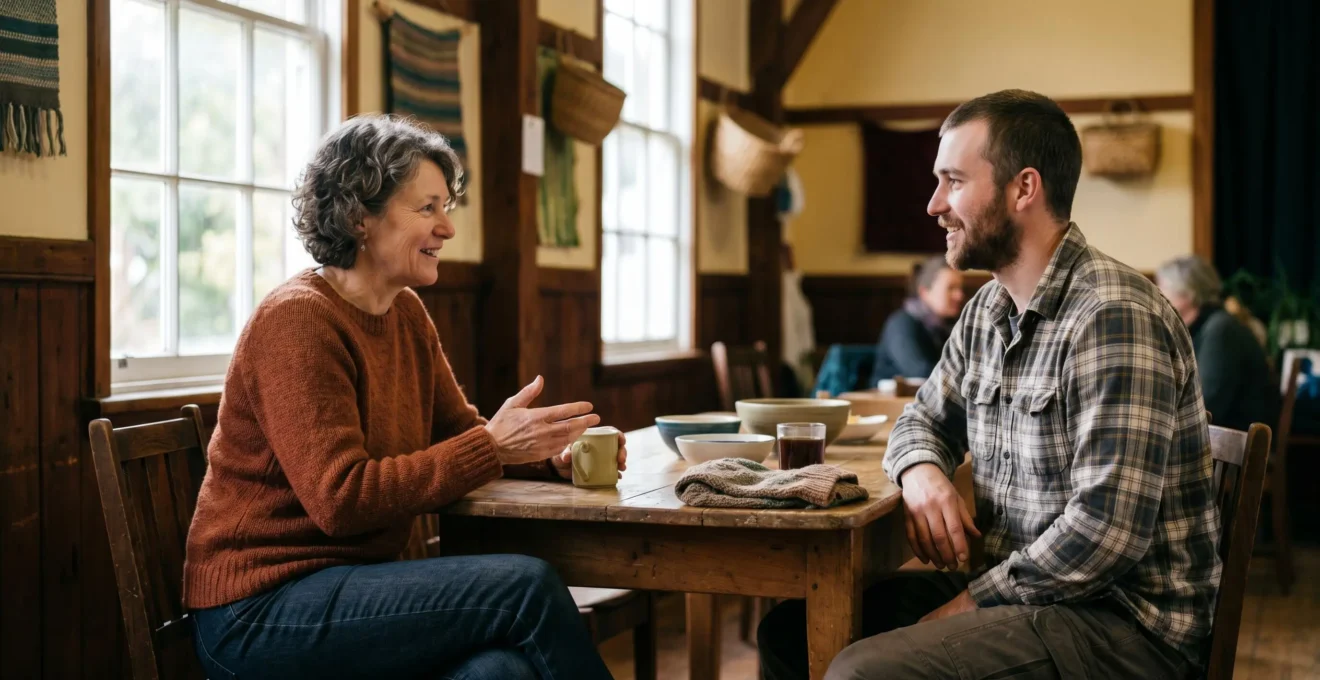
This image captures a scene where the host-guest script is absent. It’s not a tourist spot but a genuine community space, allowing for interaction based on shared context rather than a transaction.
To move beyond this, interactions need to be re-contextualized. The goal is to find situations where you are not a “guest” but a co-participant, a volunteer, or a fellow learner. It is in these shared, non-transactional contexts that the host-guest script dissolves, allowing for more authentic, person-to-person connections to emerge.
How Your Weekly Food Choices Directly Impact Your Local Biodiversity and Soil Health?
The connection between culture and place is nowhere more tangible than in its food. What we eat is a direct expression of a region’s history, climate, and soil. When we choose our food, we are not just making a nutritional or economic decision; we are participating in a cultural and ecological system. Approaching food as a cultural immersion tool reveals how your weekly shop can become a profound act of local engagement.
Case Study: Cultural Immersion Through Local Food Systems
Heritage food systems and traditional agriculture are intimately linked to regional identity. Choosing to support a local Community Supported Agriculture (CSA) scheme or a farmers’ market that features regenerative methods is an act of cultural patronage. These practices, such as mob grazing or no-till farming, do more than just produce food; they preserve the cultural landscape. They maintain heritage seed varieties that have been adapted to the local terroir for generations and protect the soil health that gives regional produce its unique character. This approach transforms a simple food choice into an active participation in preserving the very essence of a locality’s unique food culture, from the flavour of its carrots to the biodiversity of its pastures.
When you buy a heritage apple variety from a small Cumbrian orchard, you are helping to preserve a genetic lineage that might otherwise disappear. When you choose cheese from a farm practicing traditional Somerset cheesemaking, you are supporting a living heritage skill. These choices send a powerful market signal that there is value in biodiversity, in small-scale farming, and in the traditional techniques that are often squeezed out by industrial agriculture.
This deepens the immersion experience by connecting you to the very land you are visiting. The food is no longer just fuel; it’s a story. A conversation with a farmer at their market stall about the challenges of their particular soil type provides a more profound insight into a region’s character than a visit to a generic supermarket. By seeking out and supporting these local food systems, your meals become a daily act of cultural and ecological stewardship.
Key Takeaways
- Shift your mindset from a passive consumer to an active contributor; ask how you can participate, not just what you can see.
- Seek out ‘living heritage’—skills, traditions, and food systems that are actively practiced—rather than just visiting static historical sites.
- Practice cultural humility and reciprocity, ensuring any exchange is respectful and mutually beneficial, leaving the community better off for your visit.
How to Foster Authentic Human Connections During Travel and Staycations Instead of Surface-Level Experiences?
Synthesising these ideas, the ultimate goal is to create opportunities for authentic human connection. This doesn’t happen by chance; it happens by design. It requires a strategy that intentionally places you in situations where the “host-guest script” is irrelevant and shared humanity can take centre stage. This strategy is built around becoming, for a short time, part of the fabric of a place.
This approach has benefits that extend beyond the travel experience itself. Engaging with strong community “third places” is not just good for cultural immersion; it’s good for well-being. Research on community social infrastructure indicates that third place use correlates with better mental health outcomes. By seeking out these hubs of community life, you are not only enriching your travels but also tapping into a fundamental source of human connection and psychological resilience.
The following plan provides a concrete, step-by-step method for engineering these opportunities for connection. It’s a deliberate strategy to go from being an anonymous stranger to a familiar, friendly face—a “temporary regular.”
Action Plan: The Anchor Strategy for Genuine Connection
- Choose one small village, neighbourhood, or specific pub as your ‘anchor’ location for an extended period (a minimum of 3-5 days is ideal).
- Return to the same spots (e.g., the same coffee shop, park bench, or coastal path) repeatedly at similar times to become a ‘temporary regular,’ allowing natural familiarity to develop.
- Join hyper-local, short-term shared activities like a beach clean, helping set up for a village fete, or volunteering at a local parkrun to connect through shared purpose.
- Practice ‘vulnerable curiosity’ by asking deep but non-intrusive questions about local stories, motivations, and changes over time, rather than just superficial small talk.
- Signal genuine interest in the community’s future through small gestures, like asking about the next local event or mentioning plans for a future return.
Ultimately, experiencing genuine cultural immersion in the UK is an act of intention. It requires looking past the polished veneer of the tourism industry and seeking the messier, more rewarding reality of community life. By applying these principles, your next trip—whether it’s to the next county or the next village—can become a journey of profound and lasting connection.