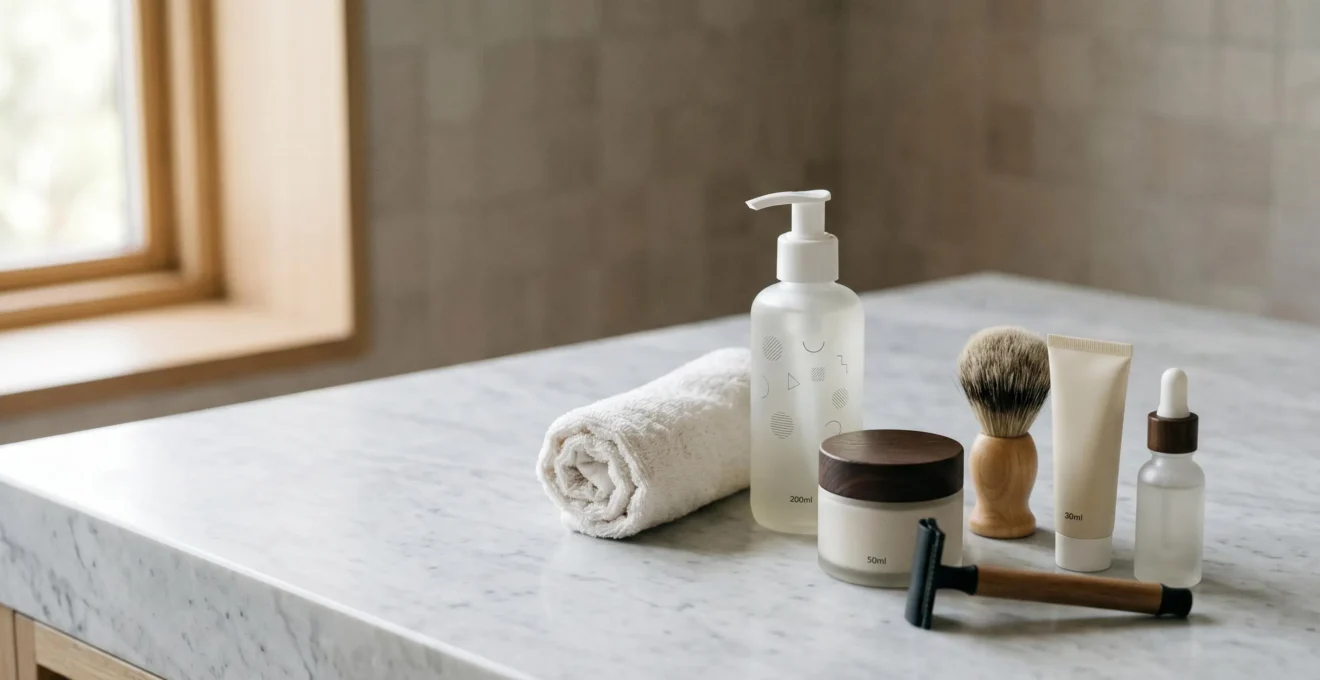
The secret to a fast, effective grooming routine isn’t adding more products; it’s building a smarter system based on strategic subtraction and high-leverage habits.
- A simplified 5-step core routine is more sustainable and can be more effective than a complex 15-step one, reducing both skin irritation and decision fatigue.
- Investing in quality tools (like a razor) and periodic professional services provides a better return on investment for daily appearance than a shelf full of trendy, disposable products.
Recommendation: Stop chasing new products and start auditing your routine. Identify and eliminate anything that doesn’t solve a core need, then automate the essentials by linking them to existing daily habits.
For the busy professional, the equation seems unsolvable: how do you project a consistently polished and put-together image when your schedule is packed from the first alarm to the last email? The grooming industry, projected to reach $115 billion by 2028, often suggests the answer lies in more. More steps, more products, more time spent in front of the mirror. We’re sold 15-step routines, specialized serums for every conceivable micro-problem, and a dizzying array of gadgets.
This approach is fundamentally flawed for anyone whose primary currency is time. It leads to cluttered bathroom shelves, wasted money, and inconsistent application. The paradox is that chasing a perfect routine often results in no routine at all. But what if the key wasn’t addition, but radical subtraction? What if looking effortlessly polished was the result of a carefully engineered system, not a longer checklist? The answer lies in shifting our mindset from accumulating products to optimizing a process. It’s about applying principles of efficiency and system design to your daily life, creating a “grooming mise en place” that makes the daily execution fast, simple, and automatic.
This guide will deconstruct that system. We will explore why a minimalist routine outperforms a complex one, how to strategically declutter your product arsenal, where to invest your money for maximum impact, and how to identify the keystone habits that make the entire process self-sustaining. It’s time to trade complexity for consistency.
Summary: The 15-Minute Grooming System
- Why 5 Essential Grooming Steps Outperform 15-Step Routines for Consistent Daily Maintenance?
- How to Reduce Your Bathroom Shelf from 20 Products to 6 Without Compromising Results?
- Quality Razor and Basic Cream or Cheap Razor and Premium Products: Which Grooming Investment?
- The Grooming Trend Trap That Makes You Buy Products You’ll Never Consistently Use
- Daily Shaving vs Every 3 Days: When Does Grooming Frequency Cross from Care to Unnecessary?
- How to Layer Skincare Products in the Correct Order for Maximum Absorption?
- How to Identify the 2 Keystone Habits That Make Your Entire Routine Self-Sustaining?
- How to Create an Effortless Appearance That Actually Requires Minimal Daily Effort?
Why 5 Essential Grooming Steps Outperform 15-Step Routines for Consistent Daily Maintenance?
The logic of “more is better” collapses under the weight of daily execution. A complex, 15-step routine introduces two significant roadblocks to a polished appearance: decision fatigue and a higher probability of inconsistent application. Every morning, you’re forced to remember sequences, choose between similar products, and dedicate a substantial block of time you likely don’t have. The result? You skip it altogether. Conversely, a core routine of 5 essential, high-impact steps—cleansing, targeted treatment (if necessary), moisturizing, sun protection, and shaving/styling—becomes an automatic, non-negotiable habit.
Beyond the psychological benefits, a minimalist approach is often superior for skin health. Overloading the skin with too many active ingredients from different products can disrupt its natural barrier, leading to sensitivity, redness, and breakouts. This is not just theory; some research shows up to 40% less skin irritation in users who switch to simplified routines. The goal is not to do more, but to do the right things consistently. By focusing on a handful of products that address your primary needs, you ensure they are used correctly and daily, leading to compounding results that a sporadic, complex routine can never match. Consistency is the true engine of effective grooming, and simplicity is its fuel.
Action Plan: The Decision Fatigue Reduction Framework
- Identify your core grooming needs: cleansing, moisturizing, sun protection, and one targeted treatment if needed.
- Eliminate products that ‘sort of work’ and keep only those that definitively work for your specific hair and skin type.
- Establish fixed product placement in your bathroom to create visual cues and reduce morning decision-making time.
- Create a single-sequence routine (same order every day) to convert grooming from active decision-making into automatic habit.
- Evaluate new products only by asking: ‘Does this replace an existing step or add a new one?’ to prevent routine creep.
How to Reduce Your Bathroom Shelf from 20 Products to 6 Without Compromising Results?
Shrinking your grooming arsenal from a chaotic collection to a streamlined set of essentials is an exercise in strategic elimination. The goal is to isolate the true workhorses from the “nice-to-have” or “bought-on-a-whim” products. Start by categorizing everything you own: cleansers, moisturizers, serums, masks, oils, shaving products, and so on. Within each category, be ruthless. You only need one primary product per function. You don’t need three different cleansers; you need the one that works best for your skin type, used consistently.
This minimalist philosophy, often termed “skinimalism,” is not about deprivation but about effectiveness. It prioritizes quality and purpose over quantity. The process forces you to understand what each product actually does for you. If you can’t articulate a product’s specific, unique benefit that your other essentials don’t provide, it’s a candidate for elimination. The target number of 6 isn’t arbitrary; it typically represents the core functions: Cleanser, Moisturizer, Sunscreen, a primary shaving product, a targeted treatment (like a serum for a specific issue), and a basic hair styling product. Everything else is likely redundant.
Case Study: The Skinimalism Movement
The skinimalism trend demonstrated that consumers successfully reduced their routines to 3-4 essential products (cleanser, moisturizer, sunscreen) after years of overwhelming multi-step approaches. This shift was driven by the realization that using fewer, thoughtfully chosen products proved just as effective while preventing irritation caused by overloading the skin with conflicting active ingredients. The movement validated that quality over quantity saves time and money while achieving superior results.
By curating a lean collection, you not only save time and money but also give your skin a chance to stabilize. You’ll be better able to tell what’s working and what isn’t, turning your routine from a guessing game into a precision-tuned system.
Quality Razor and Basic Cream or Cheap Razor and Premium Products: Which Grooming Investment?
When optimizing a system, the most critical question is where to allocate resources for the highest return on investment (ROI). In grooming, a common dilemma is whether to invest in the tool (the razor) or the consumables (creams, serums). The answer, from an efficiency and results-focused perspective, is clear: prioritize the tool and the core preparation. A high-quality, sharp razor is a non-negotiable, high-leverage investment. A dull or poorly designed blade is the primary cause of nicks, irritation, and ingrown hairs, regardless of how expensive your post-shave balm is. It inflicts micro-trauma on the skin that no cream can instantly undo.
Conversely, a superior razor can deliver a clean, non-irritating shave with even a basic, functional shaving cream. The cream’s main job is lubrication and protection of the skin barrier during the shave. While premium creams can offer better scents and additional moisturizing ingredients, their core function can be met by many affordable, well-formulated products. Spending a fortune on a “miracle” cream to compensate for a cheap, skin-damaging razor is a fundamentally flawed strategy. It’s like putting premium fuel in a car with a faulty engine. Invest first in a quality multi-blade cartridge or safety razor, ensure the blades are always fresh, and then find a simple, effective shave cream. This prioritizes the elements that have the most direct impact on the quality and comfort of your shave.
This table breaks down the investment priority based on the specific shaving issue you’re trying to solve, as detailed in a comprehensive analysis of shaving priorities.
| Primary Shaving Issue | Investment Priority | Rationale | Recommended Action |
|---|---|---|---|
| Frequent nicks and cuts | Quality Razor (High Priority) | Sharp, precision-engineered blades reduce skin trauma during hair removal | Invest in multi-blade cartridge or safety razor with sharp, fresh blades |
| Post-shave irritation and redness | Skin Prep & Cream (High Priority) | Proper lubrication and pre-shave preparation protect skin barrier during shaving | Focus on quality shaving cream with glycerin and moisturizing pre-shave oil |
| Ingrown hairs | Balanced Investment | Both sharp blade technique and proper post-shave care prevent ingrown formation | Quality razor + exfoliating cleanser + consistent moisturizing routine |
| Dry, tight skin post-shave | Skin Prep & Aftercare (High Priority) | Shaving disrupts skin barrier; hydration products support recovery | Invest in barrier-supporting moisturizers with ceramides or hyaluronic acid |
The Grooming Trend Trap That Makes You Buy Products You’ll Never Consistently Use
The grooming industry thrives on novelty. Every season brings a new “miracle” ingredient, a trendy device, or a multi-step ritual promising transformative results. This is the grooming trend trap: the cycle of purchasing products based on marketing hype rather than a genuine need. It’s the reason your bathroom cabinet contains a charcoal mask used twice, a fancy face oil that feels too greasy, and a “pre-serum” you’re not sure how to use. These products don’t just clutter your shelf; they clutter your routine, adding steps and decisions that actively work against your goal of sub-15-minute efficiency.
Escaping this trap requires a shift from a reactive consumer to a strategic auditor of your own needs. The first line of defense is a simple question: “What specific problem does this solve that my current core routine does not?” If the answer is vague (“it gives a nice glow”) or addresses a problem you don’t actually have, it’s a hard pass. This disciplined mindset is becoming more common, with a reported 42% of male consumers actively seeking specific ingredients, indicating a move away from trend-based buying toward results-oriented purchasing. Before any new product enters your bathroom, it must pass a rigorous entry exam. Does it replace a current step with a better alternative, or does it add a new, likely unnecessary, one? This prevents “routine creep” and ensures your system remains lean and effective.
Think of it as a one-in, one-out policy for your face. This mental framework transforms you from a passive target of marketing into the active CEO of your grooming routine, focused solely on an efficient, repeatable system that delivers a polished result.
Daily Shaving vs Every 3 Days: When Does Grooming Frequency Cross from Care to Unnecessary?
The optimal shaving frequency is not a one-size-fits-all rule but a personalized calculation based on three factors: your beard growth rate, your skin’s sensitivity, and your professional presentation standard. While many men feel pressured to achieve a perfectly smooth face daily, this frequency can be more detrimental than beneficial for skin health. Shaving is, by its nature, an act of exfoliation and a stressor on the skin barrier. Doing it every 24 hours can mean you are disrupting the barrier faster than it can fully recover.
The science supports a less-is-more approach for many. A scientific study found a significant increase in transepidermal water loss (TEWL) 20 minutes post-shaving, indicating acute barrier disruption. While parameters returned to baseline after 24 hours, “baseline” simply means recovered, not strengthened. For individuals with sensitive skin, allowing a 48-72 hour cycle (shaving every 2-3 days) enables the skin barrier not just to repair but to fortify itself, leading to less irritation and redness over time. A “five o’clock shadow” by the end of the day is often less noticeable to others than the redness and bumps from an overly aggressive daily shave. The goal is a face that looks calm and healthy, not one that is perpetually recovering from trauma. Experiment with stretching the time between shaves; you may find that a 3-day cycle provides the perfect balance of a professional appearance and optimal skin health.
Understanding your skin’s recovery cycle is crucial. The goal is to work with your body’s natural processes, not against them. A well-groomed appearance is defined by healthy, comfortable skin, not just the absence of stubble.
How to Layer Skincare Products in the Correct Order for Maximum Absorption?
Applying products in the wrong order is like trying to water a plant by pouring water on the leaves of the plant next to it—ineffective and wasteful. The core principle of product layering is simple and based on chemistry: go from the thinnest, most water-based formulas to the thickest, most oil-based ones. Water and oil don’t mix, and a thick, oily cream will create a barrier that prevents any water-based product applied afterward from penetrating the skin. Following the correct sequence ensures that each product’s active ingredients can be absorbed effectively and do their job.
The correct, efficient sequence is as follows:
- Cleanser: Always start with a clean canvas. This removes dirt, oil, and impurities that would otherwise block absorption.
- Water-Based Serums (if used): After cleansing, on slightly damp skin, apply any thin, watery serums. Their small molecular size allows them to penetrate deeply and deliver concentrated active ingredients. Give it 30 seconds to absorb until your skin feels tacky, not wet.
- Moisturizer: This more substantial cream hydrates the skin’s surface and, crucially, locks in the serum you just applied.
- Sunscreen (AM Routine): The final and most critical step in the morning. Sunscreen is a protective shield that sits on top of your skin, so it must always be applied last.
This simple hierarchy maximizes the ROI of each product you use. Getting this sequence right is a zero-cost upgrade to your entire routine, ensuring the products you’ve invested in can deliver their promised results.
How to Identify the 2 Keystone Habits That Make Your Entire Routine Self-Sustaining?
A routine is only effective if it’s performed consistently, and consistency is born from habit, not willpower. In habit science, a “keystone habit” is a single, small action that triggers a cascade of other positive behaviors. The key to automating your grooming routine is not to create a dozen new habits at once, but to identify and anchor your routine to one or two keystone habits you already perform without thinking.
For most men, there are two perfect candidates for grooming keystone habits, one for the morning and one for the evening:
- Keystone Habit #1 (Morning): The Morning Face Splash. Whether you’re in the shower or at the sink, the moment you splash water on your face is the trigger. Your face is already wet, so the friction of starting is gone. This is the natural trigger to grab the cleanser. Cleansing then naturally leads to moisturizing.
- Keystone Habit #2 (Evening): Brushing Your Teeth. You’re already at the sink, in the bathroom, winding down for the night. This is the perfect, non-negotiable anchor. The habit stacking formula is simple: “After I brush my teeth, I will apply moisturizer/serum.”
The strategy is to physically place your products where they intersect with these keystone habits. Put your cleanser in the shower. Place your moisturizer right next to your toothbrush. This is called “designing your environment for success.” By removing friction and linking new actions to established ones, you bypass the need for motivation or decision-making. Your grooming routine stops being a chore you have to remember and becomes an automatic, self-sustaining system that runs on autopilot.
This automation is the ultimate goal of an efficiency-focused system, freeing up mental energy for more important decisions.
Key takeaways
- System Over Steps: A successful grooming routine is an efficient system, not a long checklist. Focus on consistency with a few core products.
- Invest in Leverage: Prioritize spending on high-impact tools (like a quality razor) and professional services that reduce daily effort, rather than on a multitude of consumable products.
- Automate with Triggers: Anchor your simple routine to existing, non-negotiable daily habits (like brushing your teeth) to eliminate decision fatigue and make consistency automatic.
How to Create an Effortless Appearance That Actually Requires Minimal Daily Effort?
The ultimate goal of an optimized grooming system is to achieve a state of “effortless” appearance—an outcome that looks polished and intentional but requires minimal daily input. This is the essence of “Grooming Mise en Place.” In a professional kitchen, ‘mise en place’ is the strategic upfront preparation—chopping vegetables, preparing sauces—that allows for rapid, flawless execution during the chaotic dinner service. In grooming, the same principle applies: smart, periodic investments of time and money that drastically reduce the effort required for the “daily service.”
This means shifting your focus from daily fiddling to high-leverage periodic actions. For example:
- Getting a high-quality haircut that is designed to grow out well, requiring minimal daily styling beyond a simple product application.
- Investing in a professional eyebrow shaping once every 6-8 weeks to maintain a clean look that you can’t replicate at home.
- Using a quality razor and technique to prevent irritation, which eliminates the need for daily cover-ups or soothing balms.
Case Study: The U.S. Premium Grooming Market Shift
The U.S. premium men’s grooming market is a perfect example of this principle in action. The premium segment is projected to see a CAGR of 10.3% from 2024 to 2030, reflecting men’s recognition that high-leverage periodic investments drastically reduce daily effort. This trend shows that investing in fewer, higher-quality products and professional services is the most efficient path to creating a polished appearance with minimal daily maintenance. It is Grooming Mise en Place realized.
This strategic approach creates a high baseline of “put-togetherness.” Your daily 15-minute routine is then no longer about construction, but simple maintenance. It’s the difference between building a car from scratch every morning and simply washing a well-maintained vehicle. By making smart, periodic investments, you ensure that you look your best by default, with daily actions serving only to add the final polish.
Now that you have the framework for an efficient system, the next step is to implement it. Begin today by auditing your current products and identifying the keystone habits that will serve as the engine for your new, streamlined routine.