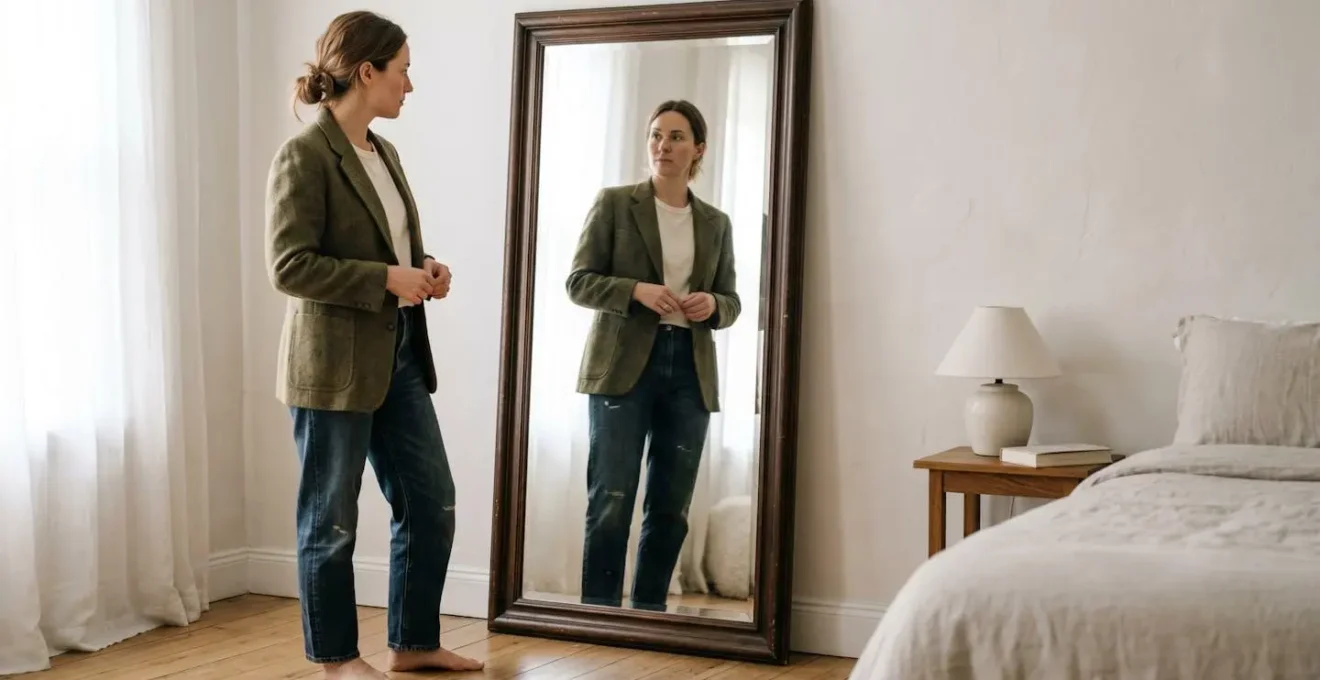
Contrary to popular belief, developing personal style isn’t about finding the right trends to follow; it’s about ceasing to follow them altogether. The key is to shift your focus inward, treating your wardrobe as an architectural project built on the foundations of your unique identity, physical form, and personal values. This guide provides the blueprint for constructing a style that communicates who you are, creating a closet where every single piece feels authentic and purposeful.
You open your wardrobe, and a wave of frustration washes over you. It’s full, yet you have nothing to wear. That viral jacket you bought after seeing it on a dozen influencers hangs unworn, its tag still on. The “it” jeans of the season feel awkward, not quite right on you. This experience, a form of aesthetic friction, is the direct result of a modern style dilemma: we consume fashion, but we fail to cultivate a personal style. We are told to find inspiration on Pinterest, to buy “timeless basics,” and to follow the lead of digital tastemakers. But this approach often leaves us with a collection of disparate items that represent fleeting moments in culture, not the core of who we are.
The problem is that we are trying to decorate a house before we’ve understood its architecture. True style isn’t about applying a surface-level aesthetic; it’s about building a functional and beautiful structure from the inside out. What if the answer wasn’t in another trend report, but in understanding the fundamental principles of your own identity? What if you could build a wardrobe that felt less like a costume and more like a second skin, a true extension of your personality?
This article will guide you through that very process. We will deconstruct the psychological traps of trend-chasing and provide a practical framework for building your own “style architecture.” By focusing on your unique silhouette, learning to identify true quality, and understanding the language of your clothes, you can finally create a wardrobe that is not only wearable but is a genuine and confident expression of you.
To guide you through this process of sartorial self-discovery, this article is structured to build your knowledge from the ground up. We will explore the psychological pitfalls of digital trends before moving on to the foundational pillars of building an authentic and lasting personal style.
Summary: How to Cultivate a Sense of Style That Reflects Your Identity
- Why Copying Instagram Aesthetics Leaves Your Wardrobe Feeling Inauthentic and Unwearable?
- How to Identify the 3 Silhouettes That Flatter Your Body Rather Than Following Generic Rules?
- High Street vs Designer: Which Quality Markers Matter When Building a Lasting Wardrobe?
- The Aspirational Buying Trap That Fills Wardrobes with Unworn Clothes Worth £800+
- When Is Changing Your Style Genuine Evolution vs Insecure Trend-Following?
- Why Suppressing Personal Expression for Social Acceptance Leads to Burnout Within 18 Months?
- Why Premium Price Tags Don’t Always Equal Quality: The 5 True Markers of Well-Made Products?
- How to Express Your Personal Identity Through Lifestyle Choices Without Social Friction?
Why Copying Instagram Aesthetics Leaves Your Wardrobe Feeling Inauthentic and Unwearable?
The perfectly curated Instagram feed presents a powerful illusion: a flawless, cohesive lifestyle that can be achieved simply by acquiring the right items. We see an aesthetic—”cottagecore,” “clean girl,” “mob wife”—and are sold a package of clothes, accessories, and poses to replicate it. Yet, the result is often a wardrobe filled with pieces that feel alien in our day-to-day lives. This disconnect happens because we are adopting a visual identity without its underlying context. The clothes are designed for a two-dimensional, filtered world, not for the complex reality of our bodies, our commutes, or our personal comfort.
This pressure to conform to a digital ideal creates a significant gap between our online persona and our physical self. As the Fashion Psychology Research Team notes in their work on social media’s impact on fashion, the goal shifts from personal satisfaction to performative accuracy. They explain:
The priority shifts from comfort to matching a digital standard.
– Fashion Psychology Research Team, In-Mind Magazine – Dressed for the Feed: The Psychology of Fashion in a Filtered World
This performative dressing leads directly to the feeling of having a closet full of unwearable clothes. The floaty dress that looked ethereal in a sun-drenched field is impractical for an office environment. The razor-sharp blazer that defined a “power look” online feels stiff and restrictive during a casual weekend. This is not a personal failing; it is a systemic issue. You are not buying clothes for yourself; you are buying a costume for a role you are expected to play online, creating an ever-widening chasm between your authentic self and your curated one.
The first step toward authenticity is to turn off the external noise and start listening to your own needs, beginning with the very architecture of your body.
How to Identify the 3 Silhouettes That Flatter Your Body Rather Than Following Generic Rules?
For decades, personal style advice has been dominated by generic, often unhelpful rules based on categorizing bodies into shapes like “apple,” “pear,” or “hourglass.” This approach is fundamentally flawed because it attempts to fit the infinite variety of human forms into a handful of restrictive boxes. A more empowering and effective method is to abandon these labels and instead develop a “Silhouette Blueprint”—an understanding of the architectural principles that work with your unique body.
Instead of asking “Am I a pear?”, ask “How does fabric interact with my form?” This shifts the focus from conforming to a type to understanding three key elements: volume, line, and drape. These are the building blocks of any silhouette, and mastering them allows you to sculpt looks that feel harmonious and intentional, regardless of your size or shape. Thinking like a designer, not a consumer, is the key to unlocking a wardrobe that truly flatters.
As the image above illustrates, different fabrics create entirely different effects. To build your Silhouette Blueprint, experiment with these three concepts:
- Structure & Volume: This refers to how a garment creates or occupies space around the body. Stiff fabrics like linen, denim, or structured wool build a shape of their own. Playing with volume can mean balancing a fitted top with wide-leg trousers or using a tailored blazer to create a strong shoulder line. It’s about creating shape, not hiding it.
- Line: This is the path your eye follows when looking at an outfit. Vertical lines (created by pinstripes, long cardigans, or the flow of a maxi dress) can elongate your frame. Horizontal lines (like a boat neck or a color-blocked hem) can create width. Understanding how to direct the eye is a powerful tool for creating balance.
- Drape: This describes how a fabric falls and moves with the body. Soft, fluid materials like silk, jersey, or viscose cling and flow, highlighting your natural form. A draped neckline can soften a silhouette, while a well-draped skirt adds graceful movement.
By focusing on these three principles, you move beyond restrictive rules and begin to make conscious, creative choices about how you present yourself to the world.
High Street vs Designer: Which Quality Markers Matter When Building a Lasting Wardrobe?
Once you understand the silhouettes that work for you, the next layer of your style architecture is material substance. In a market saturated with options ranging from £10 fast-fashion finds to £1000 designer pieces, the relationship between price and quality has become increasingly blurred. A high price tag is no longer a reliable guarantee of longevity, and an affordable item is not always a poor investment. Building a lasting wardrobe requires moving beyond brand names and learning to assess the structural integrity of a garment itself.
The critical distinction lies not in the logo on the label, but in the tangible markers of craftsmanship. A well-made garment, whether from a high-street store or a luxury brand, shares certain non-negotiable characteristics. These are the details that determine whether a piece will hold its shape after three washes or thirty, whether it will look better with age or fall apart at the seams. Fast fashion often prioritizes trend replication at the lowest possible cost, which inevitably leads to compromises in fabric density, stitch count, and finishing.
In contrast, quality-focused brands (which exist at various price points) invest in construction. They use more durable fabrics, employ stronger sewing techniques, and pay attention to the small details like buttons and zippers that signal a commitment to longevity. Learning to spot these markers empowers you to become a more discerning shopper. You begin to evaluate clothing based on its intrinsic value rather than its perceived status, making choices that will serve your wardrobe for years, not just a season. This is the essence of building a truly sustainable and cost-effective style.
Ultimately, a lasting wardrobe is a curated collection of well-made pieces that you love, regardless of where they were purchased.
The Aspirational Buying Trap That Fills Wardrobes with Unworn Clothes Worth £800+
Many closets function as museums for a “fantasy self”—a person we aspire to be but who rarely aligns with our actual life. This is the essence of the aspirational buying trap: we purchase clothing not for the life we have, but for the life we imagine. We buy the slinky dress for the glamorous parties we don’t attend, the tailored suit for the high-powered job we don’t have, or the rugged boots for the mountain hikes we never take. These items become expensive, unworn artifacts that generate guilt and clutter.
This behavior is deeply rooted in psychology. We are not just buying a garment; we are buying a piece of an identity. According to behavioral psychologist Dr. Carolyn Mair, this disconnect is startlingly common. In an interview with the American Psychological Association, she highlighted research suggesting that as much as 80% of the clothes in the average wardrobe go unworn. These pieces are not discarded because they are low quality or out of style, but because they represent a gap between our reality and our aspirations. They are tokens of a future that never materializes, making our current selves feel inadequate in comparison.
The financial and emotional cost is significant. That unworn formal gown or pair of pristine designer heels represents not just wasted money, but a constant, silent reminder of an unfulfilled ideal. The key to escaping this trap is to perform an honest lifestyle audit. Before making a purchase, ask yourself: “Where will I wear this in the next month?” and “Does this fit the reality of my daily activities, my job, and my social life?” If the answer requires imagining a completely different version of your life, the item is likely an aspirational buy. Redirecting that investment towards high-quality pieces that enhance your *actual* life is a revolutionary act of self-acceptance and a critical step in building a functional, authentic wardrobe.
True style serves the person you are today, not the person you think you should be tomorrow.
When Is Changing Your Style Genuine Evolution vs Insecure Trend-Following?
Style is not static; it is a living language that should evolve as we grow, change careers, or enter new phases of life. However, there is a crucial difference between this organic evolution and the anxious, reactive churn of insecure trend-following. Genuine style evolution is an internal process, while trend-following is driven by external pressure and a fear of being left behind. Knowing how to distinguish between the two is key to maintaining an authentic sense of self.
The primary indicator is the source of the motivation. Does the desire for change come from within? Perhaps a newfound confidence makes you want to explore bolder colors, or a shift in lifestyle requires more comfortable, practical clothing. This is evolution. It’s about your clothes adapting to *you*. In contrast, trend-following is often sparked by a sense of anxiety or inadequacy. The thought process is not “I feel drawn to this,” but rather, “Everyone is wearing this, so I should too.” This external validation-seeking results in a constant, and often expensive, cycle of wardrobe updates that never quite feel right.
Case Study: The Pace of Authentic Style Change
In her analysis of personal style development, fashion commentator Chani Ra outlines a clear distinction. She explains that genuine style evolution stems from internal confidence shifts, such as realizing “I feel more confident in simpler shapes now.” Conversely, insecure trend-following is a reaction to external pressures, like thinking, “Everyone is wearing wide-leg jeans, so I need a pair.” The study she references highlights that rapid, wholesale wardrobe changes every 6-12 months are a strong signal of seeking external validation. True internal growth, on the other hand, is more gradual, integrating new elements thoughtfully over time rather than replacing an entire aesthetic overnight.
To assess your own motivations, consider the pace and feeling of the change. Is it a slow, intuitive integration of a new piece or idea that complements what you already own? Or is it a frantic overhaul driven by the fear of looking “dated”? Authentic style evolution feels like coming home to yourself. Insecure trend-following feels like you’re constantly trying to catch up to a standard set by someone else. Embracing the former allows your style to become a rich, evolving narrative of your life’s journey.
This self-awareness protects both your wallet and your sense of identity.
Why Suppressing Personal Expression for Social Acceptance Leads to Burnout Within 18 Months?
The pressure to fit in—at work, in a new social circle, or even within a family—can often lead us to suppress our personal style. We trade our unique sartorial voice for a uniform of social camouflage, believing it’s the path of least resistance. We wear the neutral, corporate-approved basics or adopt the aesthetic of a particular group, hoping to be accepted. While this strategy might offer short-term comfort, it comes at a steep long-term cost: identity burnout. This is the state of emotional and psychological exhaustion that arises from the chronic effort of performing a version of yourself that is not authentic.
Constantly suppressing your genuine preferences is not a passive act; it is an active, energy-draining process. Every morning, you make a subconscious decision to prioritize external approval over internal alignment. This creates a persistent, low-grade stress. As compelling research on the link between authenticity and psychological health shows, a lack of authenticity, or self-alienation, is directly associated with dysfunctional thought processes and increased stress. When your external presentation is in conflict with your internal sense of self, your mind is in a constant state of dissonance.
This dissonance is not sustainable. Within a period often cited by psychologists as around 18 months, the cumulative effect of this self-suppression can manifest as burnout. You may feel irritable, disconnected, or creatively stifled, without quite knowing why. The clothes that were meant to make you invisible now feel like a cage. As the Fashion Psychology Research Team wisely puts it:
When clothes are chosen for comfort or authenticity, they can ease stress, boost confidence, and lift mood.
– Fashion Psychology Research Team, In-Mind Magazine
The reverse is also true. Clothes chosen for conformity can amplify stress, erode confidence, and suppress your mood. Reclaiming your personal style is not a frivolous act of vanity; it is a vital act of self-preservation and a powerful antidote to this specific form of burnout.
Honoring your personal style is a fundamental aspect of honoring your overall well-being.
Key Takeaways
- True style is an “architectural” process built from your identity, not a “decorative” one copied from trends.
- Focus on your personal “Silhouette Blueprint” (volume, line, drape) instead of generic body-type rules.
- Assess clothing by its structural integrity—stitch count, fabric density, and hardware—not its price tag or brand name.
Why Premium Price Tags Don’t Always Equal Quality: The 5 True Markers of Well-Made Products?
In the world of fashion, we are conditioned to believe that a higher price tag is a direct indicator of superior quality. While this can be true, it is an increasingly unreliable rule. Many designer brands now leverage their name to sell mass-produced items with mediocre construction, a practice known as “brand dilution.” Conversely, discerning shoppers can find exceptional quality from lesser-known or even high-street brands if they know what to look for. The key is to train your eye and hand to recognize the tangible signs of craftsmanship that price tags often obscure.
To build a lasting wardrobe, you must become an educated consumer, capable of assessing a garment’s intrinsic quality. This means looking past the marketing and examining the physical evidence of its construction. These details reveal the time, care, and quality of materials invested in a piece, which are the true determinants of its longevity. A well-made garment is an ecosystem of quality components working together.
Instead of relying on brand reputation, use this checklist of five true markers of quality to evaluate any potential purchase:
- Material Density and Recovery: Don’t just feel the fabric; test it. Scrunch a piece of the material in your fist for a few seconds. Does it spring back with minimal wrinkling, or does it stay crumpled? For knits like t-shirts, a higher GSM (grams per square meter) indicates a denser, more durable fabric that will hold its shape.
- Stitch Per Inch (SPI) and Seam Finishing: Look closely at the seams. A higher number of stitches per inch means a stronger, more durable seam. Examine how the seams are finished on the inside. Flat-felled seams (like those on high-quality jeans) or French seams are signs of excellent craftsmanship, far superior to the cheaper, fray-prone overlocking found on most fast-fashion items.
- Hardware and Trims: The small details are a huge giveaway. Inspect the zippers—brands like YKK and Riri are a hallmark of quality. Are the buttons made of cheap plastic, or are they corozo, horn, or metal? The quality of the thread and the precision of the buttonholes speak volumes about the overall care put into the garment.
- Pattern Matching and Grainline: On patterned garments (stripes, plaids, florals), check if the pattern aligns perfectly at the seams. Mismatched patterns are a sign of mass-market cost-cutting. Ensure the fabric hangs straight and doesn’t twist; this means it was cut correctly on the grainline, which is crucial for how the garment drapes and holds its shape over time.
- The Inside-Out Test: The true character of a garment is often revealed on its interior. Turn it inside out. Is it as cleanly finished as the outside? Are there loose threads, messy seams, or raw edges? A high-quality piece will be just as beautiful and well-constructed on the inside.
This knowledge allows you to invest wisely, building a wardrobe of pieces that will stand the test of time, regardless of the label they carry.
How to Express Your Personal Identity Through Lifestyle Choices Without Social Friction?
You’ve done the internal work: you understand your silhouette, you can spot quality, and you’re committed to authenticity. Now comes the final, crucial step: expressing this newfound identity in the real world without creating unnecessary social friction. Many fear that dressing authentically will make them stand out in a negative way, particularly in professional or conservative environments. The solution isn’t to retreat back into conformity, but to be strategic. This is where the concept of “Communicative Styling” comes into play.
Communicative Styling reframes clothing as a form of non-verbal introduction. It’s not about shouting your personality from the rooftops, but about selectively communicating key aspects of your identity. It’s a balance between respecting the context of your environment and staying true to yourself. Instead of asking, “Will I fit in?”, you ask, “What do I want my clothes to say about me before I even speak?”
Case Study: The 80/20 Rule of Expression
Fashion experts often describe a powerful framework for this strategic self-expression: the 80/20 rule. The principle is simple: 80% of your outfit conforms to the general expectations of the environment (e.g., the professional dress code), creating a baseline of common ground that builds trust and minimizes friction. The remaining 20% is your space for authentic self-expression. This is where your personality shines through—via a piece of unique jewelry, a signature color in a scarf or tie, a pair of unusually structured shoes, or a vintage watch. This approach allows you to feel like yourself while still demonstrating an understanding of social and professional cues.
This 80/20 method is a powerful tool for navigating any social landscape. It allows you to be both appropriate and authentic, proving that personal style and social harmony are not mutually exclusive. By being intentional with your “20%,” you can share a piece of your story, spark curiosity, and connect with others on a more genuine level. It transforms dressing from a daily chore into a conscious act of communication.
Your Action Plan: Auditing Your Style Signal
- Contact Points: List all the channels where your style is “emitted.” This includes your work attire, weekend casual wear, social media profiles, and formal event outfits.
- Collection: For each channel, inventory 3-5 existing outfits you frequently wear. Be specific: “black trousers, white silk blouse, silver necklace.”
- Coherence: Confront these outfits with your core values and desired identity. Does this “uniform” communicate creativity? Reliability? Confidence? Where is the disconnect?
- Memorability & Emotion: Analyze your “20%.” Identify the unique, personal elements (a specific color, a type of accessory, a silhouette) versus the generic, forgettable ones. What part of your outfit is truly “you”?
- Integration Plan: Identify the gaps and prioritize changes. Start by replacing or enhancing the “20%” in one area (e.g., work) to better align your external signal with your internal identity.
To put these concepts into practice, start today by auditing your own style signal and identifying the first small, authentic change you can make.