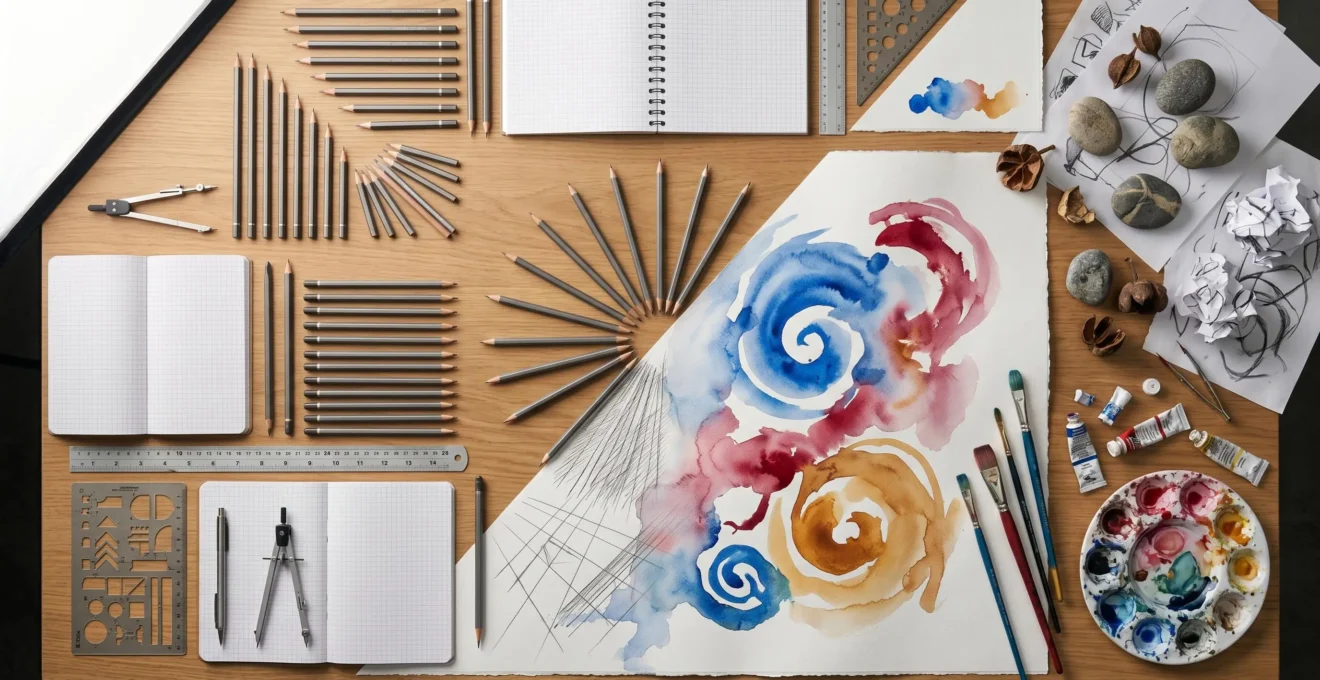
Most creatives fear structure will kill their spontaneity. This is a myth. The key to consistent, high-quality output isn’t a rigid schedule but a flexible diagnostic framework. This guide dismantles the idea that you must choose between discipline and freedom. You’ll learn to identify your current creative phase and match it with the right tools, mindset, and level of structure, turning your process into the very system that liberates, rather than cages, your artistic intuition.
For many freelance creatives, the workflow is a rollercoaster. Weeks of intense, hyper-productive flow are followed by frustrating stalls, creative blocks, and the anxious feeling of a pipeline running dry. The common advice—”be more disciplined,” “make a schedule,” “time-block your day”—often fails because it treats creative work like factory work. It ignores the essential, non-linear nature of inspiration and the delicate dance between focused execution and unfettered exploration.
This approach forces a false choice: either you’re a disciplined “professional” who risks losing the spark, or you’re a “pure artist” at the mercy of your muse. But what if this entire premise is wrong? What if the true path to consistent output isn’t about caging your spontaneity with rigid rules, but about building intelligent scaffolding for it? The problem isn’t a lack of discipline, but a frequent mismatch between the task at hand and the mental state required to perform it. Using the wrong tool or mindset for a specific creative phase is the primary source of friction and stalls.
This article provides a systematic approach for the freelance creative. We will deconstruct the creative process into four distinct phases, not as a rigid sequence, but as a diagnostic map. You will learn to identify where you are on this map at any given moment, how to choose the right tools for that specific terrain, and how to build a personal framework that enhances your artistic freedom by providing the right kind of support at the right time. This is how you transform your process from a source of anxiety into a reliable engine for high-value work.
This comprehensive guide will walk you through the essential steps to build a robust and flexible creative workflow. By understanding the distinct phases of creativity and applying the right frameworks, you can turn inconsistency into a reliable, repeatable process.
Summary: Mastering Your Creative Workflow for Consistency and Freedom
- Why Your Projects Stall: Understanding the 4 Phases Every Creative Work Must Pass Through
- How to Build a Creative Framework That Enhances Rather Than Restricts Artistic Freedom?
- Brainstorming Tools vs Execution Tools: Which Software for Which Creative Phase?
- The Endless Refinement Trap That Prevents 80% of Creatives from Shipping Work
- When to Push Through Creative Blocks vs When to Step Away and Reset?
- When to Switch Editing Software vs When to Fully Master Your Current Tool First?
- How to Decide Which Sketchbook Ideas Are Worth Developing into Full Projects?
- How to Create a Steady Stream of Freelance Opportunities Without Bidding on Job Boards?
Why Your Projects Stall: Understanding the 4 Phases Every Creative Work Must Pass Through
Projects don’t stall because of a lack of talent or discipline; they stall due to a phase mismatch. Every creative endeavor moves through four stages, often attributed to Graham Wallas: Preparation, Incubation, Illumination, and Verification. The critical insight is that these phases demand different types of energy and thinking. As the WeWork Research Team notes, “stages 2 and 3 are all about inspiration: dreaming, reflecting, imagining… Stages 1 and 4, meanwhile, are about generation: doing the external work of research, planning, execution, and collaboration.”
Your process breaks down when you try to apply the wrong energy to a phase. Trying to execute (Verification) while you should be exploring (Incubation) leads to rigid, uninspired work. Trying to brainstorm (Illumination) while you’re supposed to be polishing details (Verification) leads to chaos and unfinished projects. The key is to recognize these two distinct modes:
- Divergent Mode (Incubation & Illumination): This is the expansive, non-linear, “messy” part. It’s about opening up, making connections, and allowing the unconscious mind to work. It requires psychological safety and freedom from judgment.
- Convergent Mode (Preparation & Verification): This is the focused, logical, “clean” part. It’s about research, planning, editing, and executing with precision. It requires structure and critical thinking.
A study on creative workflows by Framework NYC confirms that disruptions during the divergent Incubation or Illumination phases are a primary cause of interrupted “flow.” Conversely, the convergent Verification stage benefits immensely from stable, structured environments for focused testing. Stalling is a signal. It’s your brain telling you that you’re trying to use a hammer (convergent focus) to paint a watercolor (divergent exploration). The first step to consistency is learning to diagnose your current phase and honoring its unique requirements.
Recognizing which mode you are in, or need to be in, is the foundational skill for managing your own creative energy and preventing the frustrating stalls that plague inconsistent workflows.
How to Build a Creative Framework That Enhances Rather Than Restricts Artistic Freedom?
The word “framework” often triggers an allergic reaction in creatives, conjuring images of restrictive rules and bureaucratic checklists. This is a misunderstanding of a good framework’s purpose. A healthy creative framework is not a cage; it is scaffolding. A cage is permanent and limiting. Scaffolding is temporary, supportive, and exists only to help build something that will eventually stand on its own. It provides just enough structure to prevent collapse during the vulnerable construction phases and is then removed.
As the composer Igor Stravinsky famously stated, “The more constraints one imposes, the more one frees one’s self of the chains that shackle the spirit.” This is the counter-intuitive truth at the heart of creative freedom. Well-chosen constraints don’t limit creativity; they channel it. A blank page is paralyzing because the options are infinite. A constraint—like a color palette, a specific theme, or a project deadline—forces you to make decisions and solve problems, which is the very essence of creative work.
Building your personal framework means defining your own supportive constraints. It’s not about adopting someone else’s rigid system. It’s about creating a series of personal “if-then” protocols based on your diagnostic skills. For example:
- IF I am in the Preparation phase, THEN I will use my analog notebook and set a 2-hour research timer.
- IF I feel a creative block, THEN I will run my “block diagnostic” (see next section) instead of forcing it.
- IF I am in the Verification phase, THEN I will switch off all notifications and work in focused 90-minute blocks.
This is not a restriction of freedom. It is the automation of decision-making, which frees up your precious cognitive energy for the actual creative task. Your framework is your personal operating system, designed by you, for you, to create the optimal conditions for your best work to emerge.
Think of your framework as a conversation with your future self, providing the guidance and support needed to navigate the entire creative journey, from a fleeting idea to a finished piece.
Brainstorming Tools vs Execution Tools: Which Software for Which Creative Phase?
One of the most common yet undiagnosed causes of creative friction is a tool-phase mismatch. We often use tools designed for structured execution (like project managers or word processors) during the fluid, chaotic phase of brainstorming, and it kills ideas before they can breathe. This is a widespread issue; a Harvard Business Review study showed that only 23% of employees believe brainstorming meetings are productive, often due to a poor match of process and tools.
The solution is to build a toolkit that is intentionally divided into two categories: Brainstorming (Divergent) and Execution (Convergent). You must be ruthless about using the right tool for the right phase.
- Brainstorming/Divergent Tools: The goal here is zero friction. These tools should allow for rapid, non-linear, and visual idea capture. Think digital whiteboards (Miro, FigJam), mind mapping software (MindNode, Chatmind), or, most powerfully, analog tools like pen and paper, index cards, and sticky notes. Their strength is in their lack of inherent structure.
- Execution/Convergent Tools: The goal here is structure and clarity. These tools help organize, prioritize, and execute tasks in a linear fashion. Think project managers (Asana, Trello), document editors with strong outlining features (Notion, Scrivener), and specialized software for your craft (Figma, Pro Tools, VS Code). Their strength is their ability to create order from chaos.
Using an execution tool like a Trello board for initial brainstorming is like trying to sketch on graph paper—the structure gets in the way of freeform exploration. Conversely, trying to manage a complex project on a wall of sticky notes leads to missed deadlines and chaos. The skill is in knowing when to transition from one to the other.
Your Action Plan: Matching Tools to Creative Phases
- Embrace Divergence First: Match divergent tools (whiteboards, mind maps) to early ideation phases requiring frictionless idea capture and visual exploration.
- Reserve Convergence for Later: Reserve convergent tools (kanban boards, project managers) for execution phases needing structure and focused task management.
- Use AI for Prep, Not Collab: Use AI-powered tools like Chatmind for solo preparation and research rather than for collaborative guided workshops where human dynamics are key.
- Prioritize Analog Messiness: Prioritize analog tools (pen, paper, index cards) for the messiest divergent phases to completely escape the inherent structure of any software.
- Transition with Intention: Transition to digital collaboration platforms only when the goal shifts to organizing and converging scattered ideas into an actionable project plan.
The transition from a divergent tool to a convergent one is a critical milestone in any project. It marks the point where an idea has matured enough to be put on the path to completion.
The Endless Refinement Trap That Prevents 80% of Creatives from Shipping Work
You’ve done the research, had the breakthrough, and built the project. It’s 95% done. And there it sits, for weeks, sometimes months, as you endlessly tweak, polish, and “refine” it. This is the Endless Refinement Trap, a specific form of perfectionism that disguises itself as a commitment to quality. In reality, it’s a fear of judgment and a failure to properly exit the Verification phase. This isn’t a niche problem; so-called ‘maladaptive’ perfectionism can lead to a 12% decrease in productivity and output as creatives get stuck in revision loops.
This trap is particularly dangerous because it feels productive. You’re “working” on the project, after all. But you’re not making it significantly better; you’re just making it different. The law of diminishing returns applies viciously here: the first 80% of the quality comes from 20% of the effort. The final 20% of effort yields maybe 5% more quality, and often, it can even make the work worse by stripping it of its initial energy and spontaneity.
Breaking free requires a mindset shift, away from the nebulous goal of “perfection” and toward the concrete action of “shipping.” It also requires a system:
- Define “Done”: Before you even begin the Verification phase, define what “done” looks like. What are the 3-5 objective criteria that this project must meet to be considered complete? Write them down. Once those criteria are met, the project is done.
- Set a “Pencils Down” Date: A project without a deadline is a hobby. Set a hard deadline for when the project must be shipped, published, or delivered. This creates desirable pressure and forces you to prioritize essential changes over minor tweaks.
- Version Control: If you’re afraid of “ruining” it, save a version and call it “Final_v1.0.” Then, if you must, you can create a “Final_v1.1.” This often reveals that the changes are minimal and helps you recognize when you’re just shuffling deck chairs.
Ultimately, shipping is not the end of the creative process; it is an integral part of it. It’s the moment you get feedback from the world, which is the most valuable input for the Preparation phase of your next project. As author and marketer Seth Godin puts it, perfectionism is a shield. He famously stated:
Perfectionism has nothing to do with being perfect. We become creative when we ship the work.
– Seth Godin, The Practice: Shipping Creative Work
The goal isn’t to ship mediocre work; it’s to recognize that “perfect” is the enemy of “done,” and “done” is the only thing that allows you to grow, learn, and move on to the next great idea.
When to Push Through Creative Blocks vs When to Step Away and Reset?
The generic advice for a creative block—”just take a break”—is as unhelpful as telling someone with a fever to “just feel better.” A block is not a single entity; it’s a symptom. To treat it effectively, you must first diagnose the underlying cause. A creative consultant’s approach is to categorize blocks into three main types, each requiring a completely different response.
Research into the creative process, such as the work by Scott Jeffrey analyzing Wallas’s model, reveals that blocks are often failures at phase transitions. The feeling of being “stuck” is a signal that you’re trying to move from one stage to the next without the necessary resources or mindset. Here is a diagnostic framework:
- The Wall (A Skill or Knowledge Gap): This feels like hitting a brick wall. You know what you want to do, but you literally don’t know how to do it. The task requires a skill or piece of information you don’t possess.
- Diagnosis: Ask yourself, “Is there a specific technical skill or piece of information I am missing?”
- Prescription: PUSH THROUGH. This is not a time to rest; it’s a time to learn. The block is a learning opportunity. Stop the creative work and switch to deliberate practice. Watch a tutorial, read a book, analyze an expert’s work. The “break” is actually focused learning to get over the wall.
- The Maze (A Complexity or Decision-Paralysis Gap): This feels like being lost in a maze. You have too many ideas, too many options, and no clear path forward. Every direction seems equally valid or invalid.
- Diagnosis: Ask yourself, “Am I overwhelmed by options or a lack of clear constraints?”
- Prescription: PUSH THROUGH. Don’t step away; zoom out. Go back to your divergent tools (whiteboard, mind map). Externalize all the options so you can see them at once. Impose constraints. Use a scoring matrix (like the one in a later section) to force a decision. The way out of the maze is to get a bird’s-eye view and choose one path, even if it’s not perfect.
- The Desert (An Energy or Burnout Gap): This feels like being in a desert. There are no ideas. Your mind is blank, and you feel a deep sense of apathy or exhaustion. The well is dry.
- Diagnosis: Ask yourself, “Do I feel physically tired, emotionally drained, or fundamentally uninspired?”
- Prescription: STEP AWAY. This is the *only* type of block where “pushing through” is counterproductive. It’s a signal of true burnout. Pushing here is like revving an engine with no fuel. The only solution is to refill the tank. This means a true reset: sleep, exercise, time in nature, visiting a museum, reading a novel—anything that is completely unrelated to your project and replenishes your creative energy.
Stop treating all blocks the same. Learn to diagnose the type of friction you’re experiencing, and you’ll always know whether to put your shoulder to the wheel or to walk away and find a spring.
When to Switch Editing Software vs When to Fully Master Your Current Tool First?
In the world of freelance creativity, there’s a constant siren song of new software. The new video editor that promises “AI-powered cuts,” the new design tool with a “revolutionary vector engine.” The temptation to switch is constant, fueled by the belief that the tool is the problem. Sometimes it is, but more often than not, the desire to switch is a symptom of a process problem, not a tool problem.
Before you invest dozens of hours migrating your workflow and breaking years of muscle memory, you must perform a ruthless “Tool vs. Process” diagnostic. Is the friction you’re feeling a genuine limitation of the software, or is it a bottleneck in your own skills or workflow that you’re projecting onto the tool?
Ask yourself these critical questions:
- Can I name three specific, mission-critical features my current tool lacks? If you can’t articulate exactly what limitations are holding you back, it’s a process problem. “It just feels clunky” is not a valid reason.
- Have I pushed my current tool to its absolute limits? Have you completed a project of “deliberate practice” designed specifically to master its advanced features? Often, the functionality you think you need in a new tool is already present in your current one, just hidden in a menu you’ve never explored.
- Is the friction “desirable”? Some tools introduce “desirable friction” that slows you down and forces you to be more deliberate. A complex rendering process might force a final check that catches an error. Is the friction you feel a genuine obstruction, or is it a hidden guardrail?
The reality is that mastery of a single tool almost always trumps surface-level knowledge of five. The cognitive cost of switching—re-learning shortcuts, adapting to new UIs, migrating files—is almost always underestimated. As research from Goals and Progress on creative workflows highlights, context is everything. There is no universally “best” tool.
No single workflow outperforms all others across every context. Research on creativity consistently shows that context shapes output: the method that works depends on task type, team structure, and the level of ambiguity in the brief.
– Goals and Progress Research Team, Creative Workflow Approaches Compared: Find Your Fit
Switching tools should be a last resort, a strategic decision made after you’ve definitively proven that your current software is the true bottleneck to your growth, not a scapegoat for a skill you have yet to develop.
How to Decide Which Sketchbook Ideas Are Worth Developing into Full Projects?
A sketchbook, whether physical or digital, is a hotbed of divergent thinking—a place for messy, half-formed, and often brilliant ideas. But the transition from a sketchbook doodle to a full-fledged project is one of the most critical and difficult decisions a creative has to make. Committing to an idea is a significant investment of your most valuable resource: time. How do you choose wisely?
The impulse is to follow the most exciting idea, but excitement can be fleeting. A systematic approach is needed. This isn’t about killing the magic; it’s about making sure you invest your magic in projects that will truly flourish. Landmark research by Getzels and Csikszentmihalyi showed that successful artists spent significantly more time in the “problem-finding” stage—exploring, evaluating, and reframing ideas—before committing. This initial, structured evaluation correlated with producing more creative work and achieving greater long-term success.
To put this into practice, you can create a simple but powerful Project Scoring Matrix. It forces you to evaluate ideas not just on a single vector of excitement, but across several critical dimensions. This transforms a gut-feeling decision into a strategic choice.
| Evaluation Criteria | Low Score (1-3) | Medium Score (4-7) | High Score (8-10) | Weight |
|---|---|---|---|---|
| Personal Excitement (Heart) | Feels obligatory or uninspiring | Interesting but not compelling | Keeps resurfacing in your thoughts | 30% |
| Skill Development (Growth) | Uses only existing skills | Moderate skill stretch | Pushes boundaries significantly | 25% |
| Audience/Portfolio Fit (Strategy) | Misaligned with brand or goals | Neutral strategic value | Perfect portfolio or market fit | 25% |
| Resource Feasibility (Reality) | Requires unavailable resources | Challenging but possible | Resources readily available | 20% |
To use this matrix, take your top 3-5 sketchbook ideas. Rate each one from 1 to 10 on all four criteria. Then, multiply that score by the “Weight” percentage to get a final weighted score. The idea with the highest score isn’t automatically the “winner,” but the process of scoring will give you incredible clarity. You might realize an exciting idea has no strategic value, or that a simple idea is a perfect fit for your portfolio right now. This structured process doesn’t dictate your choice, but it deeply informs it, ensuring your next big project is a convergence of heart, growth, strategy, and reality.
By applying this disciplined filter at the very start, you dramatically increase the chances that a project will not only get finished but will also contribute meaningfully to your skills and career.
Key Takeaways
- Diagnose, Don’t Guess: Your feelings of being “stuck” or “uninspired” are data. Learn to diagnose your creative phase (Preparation, Incubation, Illumination, Verification) to apply the right solution.
- Match Your Tools to Your Phase: Use frictionless, divergent tools (like paper or whiteboards) for brainstorming and structured, convergent tools (like project managers) for execution. A tool-phase mismatch is the #1 killer of creative flow.
- Structure is Scaffolding, Not a Cage: Build a personal framework of constraints and protocols. This doesn’t limit freedom; it channels it, automating decisions and freeing up cognitive load for the real creative work.
How to Create a Steady Stream of Freelance Opportunities Without Bidding on Job Boards?
The ultimate goal of a robust creative process isn’t just to produce better work; it’s to build a sustainable freelance business. The feast-or-famine cycle of client work is often a direct result of a feast-or-famine creative output. The final, and perhaps most powerful, step in structuring your process is to turn it into your single greatest marketing asset.
High-value clients aren’t looking for the cheapest creative; they are buying certainty. They want to know you have a reliable, professional process that can deliver results on time and on budget. Your well-defined creative framework is the proof of that certainty. The strategy is simple: stop hiding your process and start marketing it. This is called “Process Marketing.” Instead of just showing the final, polished work in your portfolio, you show *how* the work gets made.
This shift from outbound hustling (bidding on boards) to inbound attraction (drawing clients in with expertise) is transformative. It’s backed by data; creators with a documented content strategy, for example, see up to 78% faster growth in their audience and opportunities. Your process is your strategy. Here’s how to implement it:
- Create a “Process Portfolio”: For every major project, create a short case study. But instead of only showing the final result, briefly showcase the phases: the initial mind maps (Preparation), the discarded concepts (Incubation), the “aha” moment (Illumination), and a snippet of the structured project plan (Verification).
- Share Your Frameworks: The checklists, matrices, and diagnostic tools you use—like the ones in this article—are incredibly valuable content. Share them on your blog, in a newsletter, or as a social media series. This positions you as a thoughtful expert, not just a pair of hands.
- Talk About Your “Failures”: Share a story about a time a project stalled and how you used your diagnostic process to identify the block and fix it. This demonstrates resilience and problem-solving skills, which are far more valuable to a client than a veneer of perfection.
By consistently documenting and sharing your approach, you build “inbound gravity.” You stop being a commodity competing on price and become a sought-after strategic partner. Clients will come to you not just for your creative output, but for the confidence that your process can deliver on its promises.
Start today. Take your last completed project and write a one-page case study about how you got it done. Document the phases, the tools, the decisions. That document is the first asset in your new Process Portfolio and your first step toward a steady stream of high-value freelance opportunities.